
PHOTO
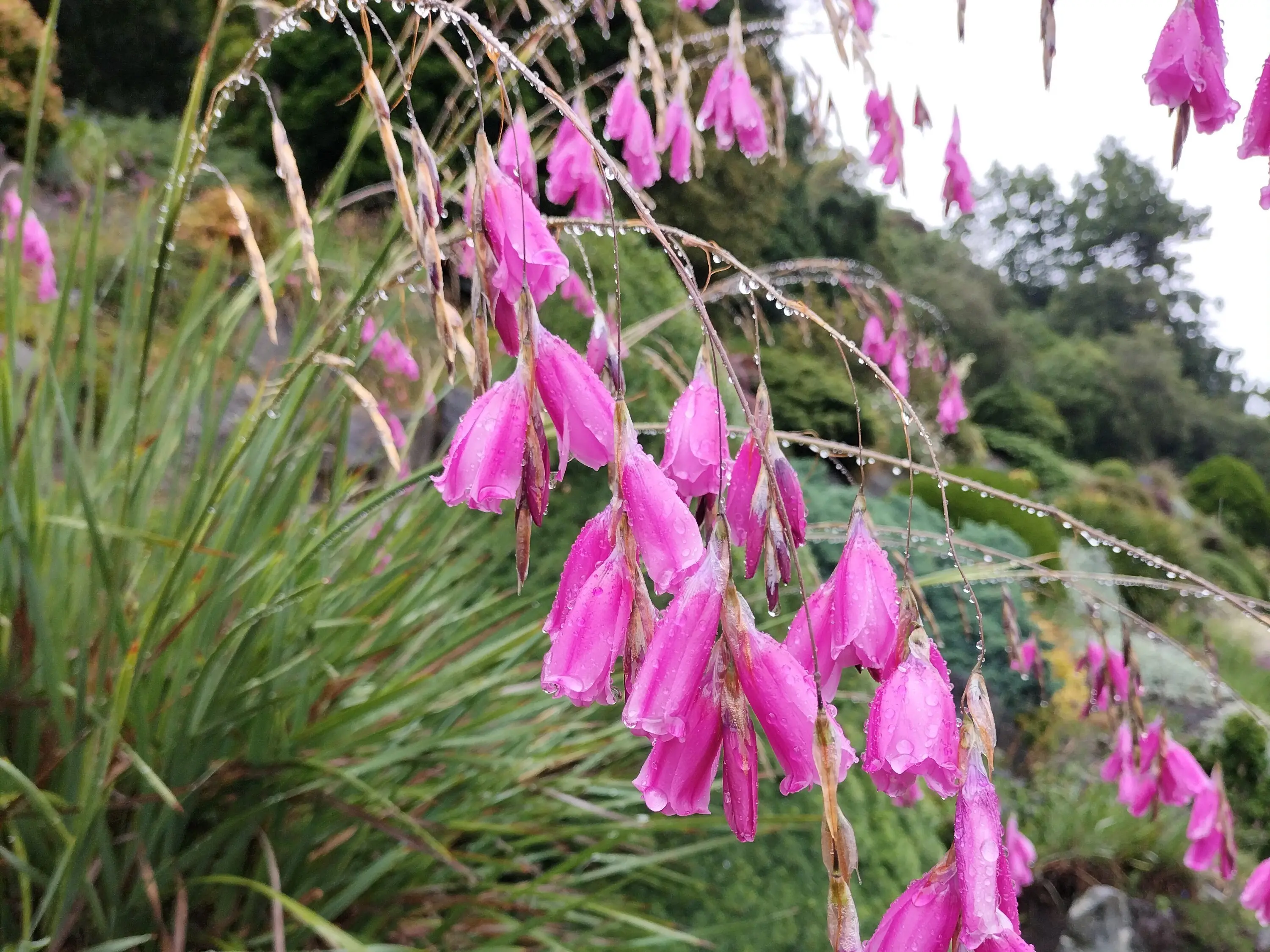
Kinetic and colourful, Dierama stops visitors in their tracks. They are flowering at present in the rock garden and the south African collection; the graceful bobbing flower heads catch the eye and add drama to the landscape.
Often referred to as angel’s fishing rod, the many species of Dierama are native to southern Africa, where most grow at reasonably high altitudes in grasslands where the soil is moist.
The plants grow from a round flattened corm which is renewed every year, creating a stack as the old corms persist under the new.
Foliage is evergreen and the flower stems emerge in mid-summer to arch above the clumps of leaves. Flowers open in succession from the tips to the base of the wiry stems, joined by such a thin stalk it almost gives the illusion they are floating.
The main species you will see in the garden are Dierama pulcherrimum (pictured) along with the very similar D. pendulum, coming in all shades of pink, including very dark, and occasionally pure white. Smaller species include D. igneum with a salmon pink flower, D. dracomontanum and the shorter flower-stemmed D. pauciflorum.
Dierama can be promiscuous and hybridisation may occur between species resulting in variation of flower colour and shape.
They look elegant hanging over the top of a wall or bank and are very graceful nodding over water.
Come and see for yourself angel’s fishing rod flowers dancing in the air at Dunedin Botanic Garden.
