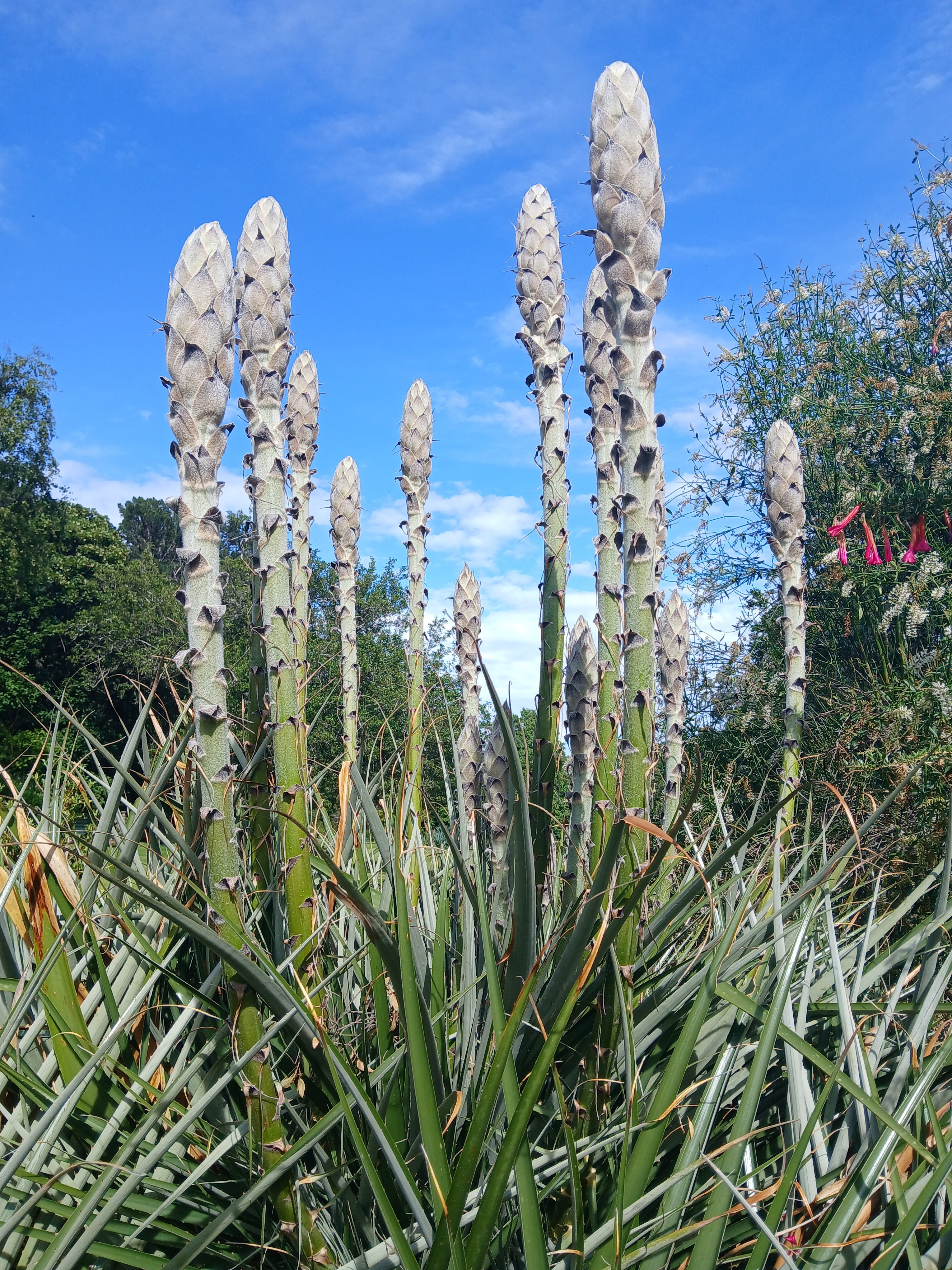
Over the years it has increased in size to now be several metres across and 2m high, making it a plant suitable only for the larger garden. It definitely needs space, not only due to its size, but the leaves have a great defence mechanism. Down each side of the leaf are spines which, near the tip, point outwards and are as fierce as the native Aciphylla, but as you head further down the leaf towards the base, the spines face back into the plant.
This adaption could be to reduce browsing by animals but has earned it the name "sheep-eating plant", as the arrangement of spines can cause animals to get entangled in the leaves, causing their demise.
In a garden setting the main thing to remember is that if you need to weed near this plant beware of the spines and ensure you wear thick gloves.
Our plant has flowered once in the last 20 years with a single flower spike, but conditions have obviously favoured it over the last few years, as this year it is sending up over 20 flower spikes. This show will be one not to miss, with green/yellow flowers on 2m spikes resembling medieval mace over the next few weeks. Puya chilensis is endemic to central Chile and can be seen in the South American border of the Geographic Collection in the upper Dunedin Botanic Garden.