
PHOTO
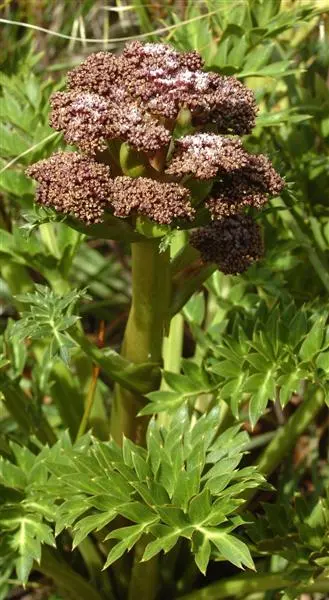
With its bold, leathery foliage and striking purple flower, Anisotome latifolia is a plant well worth a place in the garden.
Although the colour of the flowers can be variable and has been described as rosy, pale pink or reddish mauve and occasionally white, to me the flowers are purple but colour is so often in the eye of the beholder.
Even when not in flower, Anisotome latifolia is a worthy garden plant.
In leaf, this herbaceous perennial can reach heights of up to 1m, although usually less in cultivation. The lobed leaves are arranged in pairs along the leaf stalk and have quite distinctive yellow margins and pungent pointed tips.
Anisotome latifolia is best planted in a cool, semi-shady position in deep, humus-rich soil.
A layer of small stones around the crown may be beneficial in moister sites, as the plant can be prone to root rot.
• Anisotome latifolia grows naturally only on Auckland and Campbell Islands, from sea level to about 600m. Once abundant, this plant has now become restricted to areas inaccessible to stock.
• The flowering stem of this plant can grow up to 2m tall, with flower heads up to 20cm in diameter.
• Propagate by division if the parent plant is large enough to produce offset shoots, or by seed.
• The name Anisotome comes from the Greek "anisos", meaning unequal, and "tome", meaning cut, which probably refers to the unequal lobing of the leaf segments.
• The genus Anisotome belongs to the Apiaceae (carrot) family and there are over 15 native species which are endemic to New Zealand and the subantarctic islands.
• It is flowering beside the alpine scree garden next to the native lawn area in the upper botanic garden.
Shirley Stuart is curator of the native plant collection at Dunedin Botanic Garden.