
PHOTO
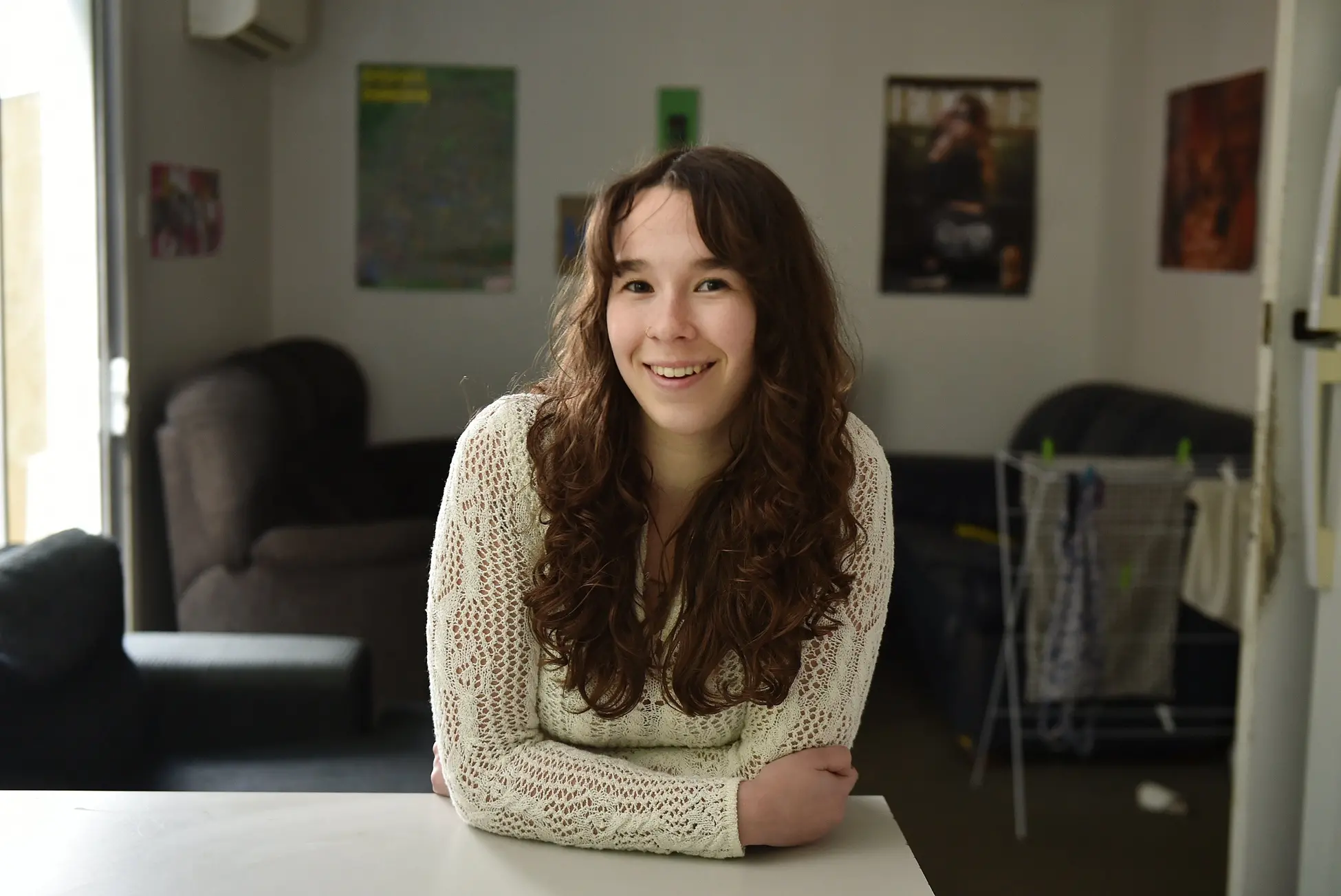
What started as a simple class writing exercise became a winning short story for emerging writer Stella Weston.
Her story, Highlights, won the student fiction section of Writer 2025, the University of Otago’s annual creative writing competition — which this year had the prompt "Being and Belonging".
Weston’s story captures a year in the life of a student who is finding life hard in a Dunedin flat.
"I started this piece in ENGL320 when we were asked to note down five things we saw on our walk to class," Weston says.
"I listed things like ‘broken bottles’, ‘couches in driveways’, and then realised that these things didn’t fit under the typical ‘homely vibe’ for most people.
"These pre-existing negative connotations were an obstacle in this piece as I wanted to show the protagonist growing into Dunedin and learning to love it."
The resulting story impressed this year’s judge, Dunedin author Breton Dukes.
Dukes says Weston’s story had humour and an overall light touch that captures the loneliness, griminess and camaraderie of flatting life.
Weston, who is in her second year of a BSc in psychology and a BA in philosophy, politics and economics (PPE), has already earned national and international recognition for her writing. A recipient of the New Zealand Society of Authors Secondary School Writing Mentorship and the Write the World Civics in Action Fellowship, she has already published widely.
Other winners in this year’s competition were Ellen Murray (student poetry), Anna Williams (staff poetry), Jennifer Haugh (staff fiction), Tui Bevin (alumni poetry) and Ellen Bernstein (alumni fiction).
Writer was established in 2019 as part of the university’s 150th celebrations.
This year a special publication celebrating all the winning entries was released.
Highlights
"What if I hate it? What if people are mean, or they don’t get me, and what if the classes are too hard and I hate it?"
Riley’s mum just hugged her again, "If it isn’t right, you’ll just come back home."
It sounded so simple put like that, as if everything was reversible.
So Riley went, walked away from her mum, into the airport with only three gates. Her bags were overweight, both of them, and she paid the $80 because her mum had to leave, and what would she actually even take out? How could anyone fit their whole lives into suitcases that were under 23kg?
In March, the morning after someone’s drunken hand had smashed their flat’s mailbox so it didn’t open in the front anymore, Riley called her mum. She held it together until the inevitable, "Riles, you sound off, you alright, pet?".
And Riley cried. Cried on the phone, below the one window that didn’t serve any of its intended purposes, below the photos of her high school friends peeling off the walls. She cried about her politics lecture that day, the group discussions that only rubbed it in that Riley didn’t get it, and didn’t really even know what it was. They all spoke some secret language that Riley only seemed to know the bones of, missing the crucial organs, the flesh and blood — a definition of breathas, or who Heidegger was. Riley thought the others all might have taken some summer school paper on the local dialect, maybe had some extra classes on how to keep warm wearing only jorts, how to pack a bag that weighed less than 23kg.
Riley told all of this to her mum through harsh sobs, and mumbles of "No, I’m fine".
Her mum listened to all of this through breaths that sounded like they got caught in her throat.
Riley was waiting for the invite home, because this wasn’t right, and she hated it.
Instead she got: "I know pet, but everyone feels like this, whether they act like it or not. Can you try and find something good for me? What’s a highlight?"
"I don’t know, calling you?"
Her mum laughed, "That’s nice to hear, but give me something else. Your neighbours? Any good?".
So far, Riley’s only interaction with their neighbours was when they had taken Riley’s flat’s recycling bin off the road on one of the first Tuesday mornings. Riley had been with her flatmate when they spotted their bin in the wrong driveway, their house number clearly spray painted down one side. Her flatmate had just laughed, and then Riley had held her bag while she darted through the neighbours’ open door, and ran back out a moment later, a half-full box of Coronas in her arms.
"We haven’t really met them."
"Alright love, why don’t you get some sleep? Have a hot shower, make sure you’re keeping warm, I’ll send you some money for some fruit, maybe some pears, would that be good?"
"Yeah, Mum, thank you. Love you."
Riley had gone to bed shivering. Nothing stayed warm in this place.
It was August. The coldest month. Riley’s chore on the chore chart was to clean the mould out of the shower. She took a sick pleasure in this, down on her hands and knees in just her underwear. A thin, cold, blue and white cloth in her left hand, half empty spray bottle of Exit Mould in her right. The mould was especially bad right now, because Riley hadn’t done her chore in three weeks. It crawled up the back wall of the shower, fingers of it reaching, slowly staining the white rim. No-one had thought to clean it while Riley was away, but nor did they expect her to do it now she was back. Someone had to though.
Riley thought the bleach particles must’ve developed tiny claws, digging and stinging at her eyes. She wondered if someone had Exit-Moulded the church last week, maybe that was why she hadn’t been able to see. She didn’t know why it had been at a church. Her mum had never been religious. Maybe the bleach particles were crawling down her throat, sinking those claws into her lungs, ripping tiny holes and letting all the air out. She thought it would be as easy as tearing the sail of a sailboat, or ripping a butterfly wing in half.
Riley hoped her funeral wouldn’t be at a church.
She scrubbed the mould until her fingernail ripped through the cloth from where she was pressing it. Until the particles claw their way through that hole, up her fingers and hands, reaching every inch of her until everything has been stripped away and she is only bones.
It wasn’t until November, after all their exams had finished, that her flatmates stopped treating Riley like a skeleton. They sat her down on the couch outside, the perpetually damp navy one they had bought off Facebook marketplace and carried through the streets. That had been a good day. That had been a highlight.
Riley thought they were going to yell at her, or tell her to stop moping around the house, or maybe stage an intervention and commit her to some institution for people who don’t leave their rooms anymore.
They just gave her the dry spot on the couch. Put a drink into her hand, a Corona. Coronas had become their flat drink. That was a highlight.
They turned up the speaker they’d been given by the head girl of Riley’s high school, when she had spotted Riley in a club, dragged her back to her flat, yapping the whole way about why that particular club sucked, and was only for freshers, and, oh wait, was Riley a fresher? No, no, yes much better to be flatting, and did she know that bars were always better than clubs, but not as good as house parties, but only if they have good music, and actually, wait, did Riley even have a good speaker? That had been a highlight.
One of the guys next door leant over the fence, laughed at their box of Coronas, the way the girls were arrayed over the one couch in the weak sunlight. He yelled something about it being a beautiful day to drink, so one of the others invited him over. He and his flatmates jumped the fence after tossing over a few mouldy beanbags, and Riley wondered if she should offer them the Exit Mould.
No-one yells at Riley, or shows up with a straight jacket.
They just pass her another beer, lie down on the beanbags, which are drying out in the sun, and ask her to settle an argument about Hobbes and Locke.
This is a highlight.