
This marks the exact moment of the southern hemisphere autumn equinox. At the equinox, the sun rises due east, sets due west, and the day and night are of equal length.

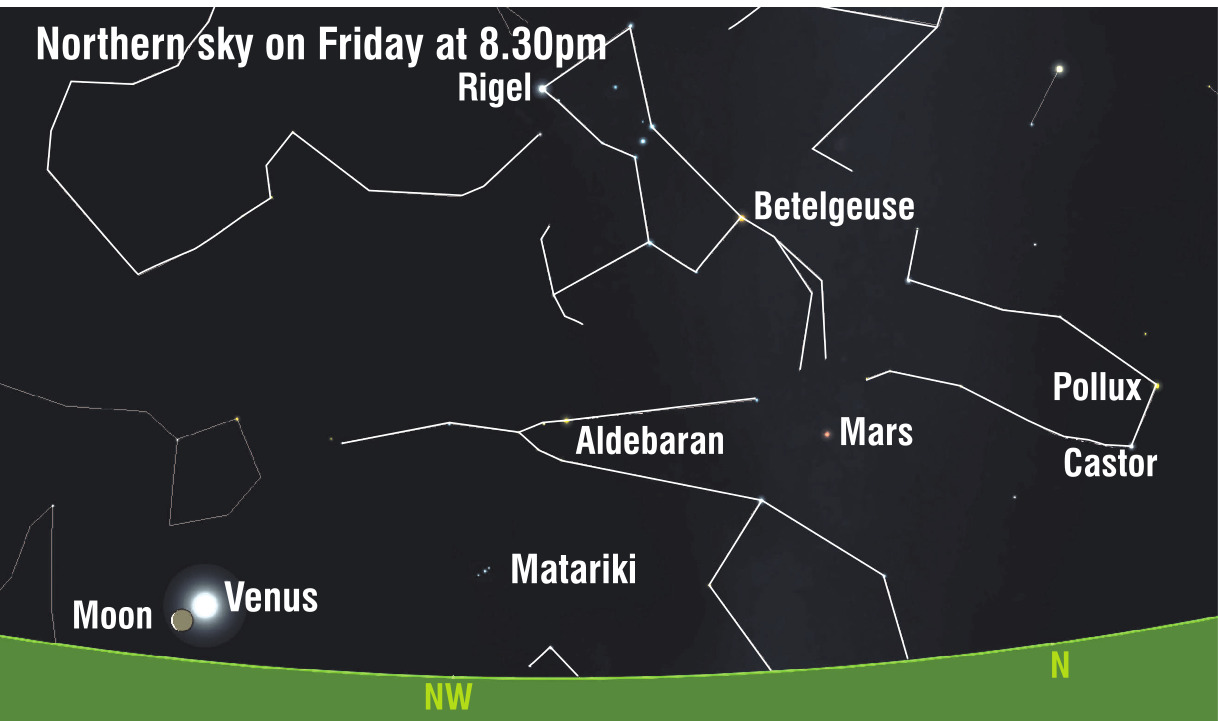
On Wednesday morning, the moon is new. By the end of the week, our closest natural celestial neighbour will be visible as a slender crescent after sunset. I'm particularly looking forward to Friday night when the moon will be very close to Venus in the Northwestern sky. On that evening, the waning crescent, almost three days past new, will be just 8% illuminated. Because both the moon and Venus will set before 9 pm, you will have to be out soon after sunset to spot this celestial pairing. Venus should be easy to see some two degrees above and to the right of the lunar crescent.
As the sky darkens, it is well worth exploring the northern sky this week. There certainly is a lot on the show. Once the moon and Venus have set, the constellation Orion will be easy to see high in the northwest. I always enjoy comparing the colours of Betelgeuse and Rigel, which are the constellation's brightest stars. Betelgeuse is a distinctly orange-red colour, while Rigel has a blue-white hue. The stars have contrasting colours because their surface temperatures are very different. Betelgeuse is a cool 3500 degrees, while Rigel is much hotter, with a surface temperature of almost 11,000 degrees.
The planet Mars is also on view. It is fading rapidly as its distance from Earth increases. Look for a red "star" roughly halfway between Betelgeuse and the horizon. If you have a telescope, Mars resembles a tiny gibbous moon, and its disk is just under 90% illuminated at the moment. To the right of Mars, forming a giant celestial triangle with the red planet and Betelgeuse is another orange-red star. This is Aldebaran, the brightest star in the constellation Taurus the Bull.


