

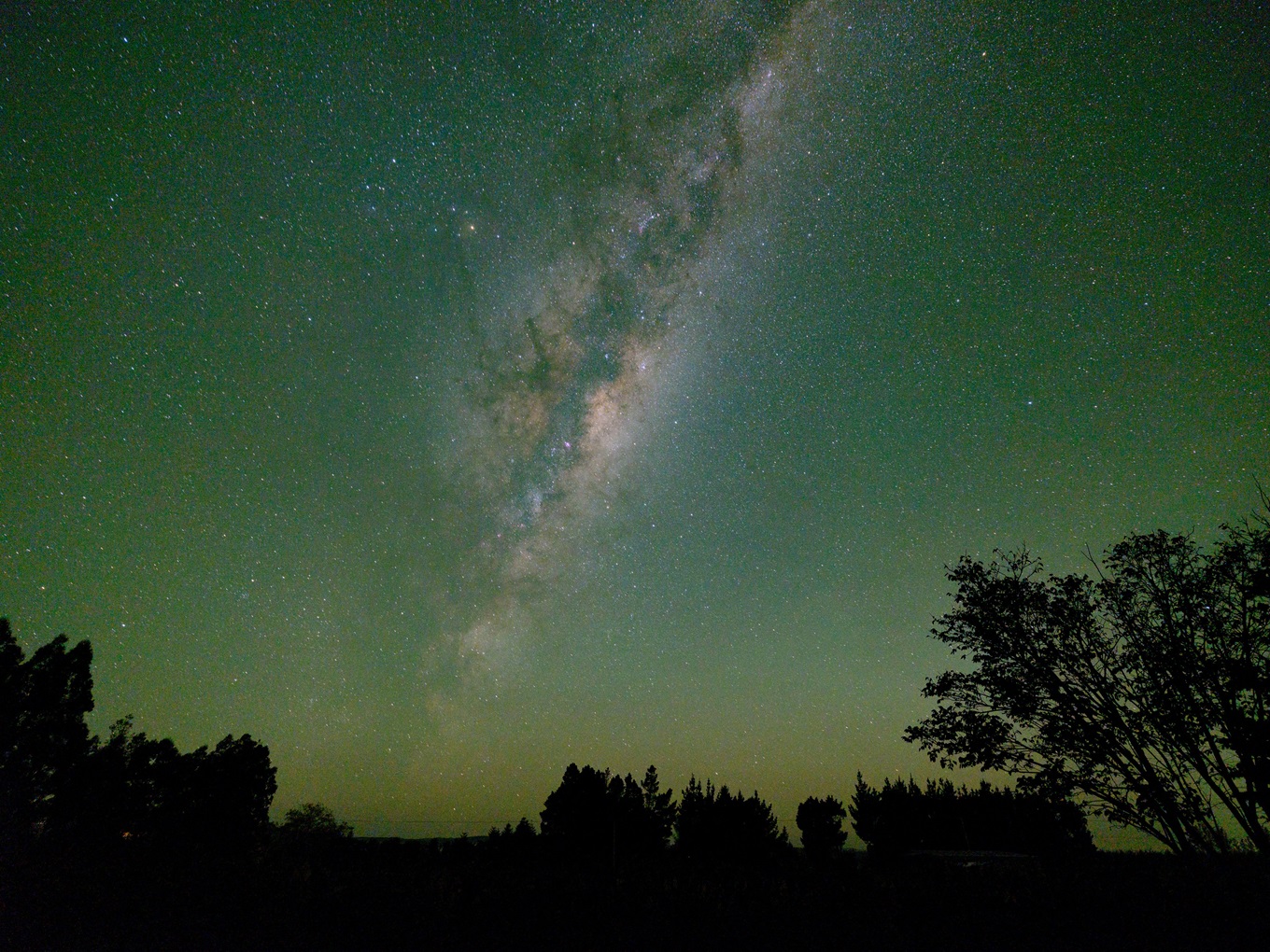
I often think about that, standing outside my observatory in Middlemarch, Otago. The coincidence of names is not lost on me. Eliot’s fictional town and this real one share more than a word. Both are places where ordinary life, looked at carefully enough, turns out to contain more than expected.
Not the heroism. The darkness. Darkness has an image problem.

Darkness is ignorance, danger and despair. Light is knowledge, safety and hope.
The verdict seems to have been settled centuries ago. As someone who spends much of his life seeking darkness, I sometimes wonder whether we reached the wrong conclusion.
Astronomers are peculiar in this regard. Most professions require more light to do their work, we require less. A dark sky is not a problem to be solved but a condition to be treasured. The universe reveals itself reluctantly and many of its finest sights appear only when the light goes away.
At first glance, there is very little to see from my observatory. No city glows bright on the horizon, the landscape is subdued and the sky appears almost empty.
Then your eyes adjust. Stars emerge in their thousands and the Milky Way stretches overhead. What first appeared vacant slowly reveals itself as crowded with wonders.
The darkness has not hidden them, it has allowed them to be seen.
Eliot understood the world is far fuller than we realise. If we could hear the grass grow and the squirrel’s heartbeat, she wrote, we would be overwhelmed by "the roar which lies on the other side of silence".
Most of the time, we are protected from that abundance. Standing beneath a truly dark Middlemarch sky, her insight feels literal. Every ancient photon, having travelled for millions of years, has always been there.
We did not need more of the universe, we needed less of ourselves.
Darkness does not conceal the world, sometimes it is how the world reveals itself.


