


Back in 1900 New Zealand, not yet a Dominion, was still firmly and loyally a part of the British Empire. England was routinely called "Home" or "the Mother Country" in these pages.
The Otago Daily Times, like most of New Zealand, had reacted enthusiastically when the Second Boer War broke out in 1899, urging that the colony play its part to back Britain and breaking out the bunting to farewell the substantial contingent of Otago men who sailed to South Africa to fight.
Contrary to most expectations the Boers — descendants of Dutch settlers who were resistant to becoming loyal subjects of Queen Victoria — did not curl up meekly when hostilities began.
Instead, their guerrilla tactics garnered them victory after victory, and handed embarrassment after embarrassment to Britain’s supposedly mighty military.
One battle in particular fascinated the British and wider colonial public: the siege of Mafeking.
A small town, it had been chosen by Colonel Robert Baden-Powell (later to find fame as founder of the Boy Scouts) as a supply base while he recruited soldiers from nearby Rhodesia. It had good transport links, but it was also perilously close to Boer territory.
In October 1899 the Boers began a 217-day-long siege of Mafeking. Among those trapped inside was the son of Britain’s Prime Minister, the Marquess of Salisbury, and the aunt of a future PM, Winston Churchill.
Although the Boers did not press their siege particularly aggressively, British newspaper readers acutely felt the peril of their countrymen and women: despatches from Mafeking were eagerly devoured as much in Dunedin as they were in London.
In May 1900 it was known that a relief army was marching towards the town, and the ODT reported its progress enthusiastically: "all were confident that [commanding officer] Lord Roberts was playing a bold and clever game and that complete success would shortly be ours."
That same issue the ODT reported that mayors throughout the country were awaiting news from Mafeking and that preparations were being made. The next day the paper assured readers that Dunedin was no different.
"Every arrangement has been made to suitably celebrate the relief of Mafeking when the news of that much desired event arrives in Dunedin. His Worship the Mayor desires citizens to observe a half-holiday on the day on which the news arrives. In the evening a mass meeting will be held in one of the large halls and thereat patriotic songs and speeches will be given."
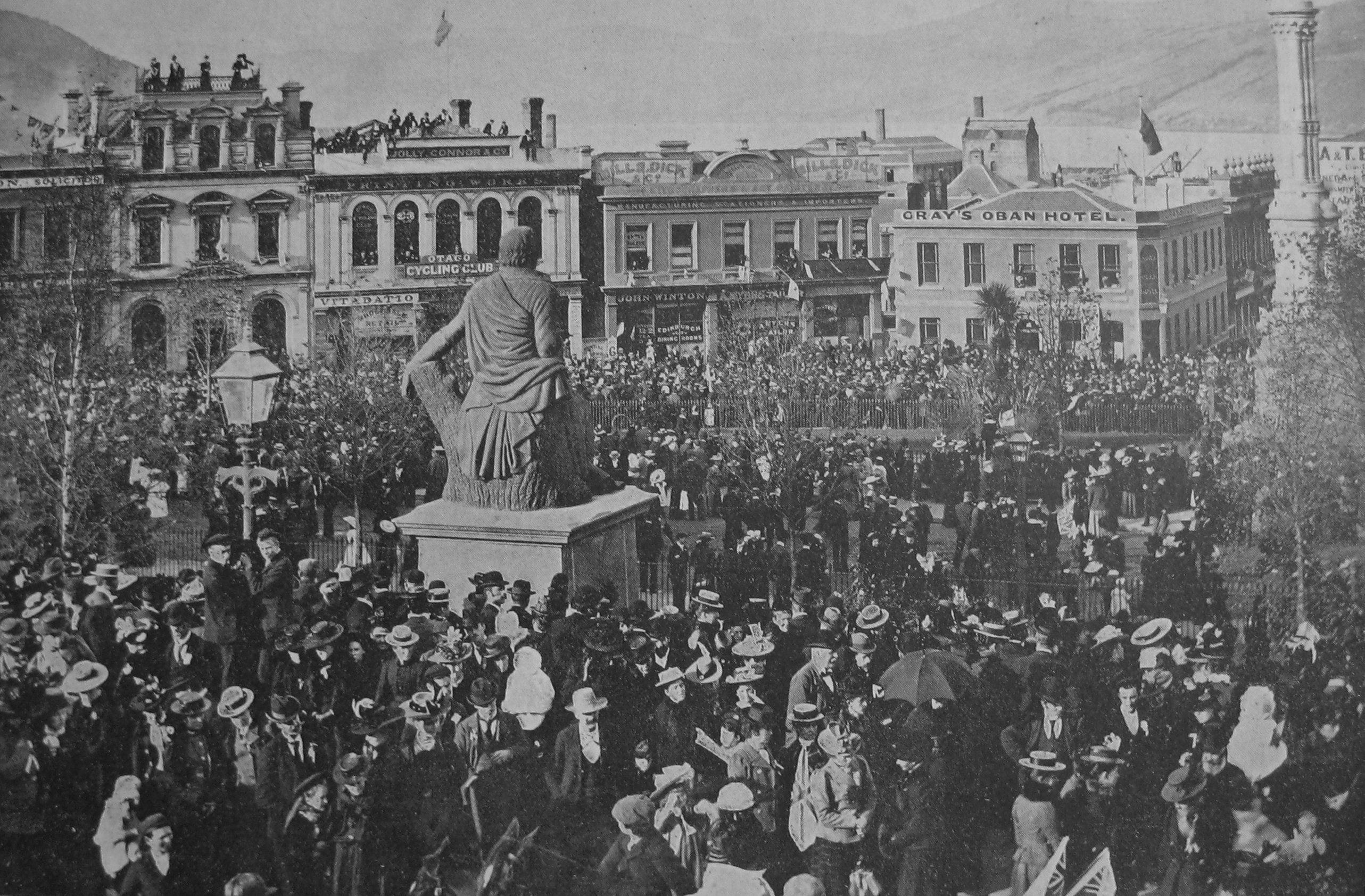
Dunedin did not have to wait long: the next day the ODT broke out the large type and block capital letters to announce "MAFEKING RELIEVED!" A few lines down, in lighter type, was noted "NO OFFICIAL NEWS TO HAND" but the mayor decided that the ODT’s report was reliable and the news was greeted with torchlight parades, bonfires and fireworks.
"The town was ablaze with bunting, there were few buildings from which flags were not displayed, and thousands of flags were carried all day long," the ODT reported.
People converged on the Octagon, where a contingent of Otago Hussars not on war duty abroad led the formal procession, Colonel Webb "on a fine charger" in front.
In behind, filed soldiers, veterans, cadets, the mayor and councillors, the fire brigade, students, "lady medical students and hospital nurses", a "German band in drag", "two niggers in a gig", the Pirates Football Club, the model yacht club, Fullers Vaudeville company, and last but not least, a cyclist.
"In one vehicle was a dummy of [Boer leader Paul] Kruger, which was unceremoniously beaten throughout the march."
After many a Māori war cry and a rendition of God Save The Queen, the good patriots of Dunedin finally returned triumphantly home.


