
PHOTO
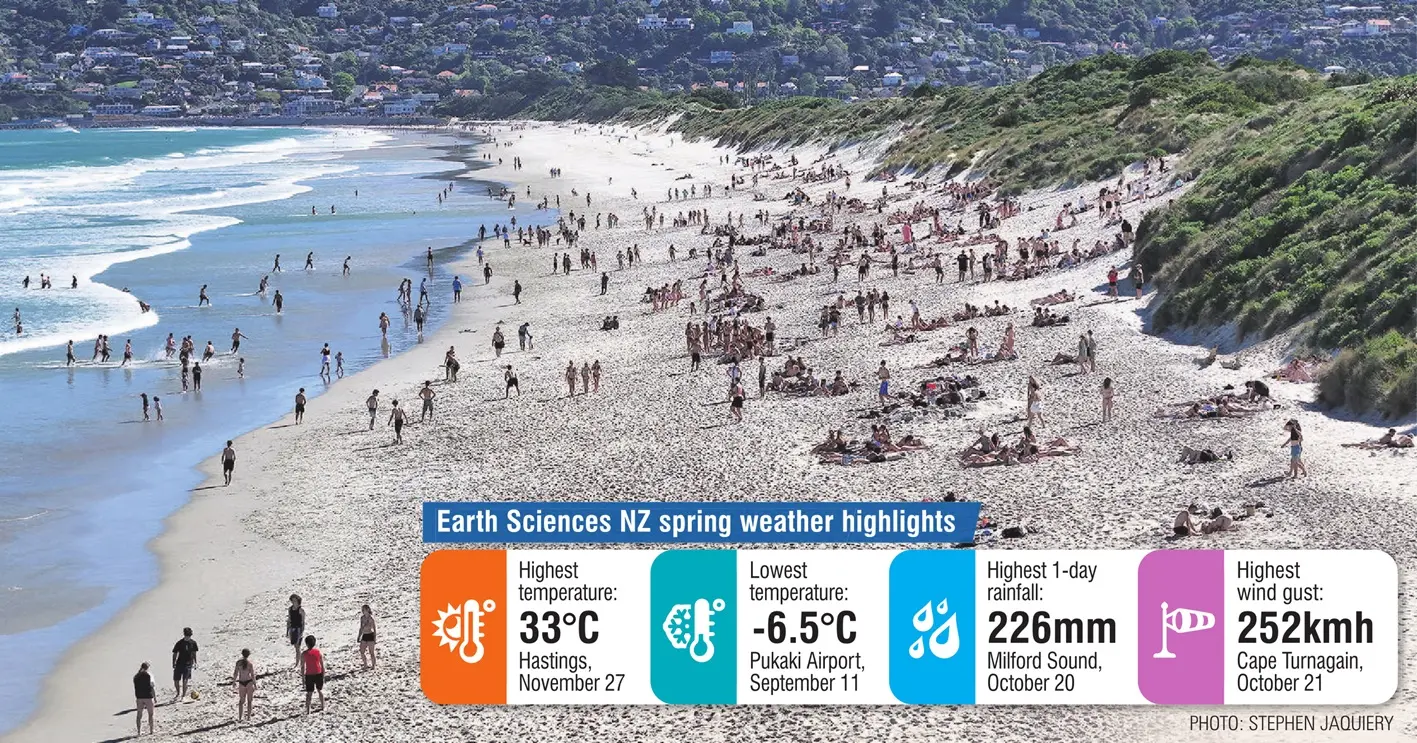
After baking in 31.7°C in Dunedin late last month, few will be surprised the city has just had its hottest spring on record.
It is just one of many places across Otago and Southland to have broken temperature and rainfall records.
Earth Sciences New Zealand meteorologist Chester Lampkin said the spring mean sea-level air pressure was lower than normal over the South Island, meaning west to northwesterly winds were dominant.
The weather pattern was partly driven by a sudden stratospheric warming event that occurred in September, which led to extremely active weather patterns in spring.
Warm air masses flowed over New Zealand regularly in November, leading to the country’s warmest November and spring on record, he said.
The nationwide average temperature in spring was 13.5°C, 1.3°C above the 1991-2020 spring average.
Across the country, 52 locations observed their highest spring mean air temperatures, including Oamaru (12.3°C), Middlemarch (11.3°C) and Dunedin (Musselburgh, 12.3°C).
On November 26, in particular, a warm air mass and relatively strong foehn winds pushed thermometers in several parts of the southern regions to break daily maximum temperature records.
Record daily maximum air temperatures for spring were recorded in Dunedin (Musselburgh), when the mercury reached 31.7°C, and in Balclutha, when it hit 28.8°C. Nugget Point (26.8°C) and Dunedin (airport, 30.4°C) recorded their second and third-highest, respectively.
Nationwide, the highest spring temperature was 33.0°C, observed in Hastings on November 27, and the lowest temperature was -6.5°C, observed at Pukaki Airport on September 11.
Mr Lampkin said spring rainfall also broke records in Otago and Southland.
New Zealand’s wettest location relative to normal was Queenstown, where 464mm (250% of normal spring rainfall) was recorded.
Despite the very high amount, it was only Queenstown’s second-highest spring rainfall total.
Invercargill also recorded its second-highest total, 386mm (129% of normal).
But Manapouri (West Arm Jetty) broke its spring record with a spectacular 2236mm, 212% higher than normal.
The highest one-day rainfall total was 226mm, recorded at Milford Sound on October 20.
A spring extreme one-day rainfall total record was also set at Monowai (161mm) on September 19.
Arrowtown (51mm, on October 20) and Roxburgh (47mm, on October 4) recorded their second-highest totals.
Wind gusts also broke spring records around the southern regions.
The highest wind gust was 252kmh, observed at Cape Turnagain on October 21.
Mr Lampkin said a significant storm with "violent winds" uprooted trees across much of the southern regions and knocked out power to more than 25,000 properties in late October.
It forced Southland and Clutha to declare states of emergency which lasted for two weeks.
The spring extreme wind gust record at South West Cape was broken when wind speeds reached 194kmh on October 23, and Manapouri’s record was equalled when it hit 102kmh.
Dunedin (Musselburgh, 119kmh) and Gore (124kmh) recorded their second-highest wind speeds, and Invercargill (137kmh) recorded its third-highest on the same day.