

PHOTO
Whatever else you might say about Christopher Luxon, he is a man who defies predictions and pundits.
A former business high-flyer and political protege of former National leader and prime minister Sir John Key, Mr Luxon was tipped as a potential party leader when first elected to Parliament in 2020 — but not as soon as his elevation to the party’s top job in October 2021.
Then, people doubted that he had what it took to topple a Labour government with the first single party majority since the advent of the MMP political system — but Mr Luxon swept to a monumental landslide in the 2023 election.
But almost as soon as he took his seat at the head of the Cabinet table alongside coalition partners Winston Peters and David Seymour, people doubted Mr Luxon could keep the obviously discordant relationship between the New Zealand First and Act New Zealand leaders from collapsing the government as soon as it formed.
Fast-forward three years and the government has lasted the distance … and Mr Luxon is still steering the National Party despite continual undermining of his position from within and two high-profile challenges to his leadership.
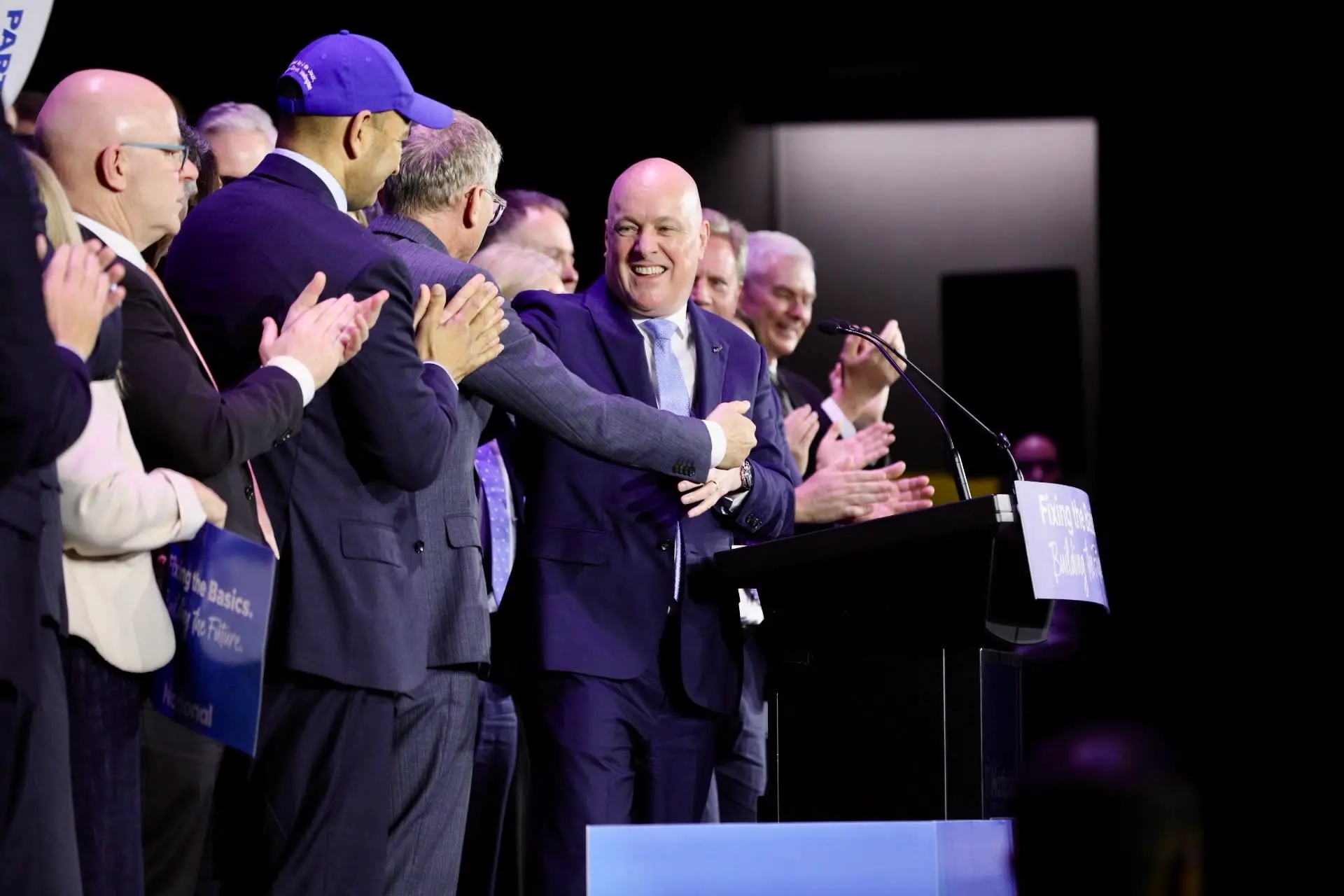
While the government might have looked highly unstable looking at it from the outside, Mr Luxon is adamant that on the inside it has been a strong and stable government.
“We are in a mature MMP environment and we have worked really hard to find common ground. We had a very good set of coalition agreements that we have followed through on, we had quarterly action plans for ministers and the public service to align around, and on the big things — how to grow the economy, how to lift education standards and healthcare, restoring law and order,” he said.
“In recent months, as we go into a campaign, there’s more noise as parties have their respective policies and positions, but don’t confuse that with the fact that I think, at the end of the day, we’ve had strong and stable government.”
Despite that confident assertion many people — many of them being National voters — have felt that the largest coalition partner was too often at the behest of its smaller partners.
Controversial and divisive provisions in the New Zealand First and Act agreements, such as gender definition and defining the principles of the Treaty of Waitangi, unleashed a hail of protest and, in the case of the Treaty Bill, sparked the largest protest march seen in Wellington for many years.
National, having agreed to support the latter Bill at first reading but no further, copped criticism for that stance and for wasting Parliament’s time in the process.
Mr Luxon, however, defends the party’s decisions as being part of the cost of doing business.
“For both Act and New Zealand First to form a government with us, they had to sign up to the National Party agenda, so we got to the end of the term having delivered, I think, everything we wanted to deliver in terms of what we went in to the election with,” Mr Luxon said.
“There were huge areas of commonality where we had overlap, which we reflected in the coalition agreements: we were doing those things anyway, it made sense.
And there’s obviously some bespoke things that different parties had that were important to them, and we’ve got to find a trade-off and a compromise in the spirit of MMP … you’ve just got to get used to the fact it’s not first past the post: we are in an MMP environment, and that’s why it’s quite OK to have leaders express things differently to how I may do it.”
Mr Luxon dismissed examples such as the two cited Bills as being “relatively minor” compared to where his focus has principally been: the economy.
On that front there have been mixed results. Early in the government’s term both inflation and mortgage interest rates dropped, both of which had been National Party targets.
There has also been positive economic growth.
However, as had been predicted in Budget documents, unemployment has risen to higher levels than experienced in recent years.
Also, as few predicted, Donald Trump became President of the United States once more and proceeded to hit the New Zealand economy with a double whammy — a tariff on New Zealand exports to the US and then a military campaign against Iran which sent petrol prices heading to infinity and beyond.
“Yes — we can’t control fuel prices, but we’re trying to support New Zealanders with a tax credit for low and middle-income working New Zealand families. We’re doing practical things around mileage rates for support and care workers out there in the community,” Mr Luxon said.
“I think is it better under a National government? Absolutely. It would be worse under a Labour government because of the spending and the taxing and the borrowing.”
————————
National’s key policies
- No new taxes
- Compulsory KiwiSaver, auto-enrolment at birth and a $1500 “baby boost”
- Widen access to 5%-deposit home loans
- Pursue a separation of New World and Pak’nSave
- Redirect funding from the International Visitor Levy to councils for infrastructure projects.
————————
"No new taxes" — the slogan Mr Luxon and National have used so often in recent weeks — is, arguably, not as compelling a promise as National’s 2023 pledge to cut taxes.
The time was not yet right for either adjusting PAYE percentages or tax brackets Mr Luxon said — that would require the government’s books to be in more robust shape.
"Our goal is we want to see a surplus in 2028. It’s really important.
We’ll start to pay down that mountain of debt that Labour ran up — you know, when they tripled the debt, they doubled it as a percent of GDP and we didn’t see a doubling of hospitals, schools or roads or anything around this country.
They wasted a hell of a lot of money and were financially irresponsible.
So we’ve got to pay down that debt but obviously, low taxes and lowering taxes is on our agenda for sure, in due course, but we’ve got to sequence our way through."
————————
Local issues
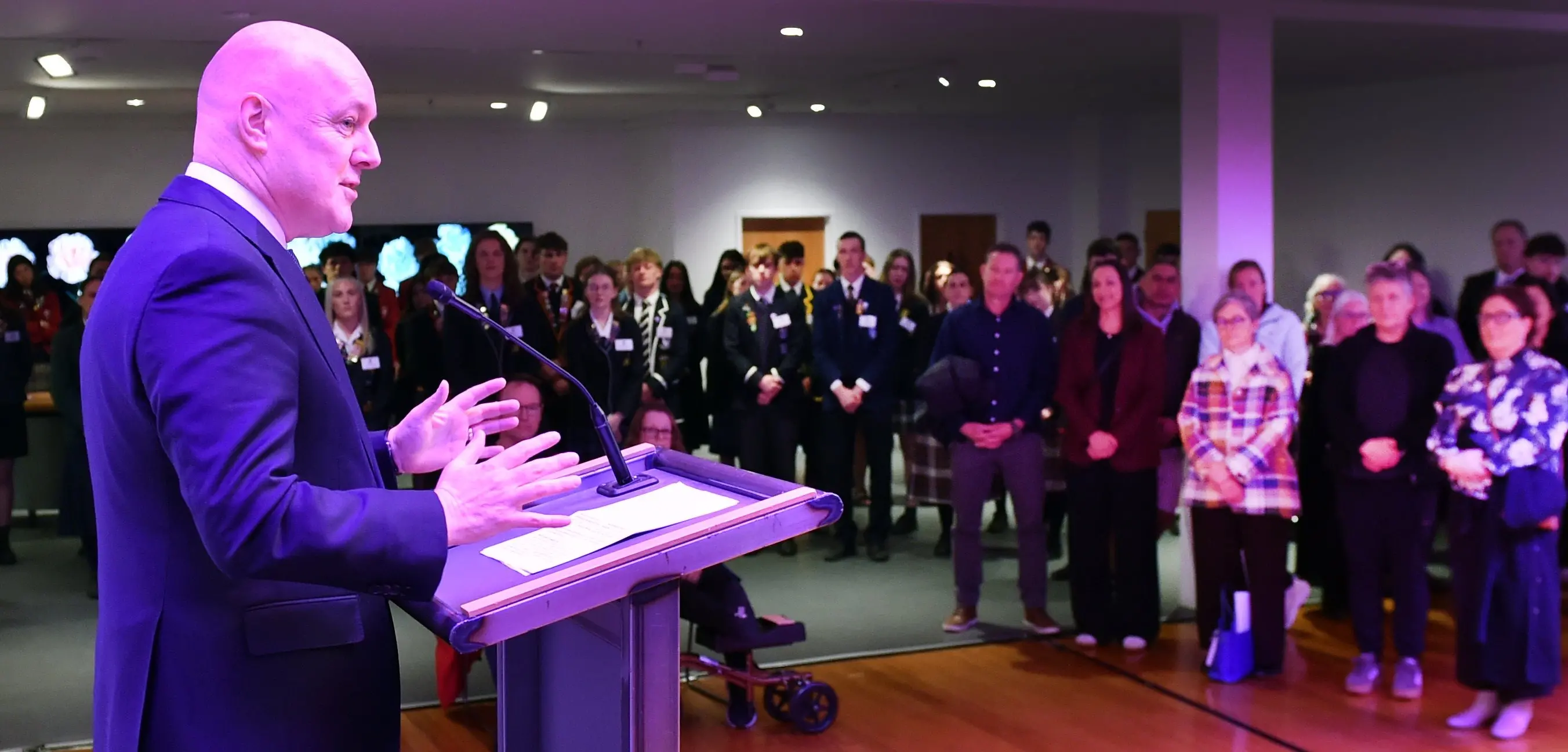
- New Dunedin Hospital: ‘‘It's really important that the build is actually built out as designed: you don't change designs along the way. Then we do what we need to do is ensure it's future proof. We can add to it over time, but the point is we've got to crack on and get that thing built and get it delivered. The good news is it's on time and it is being delivered within budget.’’
- Bed taxes: ‘‘A bed tax — two-thirds of it is paid by local New Zealanders. The truckie that's trying to get around to the South Island and is having to stay in a motel tonight in Timaru: I don't think that's fair that he has to pay a bed tax. I don't think it's fair when you go into a tangi or a funeral at short notice, that you've got to pay a bed tax. We believe in no new taxes, it's as simple as that.’’
- AI data centres: ‘‘There's no doubt about it: we need to embrace technology and particularly AI, and it's got a huge opportunity for New Zealand, particularly in improving productivity. But there are also some dangers and challenges around AI: we need to do it in partnership with other nations around legislative frameworks.”
- The proposed Bendigo mine: ‘‘I won't comment on projects that are before expert panels ... but responsible mining is very important. We've got abundant natural resources and we should be using them … but we've got to do it in a responsible way.’’
————————
But for all that Mr Luxon talks up a strengthening economy under his watch — 2.6% growth, a predicted 220,000 new jobs to be created in the next four years and wages growing faster than inflation — anyone going to the supermarket or filling their car with petrol will be wondering if the economy really is that rosy.
The government can be absolved of most of the blame for petrol price rises, and the associated inflation — that rests with US President Donald Trump.
However, with the cost of living fast becoming the main election issue, National had to come up with something — in its case, a proposal to break up the supermarket duopoly, should the Commerce Commission deem its wish to do so feasible.
"We’ve got a structural challenge in our grocery sector," Mr Luxon said. "Banner separation is the way forward.
Break Foodstuffs into two, put them into three big groups, have them compete on price, on range, on service, on location. Have them innovate a nd that will certainly help supermarkets.
"I worked in that sector for 18 years. I can tell you, I cannot think of a single country on earth that has two operators with 82% market share in that sector.
I cannot think of a single country that has a 4% margin in return: many countries run on 1, 1 to 2%. They are making a one million dollar profit a day."
National proposes a panel of economists and the Commerce Commission join forces to examine splitting up the existing firms to create a third competitor.
"Then they will either have to voluntarily demerge or we’ll mandatorily do it. Then we’ll have three operators competing, which would be great."