
PHOTO
Warning: This story discusses details of a suspected suicide.
A coroner has questioned whether it was appropriate to send a 12-year-old New Plymouth girl home with a "safety plan" shortly before her suspected suicide in 2017.
An inquest into the girl's death is being held at the New Plymouth District Court.
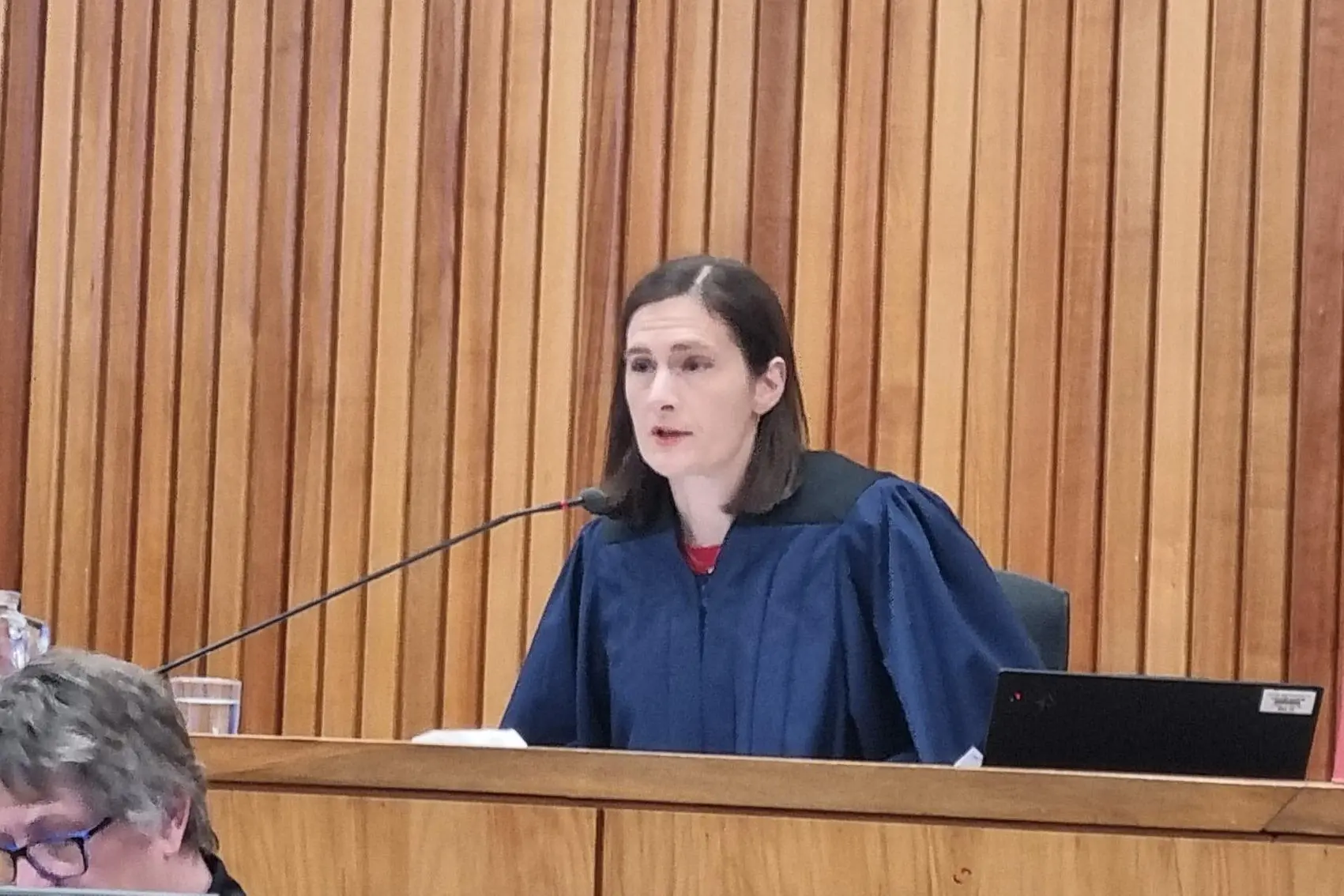
Coroner Heather McKenzie asked the Oranga Tamariki supervisor, who managed the social worker dealing with the case, how a child could be responsible for their own safety.
"I'm challenged by what seems a pretty big thing to put on a 12-year-old's shoulders. Do you have any comment on that?"
The supervisor, who cannot be named for legal reasons, said it could be appropriate for a young person of that age.
"A child of an age who has a certain ability to run away, to call somebody for help as opposed to an infant who has not got that ability... she had the ability to what we call 'self-protect' to a degree, to let people know that stuff was happening."
The safety plan involved teachers, wider whānau members - including an aunt who lived in the home - neighbours and calling 111 if the girl felt unsafe.
Two years after her death, a drug-addicted Taranaki woman was jailed for four years and three months for the physical and psychological abuse of three children.
The Oranga Tamariki supervisor gave evidence for most of Tuesday, outlining the ministry's interactions with the child's family and those with other agencies dating back to the mid 2000s.
The coroner asked the supervisor if she had a "magic wand", what would she wish for that could have made a difference in the girl's case.
"I wish that we had a centralised point by which some key agencies and ministries - so we're talking Ministry of Education, Ministry of Health, police and Oranga Tamariki - had a centralised place to record things.
"If there was a database and it had a particular criteria where we could all... just instantaneously access that information, we would be a lot further ahead."
The supervisor said the social worker who had allowed the girl to return home with a "safety plan" and was managing the situation via a "whānau family agreement" didn't have all the information available at the time because of the way it was being reported and sometimes filed.
She said workload was also an issue, with the social worker concerned dealing with 42 clients when "the ideal was no more than 17".
The supervisor pushed back on previous witnesses assertions that Oranga Tamariki did not act quickly enough in the girl's case.
"I consider that incorrect. We actually did give it urgency. We gave it more urgency than even our own contact centre believed we should."
Asked by McKenzie if the agency had done anything wrong up until the time the child died, the supervisor said she didn't believe so.
"I think everybody did everything they could with what they had at the time, and so from Oranga Tamariki's perspective, every practice guidance that we had at the time, and every policy that we had at the time, was met."
Counsel assisting the inquest Rebekah Jordan had earlier asked the supervisor about the 12-year-old's well-being and suicide risk assessment.
The child had scored 4 out of 25, when 12-plus was considered high-risk and would result in a referral to the Child and Adolescent Mental Health Services.
This was despite her admitting to having thoughts about "ending it all" and having self-harmed.
The Oranga Tamariki supervisor said her risk was considered low.
"It seems crazy to say that now, doesn't it? Now, given what we know now. But from the Kessler screening, her risk was considered low. She certainly had need in that space, but it wasn't considered urgent that day.
"So, at the assessment at that time, she said she wasn't suicidal, she didn't have a plan ... and she was [considered] in very low psychological distress."
Earlier, Detective Sergeant David Beattie, who had oversight of New Plymouth police family harm unit at the time, gave evidence.
After the child died, he carried out an internal review of the family harm unit's involvement in the case.
Beattie said the review found there was a high degree of collaboration between the unit and the agencies dealing with the family, but there was inconsistent recording of outcomes, a reliance on partner agencies to do follow ups, and difficulty responding to a high volume of cases.
He was sad the girl had found herself at a "crossroads".
Beattie feared a serious allegation made by the 12-year-old in May 2017 could've been a tipping point.
"She's either acting out and behaving badly, and there's been some behavioural stuff going on at school, or she's being completely honest, and she's let that secret out, and she's shared it with the school about what's really going on at home."
Police questioned the mother about the allegation but she denied it.
Beattie said if allegation was true, then the girl "would have felt extremely alone that the one person who was supposed to have her back, didn't".
"I say that with a lot of caution, but if she was telling the truth, then she would have felt extremely betrayed by her own mother."
He said the case had affected a lot of staff and was "just a tragedy".
Coroner McKenzie asked the detective what challenges still existed working with families in similar situations.
He pointed the finger firmly in one direction.
"I think alcohol plays a big part part in in our communities. I've seen mothers give up their children because the desire for the bottle is stronger than the love for their child. I think it gets underestimated, the impact of alcohol in our community.
"When it's just alcohol abuse or alcoholism, I think it gets lost. Like there almost needs to be blood on the floor to really get people to see it for what it is."
The inquest continues on Wednesday.
Where to get help
- Need to Talk? Free call or text 1737 any time to speak to a trained counsellor, for any reason
- Lifeline: 0800 543 354 or text HELP to 4357
- Suicide Crisis Helpline: 0508 828 865 / 0508 TAUTOKO. This is a service for people who may be thinking about suicide, or those who are concerned about family or friends
- Depression Helpline: 0800 111 757 or text 4202
- Samaritans: 0800 726 666
- Youthline: 0800 376 633 or text 234 or email talk@youthline.co.nz
- What's Up: 0800 WHATSUP / 0800 9428 787. This is free counselling for 5 to 19-year-olds
- Asian Family Services: 0800 862 342 or text 832. Languages spoken: Mandarin, Cantonese, Korean, Vietnamese, Thai, Japanese, Hindi, and English.
- Victim Support 0800 842 846.
- Rural Support Trust Helpline: 0800 787 254
- Healthline: 0800 611 116
- Rainbow Youth: (09) 376 4155
- OUTLine: 0800 688 5463
- Aoake te Rā bereaved by suicide service: or call 0800 000 053
If it is an emergency and you feel like you or someone else is at risk, call 111.
