
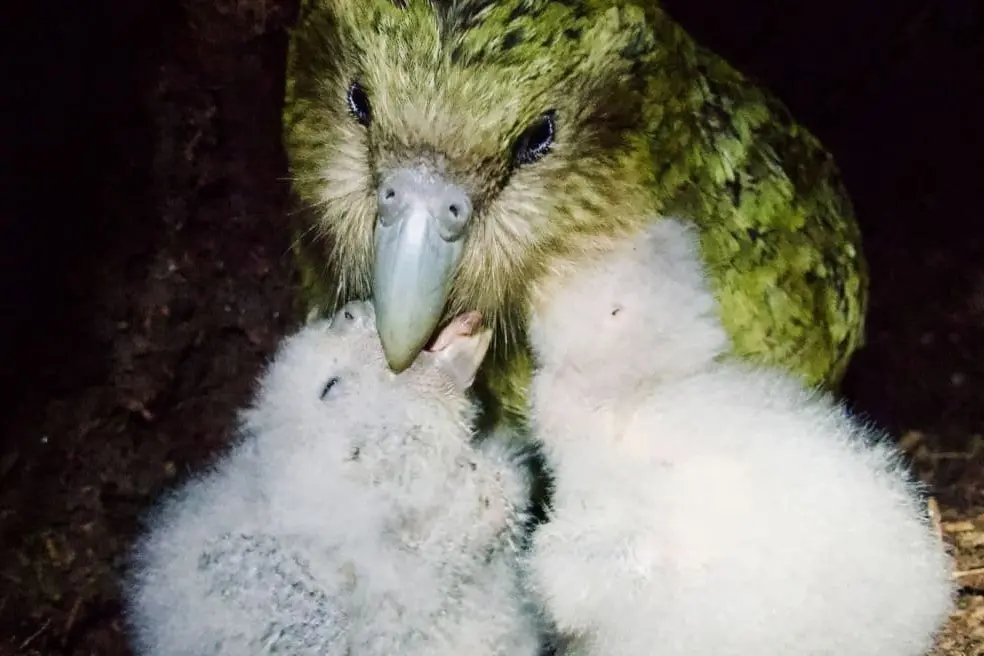
PHOTO
The 2026 kākāpō breeding season, the biggest on record, has come to an end with a bumper number of kākāpō chicks produced.
The youngest chick has just passed 150 days old, a milestone that marks its independence.
"We had 90 chicks reach that milestone," said Deidre Vercoe, operations manager for the Department of Conservation's Kākāpō Recovery Programme, who is delighted with the success.
Those 90 chicks are officially added to the kākāpō population on Monday, taking the critically endangered night parrot from 235 birds to 325.
Vercoe told RNZ's Kākāpō Files podcast that "to blow through that 300 population mark just knocks my socks off. Even as I say it now I think 'really? 325 - has that actually happened?' But it is true, it is fantastic."
When the Kākāpō Recovery Programme began in 1995 there were just 51 living kākāpō.
Kākāpō only breed every two to four years, so it's taken a while to get to the point where the population can increase by a third in just a single breeding season.
"It took about 16 years to make 90 chicks in the early days of the recovery programme," Vercoe says. "And we've just done that in one season."
2026 Kākāpō breeding season by the numbers:
- 79 female kākāpō nested
- 258 eggs laid
- 106 chicks hatched
- 48 females produced living chicks
- 32 dads fathered chicks
- 90 chicks made it to 150 days
Kākāpō breeding is triggered by the intermittent mass, or mast, fruiting of forest trees such as rimu.
In autumn, the ripening fruit is also a great food source for kākāpō mums to feed their hungry chicks, which grow from just 25 grams at hatching to about 1.5-2 kilos in weight at independence.
Intensive management, such as extra food for breeding mums in years when the fruit fails to ripen, has been a feature of kākāpō conservation.
This year a very abundant rimu crop ripened on the kākāpō's two breeding islands in Fiordland, meaning mums on those islands did not require any extra food.
However, on Whenua Hou / Codfish Island, near Rakiura / Stewart Island, the rimu failed to ripen and the female kākāpō there still needed supplementary food to raise chicks.
In the past three decades, hand-rearing has also been an important tool, but this season only two chicks that had required medical treatment ended up being hand-reared. The rest were fully raised by kākāpō mums.
Stepping back from intensive management, like feeding and hand-rearing, has been a deliberate move. It is an important and necessary change, says Kākāpō Recovery science advisor Andrew Digby.
"It's been a really significant breeding season for us," Digby says. "Obviously it's the biggest one we've ever had, so that's very significant. But I think just as important are the methods that we've employed and some of the things that we've changed this breeding season. And in particular that's that real emphasis on trying to step back and do a little less of the intensive management that we've done in the past, and let kākāpō do things on their own."
Technology has been key to the evolving management regime for kākāpō. Every bird wears a smart transmitter and its activity can be remotely monitored.
Deidre Vercoe says "we were able to put a lot more faith in our remote technology data, and really carefully monitor that data, and make decisions about when we would step in and interfere at a nest, to move an egg or to help a chick, or when we were okay to stay hands off".
All existing adult kākāpō have names, but Vercoe says this tradition is about to change.
"Not all the chicks will be named this year - some will remain unnamed. That's a bit of a symbol of heading towards a more natural state for kākāpō where they're not all individually managed and individually known."
The last two kākāpō breeding seasons were four years apart, but we won't have such a long wait until next time, Digby says. The key is a pattern of summer temperatures that triggers rimu fruiting.
"We look at temperature differences and that gives us a two-year heads-up. And there's an indication from those differences that 2028 will be another kākāpō breeding season."
While it's exciting news that there'll be more kākāpō chicks in two years time, the rapidly growing kākāpō population faces a challenge - the existing kākāpō islands are already full and we need more safe predator-free places for kākāpō to call home.
"After this next breeding season we desperately need another breeding site," Digby says. The search is on.
Among the highlights of the 2026 kākāpō breeding season were three four-year-old females that bred for the first time, the youngest females to ever breed.
Ten chicks were conceived through artificial insemination, a technique which is used to boost egg fertility and match-make good genetic matches. Ralph, an original male from Rakiura / Stewart, became a father for the first time as a result of artificial insemination.
The 'dad of the year' was ten-year-old Tūterangi. A first-time breeder, he mated with six females and fathered 10 living chicks.
The 'mums of the year' were Vori and Tīwhiri who both produced four living chicks.
