
PHOTO
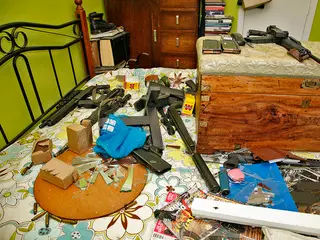
Police have "no idea" how many guns are in the hands of unlicensed owners, an expert on gun safety says.
The arsenal of weapons found at Napier gunman Jan Molenaar's house following a 50-hour siege last week sparked concerns about firearms laws in New Zealand.
Molenaar shot and killed Senior Constable Len Snee and wounded two other officers and a civilian when police conducted a drug search at his home last Thursday.
Gun safety advocate Philip Alpers told the New Zealand Herald newspaper it was "a perfect illustration of how the police have lost control over the situation".
There were about 225,000 licensed firearm owners with about 1.2 million guns in New Zealand.
Police did not know exactly how many gun owners were without licences and Mr Alpers, who works at the University of Sydney lecturing in gun safety, said police had "no idea of how many guns are out there".
In 1992, the Government got rid of lifetime licences in favour a 10-year system.
Despite an advertising campaign run in 2002, nearly 50,000 people still had not registered for the new license.
Police national manager of operations Tony McLeod told Radio New Zealand those people had had their licenses revoked and a file on each individual was sent to the district in which they were last known to live, with the expectation it would be followed up on.
Molenaar had held general and collector's firearms licenses but was one of the 50,000 who saw them expire in 2002.
With an unknown number of guns in the hands of unlicensed owners, Mr Alpers referred to the recommendations of a firearms control review conducted in 1997.
It said all firearms should be registered, there should be a buy-back of military style semi-automatic weapons, and firearms licences should be renewed every three years.
"Not a single one of the recommendations have been enacted in legislation", he said.
Council of Licensed Firearms Owners member Trevor Dykes said tougher laws would not have stopped Molenaar obtaining weapons and cautioned against a "knee-jerk reaction".
"The situation you had in Napier is the licence was revoked, so he just went out and got the firearms illegally anyway. All the legislation in the world won't stop that from happening."
Prime Minister John Key said the case had raised concerns, but emphasised it was not a common occurrence.
"This is one that has gone tragically and terribly wrong and I guess we will go away and take stock of that."
Mr McLeod said he could recall working in Napier as a constable prior to a law change in 1983 when it became no longer necessary to register each gun.
He said even then the system did not provide an accurate picture of the number of weapons floating around as it relied on the honesty of owners.