
PHOTO
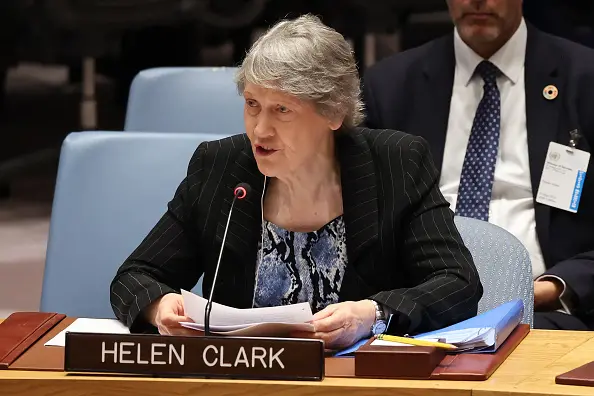
Former Prime Minister Helen Clark has slammed New Zealand's abstention on a vote on global pandemic preparedness at the United Nations, describing it as "humiliating".
New Zealand was among five countries that did not vote for a UN declaration designed to strengthen national, regional and international co-operation in the event of a future pandemic.
The United States, Israel and Argentina voted against the Political Declaration on Pandemic Prevention, Preparedness and Response, while New Zealand and Paraguay abstained.
The other 153 member states of the UN voted for the declaration, which called for "stronger national, regional and international cooperation, guided by science, equity and respect for human rights, and it welcomes last year's landmark adoption of the World Health Organisation (WHO) Pandemic Agreement".
In a statement, the Ministry of Foreign Affairs and Trade (MFAT) said "New Zealand supports the aim of strengthening global health systems and improving pandemic preparedness and response."
But it said: "New Zealand does not support language welcoming the adoption of the Pandemic Agreement… It is very important to New Zealand that its sovereign decision making on health is protected."
The UN said the declaration was "political and non-binding".
Clark - a former UN official - called the vote "humiliating for NZ" in a social media post.
"How low can NZ go?... This results from [New Zealand First]'s courting of the anti-vax vote," she said.
"As New Zealand noted at the time of the adoption of the Pandemic Agreement by the World Health Assembly [2024], any future decision on whether or not to sign and ratify the Pandemic Agreement will be informed by a full National Interest Test under domestic procedures," MFAT said.
The International Health Regulations (IHR) define countries' rights and obligations in handling public health events and emergencies that have the potential to cross borders, a statement on the Ministry of Health website said.
New Zealand was a signatory and had been since its establishment.
But earlier this year, New Zealand told the WHO Director-General it was rejecting the amendments.
POLITICAL REACTION
In a statement on social media, New Zealand First leader Winston Peters said his party "ensured the National Interest Test was included in the coalition agreement to keep our sovereign decision making with New Zealand, not Geneva".
"We believe it is essential to New Zealand that its sovereign decision making on health is protected," Peters said.
Labour leader Chris Hipkins called the vote "an embarrassment to New Zealand".
"Frankly, I am astounded that New Zealand has shown such cowardice in an important vote before the UN."
It was another example of Christopher Luxon "letting Winston Peters embrace conspiracy theories as New Zealand government positions", Hipkins said.
Luxon, the current Prime Minister and leader of the National Party, initially tried to skirt questions about the vote, saying: "It wasn't a Cabinet decision, you'll need to direct further questions to the Foreign Minister."
But he then appeared to disagree with Hipkins that it was an "important vote".
"There is literally, every day, a number of declarations that go through the UN - of major and minor significance and importance. Important ones come through a Cabinet decision-making process.
"But in this case, this is one that is up to the Minister of Foreign Affairs to make a call on."
National MP Matt Doocey told Newsroom that Ministers from his party supported voting for the declaration, but because Cabinet approval was not required, Peters made the decision.
Luxon said he thought New Zealand's standing in the world was "much more enhanced than it was three years ago", when asked what kind of light he thought the abstention put the country in.