
PHOTO
Thousands of Kiwis needing intensive insulin therapy (rIIT) could live longer with wider use of real-time continuous glucose monitoring (CGM) technology, a new study has found.
The study - led by Associate Professor Ryan Paul (Ngāti Maru, Hauraki), an endocrinologist at the University of Waikato and Health New Zealand, alongside researchers in the United States and the United Kingdom - compared the use of real-time CGM devices with traditional finger-prick testing for people with type 2 diabetes.
The study estimated that people with type 2 diabetes rIIT using the technology were expected to live longer, gaining around three additional months of life on average, and spend more years in better health, with fewer complications.
"The whole idea is how can we intervene early in diabetes so we can keep people with diabetes well and not developing complications and dying from their diabetes and that is what CGM allows us to do," Paul told RNZ.
The study found that continuous glucose monitoring was very cost-effective for those on multiple injections of insulin a day, he said.
Particularly for Māori and Pacific people, who were at least two and a-half times more likely to develop diabetes, to develop complications from their diabetes and to die from their diabetes, he said.
"We are now also seeing the intergenerational cycle of type 2 diabetes, and what I mean by that is that babies born to mums that have diabetes during their pregnancy will now have a very high chance of developing type 2 diabetes themselves by the time they become 30 years of age, and then subsequently potentially increasing the risk of their children and that's both fathers and mothers."
The technology could also be cost effective for young people with type 2 diabetes, which when it did start at an earlier age was much more aggressive, he said.
"In fact, for our young Maori and Pacific people, they're actually dying up to 20 to 25 years earlier than European people without diabetes.
"Now, they are not small numbers, and that's why we're really passionate to try and do all that we can in this space to try and improve care. Part of it is getting access to technology that we know that works and is cost-effective."
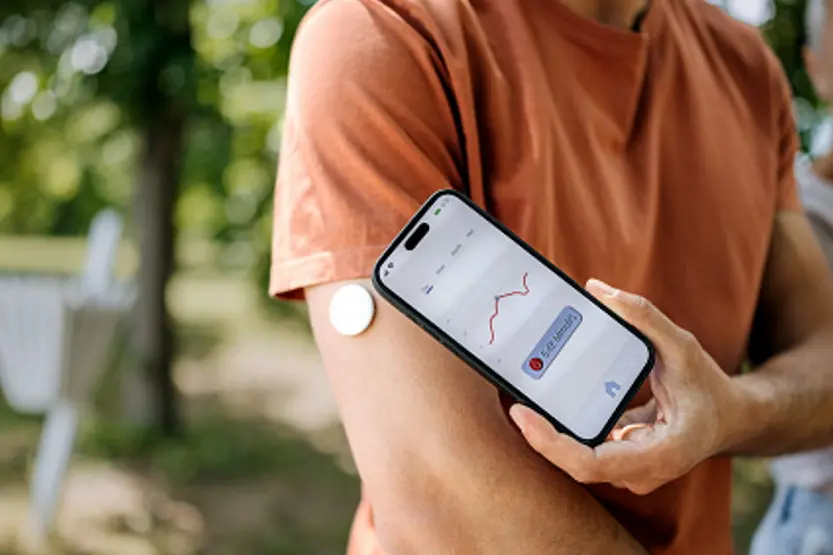
Paul said CGMs involved a small sensor which sat under the skin and tracked glucose levels throughout the day and night, sending that information to a receiver, usually a smartphone.
"So people in real time can know what's happening to their glucose levels, that means they can change their treatment, they can see the effects of kai or food or physical activity, and they know what needs changing, and it really empowers people to manage their diabetes."
It was much less invasive than traditional finger-prick testing and, with the sensor lasting at least 10 days, it meant one finger prick every two weeks rather than up to four a day, he said.
Paul said he encouraged patients with a CGM to experiment with how different types of kai and exercise affected their glucose levels.
"That real-time positive reinforcement provides exponentially more information than what fingerpricks do.
“Fingerpricks are only a snapshot - what CGM shows is the complete trends and will actually alarm whenever glucose levels get too low or get too high and that enables whānau to act there and then to correct their glucose levels rather than waiting at least hours till their next fingerprick is due."
Paul said the price of CGMs were dropping as more competitors came onto the market. The sensor involved in this study cost about $50-55 per week for people that were self-funding, he said.
That was still a lot of money, but there were other sensors on the market, the cheapest one available was $25 per week, he said.
"Test strips to do fingerpricks aren't cheap and even though these sensors may cost $50-55 per week, they still end up to downstream savings on the health system and that is because how expensive the complications of diabetes are for Health New Zealand.
"So Health New Zealand spends over 2 billion per year on diabetes care and a vast majority of that, well over 80 percent of that is actually managing complications of diabetes."
Complications included laser treatment or surgery for eye disease, dialysis or transplant for kidney disease and amputations for foot disease, he said.
Paul said it should be celebrated that New Zealand had arguably the best access in the world to CGM technology for people with type 1 diabetes but, those with type 2 diabetes on multiple injections of insulin per day would also greatly benefit from this technology.
"I'll be honest, people think that [type 2 diabetes] is all self-induced and that since it's self-induced, people shouldn't be allowed to have access to technology but what people often forget or aren't aware of is that in terms of obesity and diabetes, at least 50 to 70 percent of that is genetic and we're in what I describe as a perfect storm for an obesogenic environment in terms of the cost of living and how expensive healthy kai and food is and we know that rates of physical activity are reducing."
Paul said addressing the core causes of diabetes was important, but so was removing the stigma of the disease.

This story was first published on rnz.co.nz