
PHOTO
National is adamant its stance on superannuation has not changed since its fiery criticisms of other parties' failure to tackle the problem earlier in the year.
An economist is urging action, while political friends and foes alike are lobbing in their own criticisms.
The party unveiled its fiscal plan on Monday, setting out how policies would be paid for.
In stark contrast to ACT's own fiscals unveiled the day before, there was no sign of a specific plans to raise the age of eligibility for superannuation.
Instead, a commitment to the stance Willis agreed on TVNZ's Q+A on Sunday, to discuss the path forward in a broader cross-party accord over the retirement system with bitter rival Labour, which has promised to keep the age at 65.
National leader Christopher Luxon had promised in early May - ahead of the Budget - that "we will go to the election with another election policy around superannuation and lifting the retirement age for sure".
And when unveiling the Budget, Finance spokesperson Nicola Willis lambasted other parties on the matter, saying those "who say they won't do anything about it are prepared to rob everyone in this country under the age of 50 for their own political expediency".
"This is not a tomorrow problem, it's for today," she said at the time, "people often talk about the rising super bill as if it's something in the future. It's happening right now".
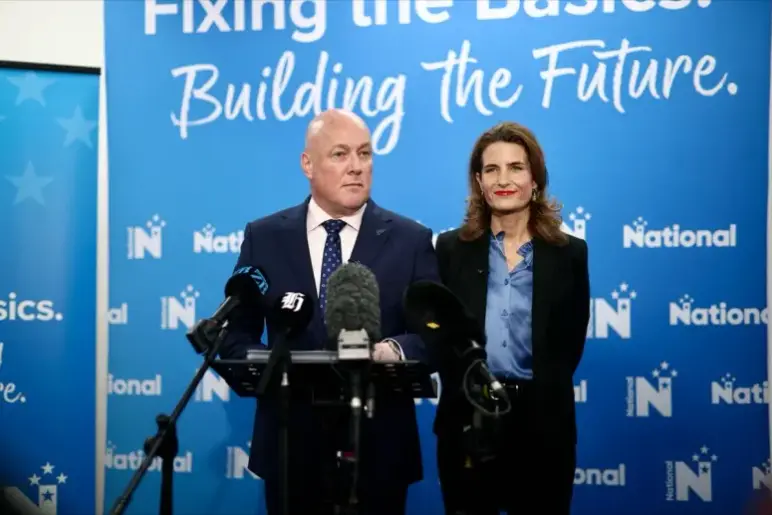
Both indicated on Monday they would have liked to make change but were clear their promised election policy was merely to hold those cross-party discussions, which Willis committed to hold within 100 days of a new government.
"It requires a political consensus, and we don't have that currently," Luxon said.
Willis said she stood by "every single one of my previous comments".
Labour's Finance spokesperson Barbara Edmonds said it was a conversation that needed to happen - but National had baulked at specifying a year to begin raising the age and seek a mandate for it at the election.
She said Labour would not increase the age from 65, "because it all comes down to affordable choices", and indicated the accord would focus on "the retirement system as a whole".
"The one area where the government is not looking is around revenue to support the increasing age of the increasing age of our population, but there are key areas where we can agree.
"In KiwiSaver employer contributions, we both agree to the 6 percent - other parties don't. So we want to try and where we can find agreement, we should."
Edmonds said many Māori and Pasifika people died under age 65, and a lower age for those groups should be looked at.
Like National, she hesitated to commit to changes without strong public support.
"You need to have the strong mandate to do it. They wanted the mandate to do it, they could have put it in their policy ... that conversation still continues, even if they're in government, [or] we're in government."
Coalition partners
National's coalition partners this term had opposing views, with New Zealand First's Winston Peters saying the two parties had been lying about the need to fund super for four decades, and nothing had changed.
Peters said it was a lie that superannuation was unaffordable.
"We can afford it, but we can't afford it with them because they can't run a sound economy. We in New Zealand First can."
Asked about the calls for cross-party agreement, he said National and Labour had "more agreements together than anybody else lately ... loneliness can have that effect on some people!"
He said National's fiscal plan did not stack up.
"Have they got $32 billion going off to India in the next $15 years? Have they got up to $22b going off to Paris in the next wee while? If that's not there they have no fiscal plan, do they?
"They don't have a fiscal plan, nor does ACT, it's pretence now."
ACT's proposal was to lift the age every year, by three months, until it reached 67 in 2035. Party leader David Seymour questioned National's commitment to raising the age, saying that party always planned to raise the age "in the future".
"That is why the government balancing the books is also just somewhere off in the future."
He said New Zealand needed to be "honest with each other about our financial situation".
Asked if National had missed an opportunity to take a position on when to raise the age to the election and have the public vote on it, Seymour said New Zealand had missed an opportunity.
"The country needs leadership to balance the books and get on top of the debt, rather than sending the bill to future taxpayers too young to vote in this election.
"But the reason we need an ACT party is to take these hard positions when nobody else will."
Greens, Opportunity
Greens co-leader Chlöe Swarbrick said the fiscal plan was "business as usual for the National Party, and business as usual is cooked".
"It's the reason that we're in the mess that we are at the moment, with the highest unemployment in 11 years, 47,000 more children living in poverty today ... [National] have managed to downgrade every fiscal metric that they inherited."
She aligned with Peters' view, saying that although the working age population was declining compared to retirees, "we have, as the retirement commissioner has pointed out, one of the most affordable retirement regimes in the world, and the fact that we have universal superannuation means that we have amongst the lowest rates of elderly poverty in the OECD.
"We can afford to ensure that everybody retires with dignity, and that means that we have to fix the tax system."
National's rhetoric at the Budget compared to its actions on the campaign trail "tells you everything that we already know about the National Party, which is where they will pander for votes, and where - when their polling is down - they'll punch down and get back into beneficiary bashing".
Opportunity leader Qiulae Wong said National's plan was lacking vision and "in our view, that is a low-emissions future, and we have not seen a credible climate plan from National".
She was pleased to see the commitment to a cross-party accord, but disappointed to see a lack of commitment on superannuation.
"This has happened so many times in elections where politicians talk about the need for change, but they're not willing to put those solutions out there on the table.
"If we weren't to implement our own tax policy, I think getting, particularly getting Labour and National to sit around the table together and figure out a way forward [is a good step] ... but I think New Zealanders don't trust that they will follow through, and I guess we've seen that today with the fiscal plan from the Nats."
"It is always politically difficult, but I think New Zealanders are ready for an honest conversation about superannuation."
Economist
Economist Michael Reddell told RNZ he would prefer to raise the age of Super to 70 "pretty quickly", saying a government could start straight away and do it over 10 years.
Reddell said the reality was the 65 age was set in 1898, when "most people didn't live to 65".
He said there was already 42 percent of people aged 65 to 69 working, and 30 percent of the population over 65 was between 65 and 69.
"So, if we make a significant dent in that pretty quickly, we bring the superannuation costs down a long way."
He suggested ACT's policy of raising the superannuation age by three months every year, reaching 67 by 2035, was a "bit tame".
"Sixty-seven is a start, but it's not really very much.
"Life expectancy had been increasing two years a decade for the last four or five decades."
He pointed to Denmark which was going to reach 69 by 2030, "we should be pushing further".
"It just doesn't make sense to be paying a universal pension at 65."
He said "we should see the ageing population as a good thing" and as people are "healthier at 65 than they ever were in the past, it's reasonable to expect that they should be working," though he acknowledged there would always be some people who were physically unable to.
He added it was good for people to have workplace community connections at that age.
Reddell said decisions around superannuation should be made within "your own community of people".
