
PHOTO
- New Zealand has turned down an offer to join a multilateral bank that would finance defence industries in member states such as Ukraine.
- According to advice, New Zealand's initial contribution would have been $NZ100 million.
- Officials say New Zealand's defence capacity would be better served by improving market opportunities.
New Zealand has turned down an invitation by Canada to join a multibillion-dollar Defence Bank.
The Defence, Security and Resilience Bank (DSRB) is currently under development. Its purpose is to finance the defence industries of its member states, which contribute capital to be re-invested.
Led by Canada, committed countries include Ukraine and Turkey, alongside several European neighbours.
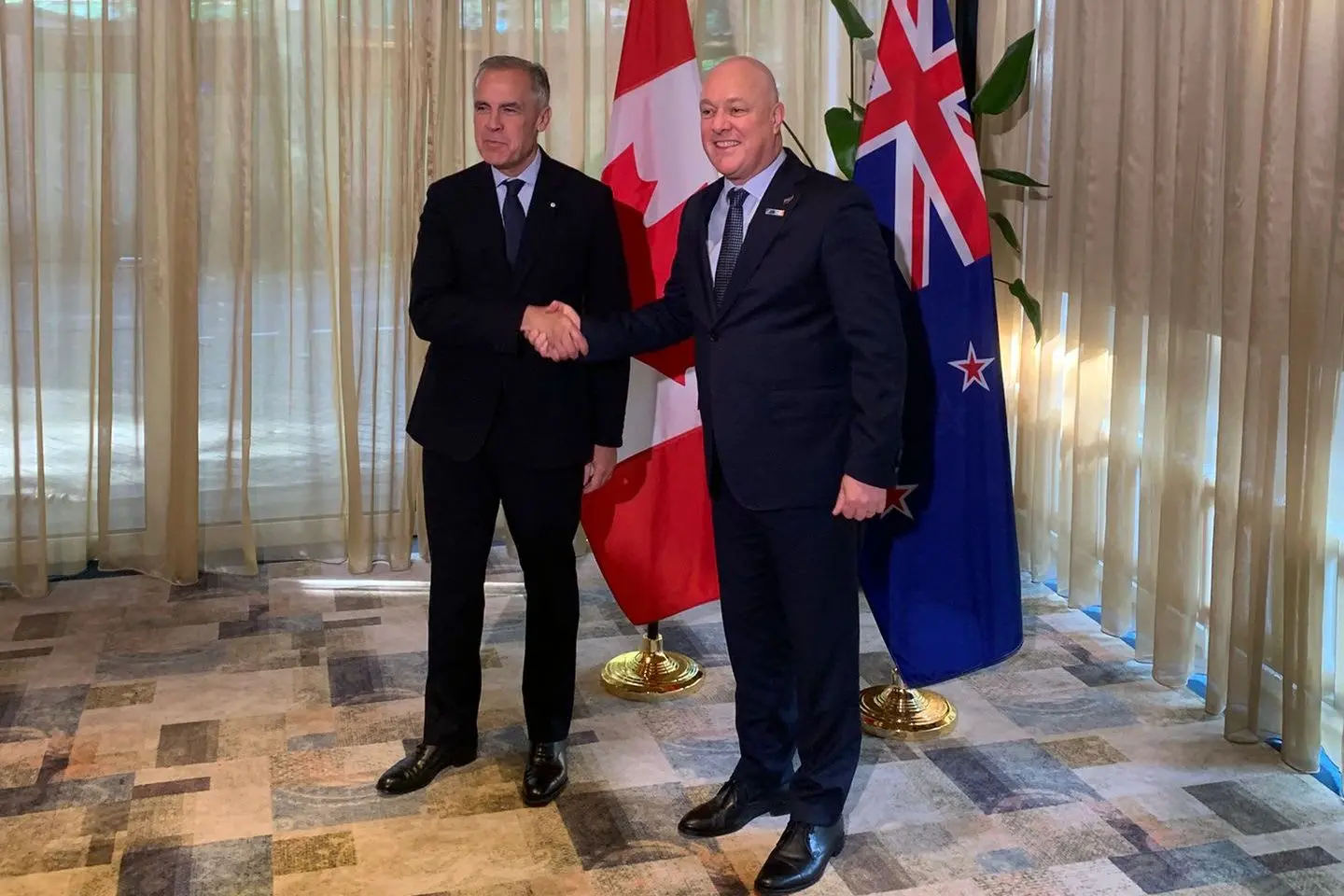
According to Ministry of Foreign Affairs and Trade (MFAT) advice released under the Official Information Act, Canadian Prime Minister Mark Carney invited his New Zealand counterpart Christopher Luxon to take part in negotiations over the bank's charter in late April, and eventually to buy in as a partner.
MFAT officials advised ministers against taking up the offer in late July, noting an initial contribution of $NZ100 million, with costs expected to run up from there.
"There would also be ongoing resourcing implications associated with the DSRB's governance," it noted.
In a statement, MFAT told RNZ that the government's decision was communicated to Ottawa in late August.
It comes as the country plans to increase defence spending to 2% of GDP ($12 billion) over eight years, under a 2025 Defence Capability Plan (DCP). Budget 2026 allocated a total of $3.5 billion for the current fiscal year.
Along with the DCP is a 'Defence Industry Strategy', which lacks any mention of overseas borrowing.
"Available evidence suggests that (the defence industry) would derive greater benefit from measures that improve market opportunities... than from the establishment of a dedicated defence financing mechanism."
The bank has a capitalisation goal of approximately €100 billion (about $NZ201 billion) by the end of the year, aiming to be operational by early 2027 with headquarters in Canada.
In early July, it was announced at a Nato summit that Albania, Belgium, Greece, Latvia, Luxembourg, Romania, Türkiye, and Ukraine had committed to joining the DSRB. It also hopes to bring in Australia, Japan, and South Korea as members in the Indo-Pacific.
While New Zealand turned down Canada's offer "at this time", it appeared that the door remains open for future membership.
"We will continue to monitor developments," MFAT said.
