
PHOTO
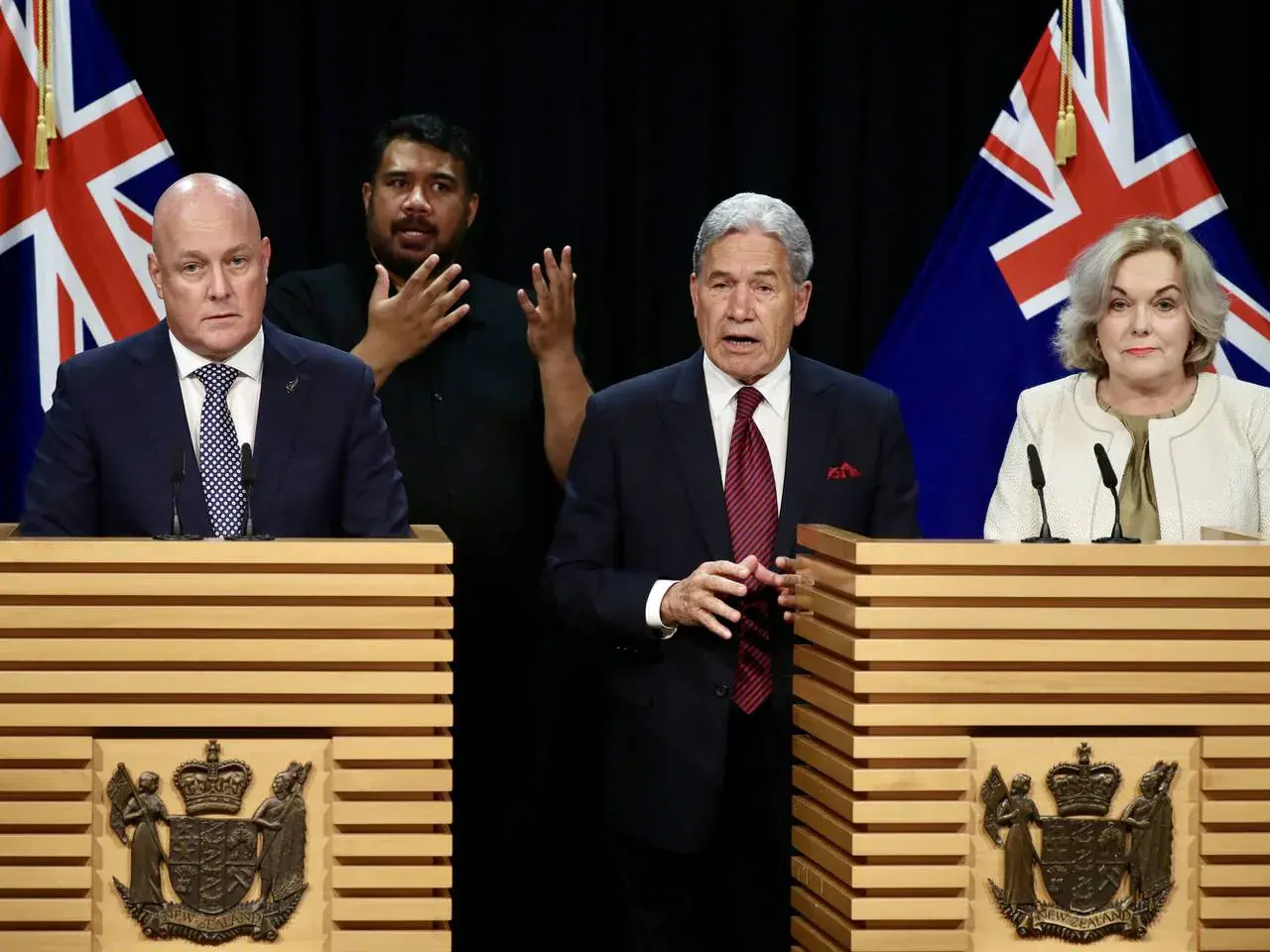
New Zealand is deploying a Defence Force team of six “highly trained” people to the Middle East to help provide maritime security in the Red Sea.
Prime Minister Christopher Luxon announced the military deployment today at his first post-Cabinet press conference of the year.
The team would be there to provide “precision targeting” through gathering intelligence information. It was expected they would not be directly involved in conflict.
”Houthi attacks against commercial and naval shipping are illegal, unacceptable and profoundly destabilising,” Luxon said.
”This deployment, as part of an international coalition, is a continuation of New Zealand’s long history of defending freedom of navigation both in the Middle East and closer to home.”
Luxon said the Defence Force team will contribute to the collective self-defence of ships in the Middle East, in accordance with international law, from operational headquarters in the region and elsewhere.
The Prime Minister said NZDF personnel will not enter Yemen and the deployment is part of a continuous New Zealand defence contribution to maritime security in the Middle East since 2013.
Foreign Minister Winston Peters also said the joint strikes being carried out by the international coalition are against Houthi military targets which have played a role in attacking commercial and naval vessels.
”These efforts support international security and the free flow of trade on which New Zealanders rely,” Peters said. New Zealand has earlier shown its support for the US and UK-led strikes.
Defence Minister Judith Collins also said the Houthi attacks show a “disregard for international law, peace and stability”, and the coalition response is an inevitable consequence of their actions.
”Our NZDF personnel are highly trained and this deployment will see them work alongside their counterparts on an important mission. New Zealand supports global stability and this deployment shows our commitment to efforts to address a serious threat to that stability.”
Peters added its action in the Red Sea should not be conflated with its position on the Israel-Gaza conflict.
”Any suggestion our ongoing support for maritime security in the Middle East is connected to recent developments in Israel and the Gaza Strip, is wrong. We are contributing to this military action for the same reason New Zealand has sent defence personnel to the Middle East for decades - we care deeply about regional security because our economic and strategic interests depend on it.
“I think conflating the two issues is very unhelpful,” Luxon said while saying New Zealand’s decision to deploy had nothing to do with the Israel-Hamas conflict.
The deployment is mandated to conclude no later than July 31.
Asked if he was open to extending the deployment, Luxon reiterated the deployment would end no later than the July 31 deadline.
The countries that the NZ deployment would join included Canada, the United Kingdom, Australia and the United States. It was not correct to say it was a Five Eyes operation, Luxon said.
Peters said he did not consult the move with the Opposition, saying those parties had been aligned with such a decision in the past.
Collins wouldn’t specify from what branch of the NZDF the personnel would come from, restating they were from the NZDF.
Collins wouldn’t give further information regarding the specific actions of the New Zealand deployment, apart from saying they would assist in targeting Houthi bases that were involved in attacks on vessels.
Luxon wasn’t aware whether the deployment would impact New Zealand’s terrorism threat level.
On Saturday’s national hui on Saturday organised by Māori in response to Government policies, Luxon accepted that a significant number of people showed up but said he had had regular conversations with iwi leaders.
Asked if he could rule out voting in favour of Act’s Treaty Principles Bill post select committee, Luxon said there was no commitment from National to support it after the select committee process.
“I outright reject it,” Luxon said of comments by Te Pāti Māori claiming the Government was underpinned by white supremacy. He added it was very offensive.
His message at Rātana tomorrow would be about wanting to partner with Māori to get better outcomes in health and education, for example.
Luxon said he was fully expecting strong challenges by Māori leaders at Rātana, saying it was the appropriate forum for such debate.
Luxon said he had met last year with Dame Jacinda Ardern to discuss her role as special envoy regarding the Christchurch Call. He wouldn’t answer whether he would commit to retaining that role, saying it would be a matter discussed in the coming weeks.
He said he and Ardern didn’t have significantly different visions with respect to the Christchurch Call and its work.