
PHOTO
By Sam Sherwood of RNZ
Police Commissioner Richard Chambers says a controversial directive sent to staff about not investigating retail crime below certain thresholds gave people the impression police were "giving license to those who choose to break the law".
He has since canned the directive, which he labelled "confusing and unhelpful".
RNZ revealed last week a directive was recently sent to staff relating to police's File Management Centre (FMC) titled 'Assignment Changes - Theft and Fraud'.
The directive told officers not to investigate allegations of shoplifting below $500, while petrol drive offs below $150 and online scams under $1000 also not be investigated.
Chambers today held a media conference in Auckland following significant backlash regarding the directive.
He told reporters that on his first day as the commissioner he made "very clear" his expectations around retail crime and the role of police and law enforcement.
"That has not changed. As recently as Friday last week, I had my full Police Executive and all 12 district commanders together talking about our priorities for the next 12 to 24 months. Retail crime is one of those priorities.
"I was very disappointed to learn of a memo that went out internally back in March this year talking about thresholds, because the content of that memo is inconsistent with my expectations as the commissioner of police.'
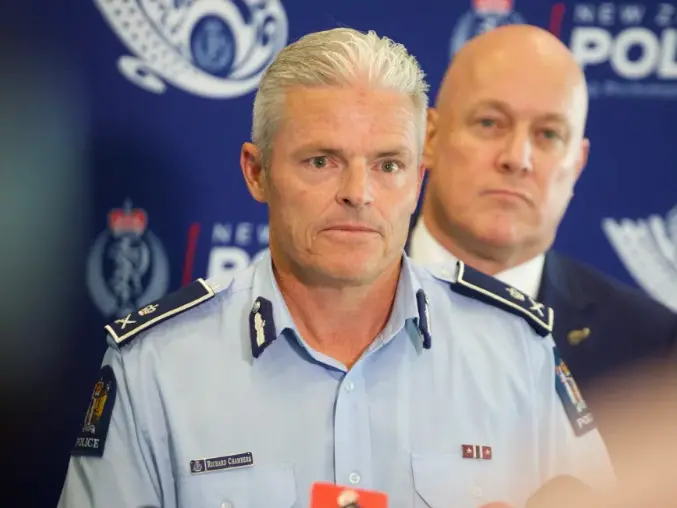
Chambers today spoke with a number of leaders in the retail sector at a pre-planned meeting.
"We sat down and we talked about what the opportunities are to work together in terms of addressing the problem of retail crime. My staff across the country work incredibly hard to address the problem of retail crime. We know that retail crime has been increasing over recent years, but so too have the number of prosecutions that police have laid addressing offenders."
Police relied on the support of the retail community and members of the public to gather information and to gather evidence that allowed police to hold offenders to account, he said.
"We won't always be able to be there, but we will do our absolute best for the retail community to hold offenders to account.
"And I want to reassure the retail community that nothing has changed since on my first day as the commissioner of police, I made very clear what those priorities were."
Chambers said he first became aware of the memo at the weekend, after RNZ revealed its existence. He read it for the first time last night.
"Having read the memo myself, some might think that we were giving license to those who choose to break the law. That's not the case. And in fact, my appeal is for the retail community and the public to continue to help us to ensure that we gather information to hold people account that hasn't changed."
Chambers said the staffer behind the directive "thought they were being helpful".
"But actually, when we think about the processes that we have internally to address demand, we must also be thinking about the impact of those decisions externally.
"Our role as law enforcement, we are working incredibly hard with the retail community, and the memo was inconsistent with my expectations. I have not spoken to the individual myself, but I think the commissioner coming out and being very clear about my expectations is probably sufficient."
Chambers described himself as an "understanding leader," but said he was "disappointed" the memo spoke to things "that are very inconsistent with my expectations when it comes to retail crime".
He said he did not expect to be briefed on all internal memos. "I don't need to know about everything, because I have a hierarchy and a structure in place to help us with that."
Asked what conversations he had with Police Minister Mark Mitchell, Chambers said the directive was an "operational matter".
"This is me as the commissioner of New Zealand Police, once again, saying what my expectations are when it comes to retail crime. As I say, that hasn't changed since day one. It's an operational matter for us. It's not a matter for the minister."
Chambers said a thresholds like the one mentioned in the directive did not make sense.
"When it comes to retail crime, and let's take shoplifting, often these events aren't one off events in isolation. Often some of our worst offenders are serial offenders.
"And that is in particular, one reason that thresholds don't make any sense, because on each case, if you look at each case on its merits, they may be quite low in terms of the cost to the retail community, but when you add up all that serial offending, and that's the reality of what it is in many cases, then our job is to put those individuals before the court and ensure that they get held accountable for that behaviour."
He was "concerned" when he read the memo that it may "impact on trust and confidence in police".
"So I'm here today making very clear, and I'm hoping reassuring, that my expectations have not changed."
He had not spoken directly to the staffer who wrote the memo.
"When we deal with crime, we often apply a series of criteria to help us prioritize, and I understand that the intent of that person was to provide some criteria that might help prioritise.
"But the reality is that is only one consideration in the complex world of crime that we deal with, and when it comes to dollar thresholds, actually, personally, I don't think that's relevant."
Prime Minister Christopher Luxon has said says he expects police to tackle crime everywhere, and that the memo got it wrong and was not appropriate.
Retail NZ advocacy manager Ann-Marie Johnson told RNZ she was at the meeting with Chambers today with other major retail chains.
"He assured us retail crime was one of his top priorities, there's no question of a baseline value that police will not go below."
Johnson said those at the meeting were "very positive", about his comments.
"I think he was frustrated at the tone of the memo that had gone out. And, so he was very keen to reassure us it did not reflect his priorities."
'We only have so much resource'
RNZ revealed last week a directive was recently sent to staff relating to police's File Management Centre (FMC) titled 'Assignment Changes - Theft and Fraud'.
The directive said that from March 26 the FMC was applying "nationally standardised value thresholds" when assessing theft and fraud files. The value thresholds are - general theft $200, petrol drive off $150, shoplifting $500, fraud (paywave, online, scam etc) $1000, and all other fraud $500.
"When assessing files with these offences, you will apply the relevant value threshold and file any file under that threshold regardless of any lines of enquiry or IFA score."
The police instructions relating to Case Management define an IFA score as "a numeric value derived from a series of weighted factors which gives an indication of the solvability of the case, based on the presence or absence of certain key lines of enquiry".
The directive sparked confusion about the reality of the situation, with police conceding on Friday that while the wording of the directive "could have been clearer" police would continue to investigate reports if there are avenues of inquiry to explore.
However, speaking to Checkpoint yesterday, director of service Superintendent Blair MacDonald, who was the author of the directive, admitted it was valid.
"We only have so much resource, so we have to prioritise the work that comes in through the door and that's a challenge. Each district has to make a choice."
MacDonald said while police might not be able to attend incidents in person, reports of crimes - including car registrations, photos and CCTV footage - may help to solve bigger crimes down the track, and all reports would be 'filed' or 'parked' for the future.
"We continue to encourage everyone to report offending to us, because even if we can't get to it today, you just don't know how important that might be further on down the track."
He said the financial thresholds helped staff "triage" crime and police resources.
"We'd love to be able to get to everything, but unfortunately that's just not the world we all live in."
MacDonald said it was mainly business as usual for police.
"We've tweaked the thresholds to make my staff slightly more efficient as they're assigning cases coming through."
'Giving liberty to the criminals'
Hamilton dairy owner Manish Thakkar said the police directive gave shoplifters a free pass.
"We are giving liberty to the criminals, 'come and steal up to $500, you are free to go', so that is wrong," he said.
He believed all offenders should be treated equally.
"Whether it is 500 or a thousand [dollars], their intention is to steal from the property, so all criminals should be taken equally, and the should be punishable, they are punishable."
Thakkar said crime - even crime that was perceived to be on a small scale - had a financial impact on business owners and their emotional state.
"If a shop keeper, retailer, is fearless, he can happily enjoy his business and he can happily think about his prosperity, what next I can do for my future growth," he said.
"Right now, that [...] has been wiped out."
Liquor shop owner Ash Parmar said retailers needed confidence that reported crimes are being followed up.
"They just need to do a much more better demonstration of giving retailers confidence. I'm aware of countless examples where high levels of thefts have happened, and the follow up has been very less than ideal, especially when so much footage has been uploaded."
He was asking questions about whether the current 105 method for reporting was up to scratch.
In Wellington, Ngaio GAS petrol worker Julian - who did not want his surname published - said the rule change was quite unfair, as most drive-offs were under the new $150 threshold.
He was worried about busier stores.
"We are community based, we are not on the main road, so we kind of carry a lower risk. However, for those petrol stations located on the main road they will be targeted again, there will be so much petrol drive-offs with this."
The Sensible Sentencing Trust called reports of the directive "disturbing". Spokesperson Louise Parsons condemned the move, saying it sent the wrong message.
"The past five or six years, retailers have been hit with an onslaught of crime, and now they're being told that crimes under certain thresholds are essentially not worth investigating. This is a green light to criminals."
The directive flew in the face of work already done by the Ministerial Advisory Group on Retail Crime, Parsons said.
"If we let this stand, it could undo all the progress we've worked so hard to achieve."
Service stations 'most preyed-on retailers'
Motor Trade Association (MTA) head of advocacy James McDowall said in a statement to RNZ today that service stations were the "most preyed-on retailers in the country".
"They provide an essential service and deserve the full protection and support of New Zealand Police and government. This directive, if enacted, would seriously erode faith in both."
McDowall said while it was "understandable" that police prioritise offending - to ignore that would amount to thousands of crimes every year.
"Last year, there was almost 30,000 instances of theft from service stations, according to NZ Police's own data.
"Many of those would be under the reported threshold - you can fill up most cars for under $150 - and therefore not investigated.
"Frankly, there is already widespread belief amongst service stations that police do not take fuel theft seriously, and this only reinforces that view."
The MTA respected that there should be a nationwide approach to retail crime, he said.
"But the standard approach should be that every theft hurts a hard-working business, operating on slim margins. We trust we can work with the minister and police to find a way forward, and keep service stations safe from retail crime."
