PHOTO
The police officer accused of fatally shooting Kaoss Price wasn’t interviewed until almost two weeks after the 22-year-old’s death.
He was also, according to barrister Christopher Stevenson KC, referred to as “mate” 14 times during his police interview, where he was treated as a witness, not a suspect.
Price, who was unarmed, was fatally shot by police in Taranaki in April 2022 after crashing into a patrol car and trying to seize another vehicle from a stranger.
No one was charged in relation to his death.
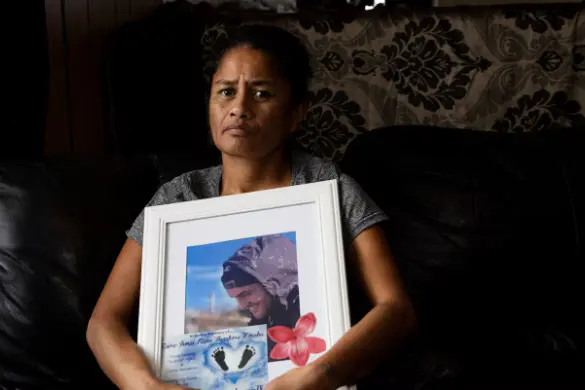
Now Price’s mother, Jillian Hana, is challenging the decision by police in July 2023 not to charge the police officers involved in her son’s shooting, whose names are suppressed but are referred to as Officer A and B.
The judicial review which is being heard in the High Court at Wellington where the public gallery in the small courtroom is filled with members of Price’s family and friends, including his mother, grandmother, aunty and friends.
In his opening remars Stevenson said it took police 15 months to decide not to prosecute, sending Hana a two-page letter, which summarised the decision in the letter’s last sentence.
“Based on an assessment of the events and the law relating to events and the law relating [to] self defence and defence of another (Section 48 of the Crimes Act), police have determined there is insufficient evidence to support a civil prosecution of the officers involved in the incident.”
“We struggle to understand how taking 15 months for a decision, with the facts being relatively straightforward, could be explicable or justified,” Stevenson said, describing the length of delay as “egregious and without reasons”.
The court also heard that, in reaching that decision not to prosecute, police had sought advice from three Crown solicitors, although that advice has never been publicly released, after it was deemed legally privileged.
But Stevenson said that left an obvious question.
“If police received advice not to prosecute, why would they go out searching for more opinions?”
Stevenson said the decision not to prosecute wasn’t an option for the police and breached prosecutorial guidelines.
In November 2024, the Independent Police Conduct Authority found the shooting to be unjustified and that excessive force was used.
It also found that Officer A’s contention that Price had a weapon when he was fatally shot was “implausible and improbable ”. It said the chances that Price was armed was “remote.”
Hana is seeking a declaration from the court that the decision not to prosecute was unlawful and wants the decision to be reconsidered.
She is also seeking damages under the NZ Bill of Rights Act (BORA).
NZ Police kill at 11 times the rate of the UK, 4 times the rate of Australia
Stevenson began his submissions with statistics about police shootings, telling the court that New Zealand Police kill at 11 times the rate of their UK counterparts and four times the rate of Australia.
Stevenson said most of the victims are Māori, adding that by any measure, these were “jarring statistics”.
Since 2000, the police in Taranaki have shot and killed five men, four of whom were Māori.
Stevenson told the court there was clearly a significant build-up and backdrop to Price’s killing, but said it was clear that by the time he left his VW car “he was running for his life”.
Price had side-swiped a police dog wagon, which prompted the officer to shoot at Price’s car.
Price’s car came to a stop, and he abandoned it on the road, sprinting up the road in search of a new vehicle.
At this point, it was abundantly clear Price was unarmed, Stevenson said.
Price then approached another car from the driver’s side and offered to give the occupants $500 to get away.
The court heard that they didn’t feel threatened by Price, instead describing Price as scared, wanting to get away, and looking “terrified”.
Price got into the driver’s seat, pushing the driver over towards his passenger. As Price grabbed the accelerator, the driver put his foot on the brake and pulled the handbrake, immobilising the vehicle.
At this point, Officer A arrived at the car and shot Price point-blank in the chest.
Under questioning from Justice Victoria Heine, Stevenson confirmed six shots were fired, with the final shot proving fatal.
Stevenson told the court that Officer A received “improperly favourable treatment” following the shooting, because he was a serving police officer, adding there was a lack of impartiality and independence about the way he was treated.
The officer wasn’t interviewed until almost two weeks after the incident, and during that interview he said the officer was treated as a suspect, not a witness.
During the interview, which wasn’t recorded on video, the officer was referred to as “mate” 14 times.
Officer A brought a handwritten account. Stevenson suggested someone accused of fatal force typically wasn’t allowed to bring handwritten notes to an interview.
Stevenson said during the interview the officer was never appropriately pressed or challenged on his account, which was contrary to the police code of conduct.
Finally, the interviewing officer was trained in interviewing techniques by the lawyer representing Officer A, which Stevenson submitted wasn’t appropriate.
Stevenson told the court a citizen has a right to life, and that right must be protected.
“We say that the investigation and the resulting decision not to prosecute in respect of the shooting of Mr Price was woefully inadequate and fell short of the right to life standard,” Stevenson said.
Breached NZ Bill of Rights
Hana’s second lawyer, barrister Max Harris, said the team also said the decision not to prosecute the officer breached BORA.
This was because it lacked independence and impartiality, wasn’t prompt, wasn’t effective and credible, and lacked transparency.
He also said the IPCA had failed to follow obvious lines of inquiry concerning the officer’s decision to use a firearm rather than a taser, which was available to him and other police who were there.
“Why was Officer A so confident about the prospect of the use of a firearm in the incident and not about the use of a taser?” Harris asked.
“We say a taser would have been a reasonable use of force and a point-blank shot to the chest was excessive,” Stevenson submitted.
The hearing before Justice Heine is set down for two days, with lawyers from the Attorney-General expected to present their case tomorrow.