
PHOTO
Warning: This story mentions suicide.
A teacher giving evidence at the trial of a woman accused of murdering her two children and leaving them in suitcases broke down in tears as she described to a court how they were adored at school.
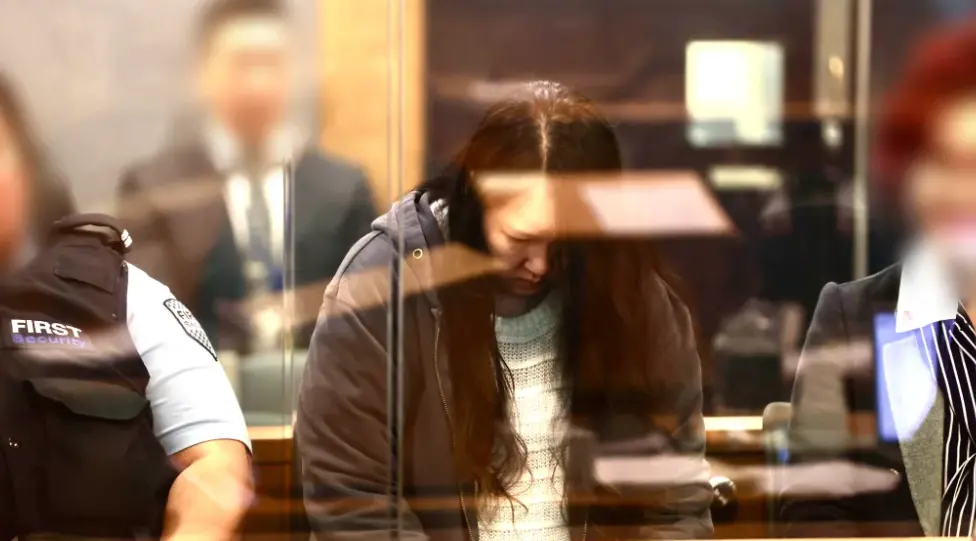
It is the first week of the trial of Hakyung Lee, born as Ji Eun Lee, at the High Court in Auckland before Justice Geoffrey Venning.
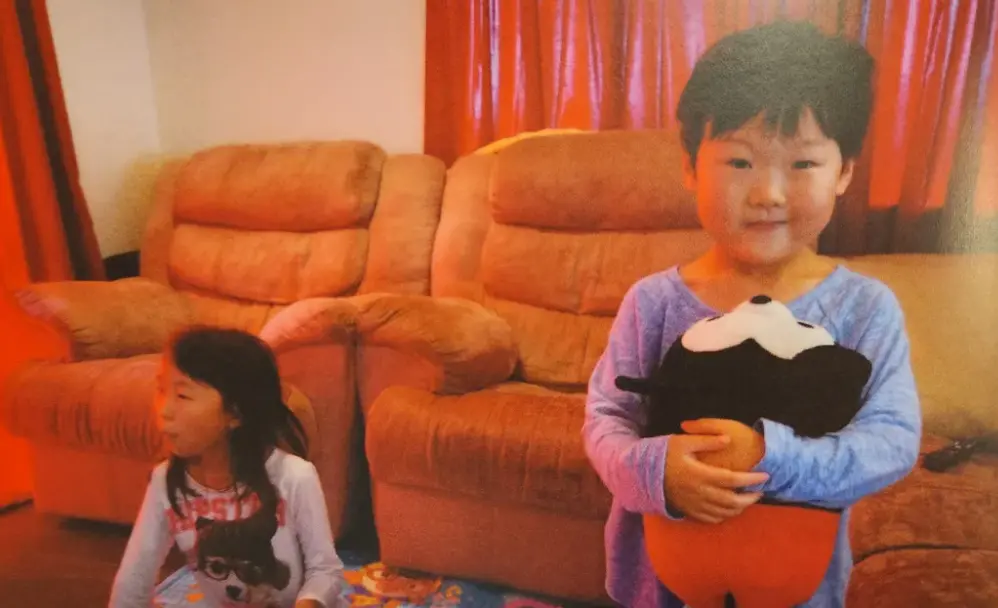
The bodies of Minu Jo and Yuna Jo, aged 6 and 8 at the time of their deaths in 2018, were discovered in suitcases almost four years after they were killed, when a family bought the contents of an abandoned storage locker in an Auckland auction.
Lee, who is representing herself in the trial assisted by two standby counsel, admits causing her children's deaths and putting their remains in suitcases in storage, but argues she is not guilty by reason of insanity at the time of the killings, following a "descent into madness" after the death of her husband Ian Jo in late 2017.
The Crown, however, argues Lee's actions following the deaths of her children including hiring a storage unit, moving the bodies, changing her name and fleeing to Korea, showed these were the actions of someone who knew what they were doing, and who knew it was wrong.
The trial was expected to last four weeks.
Yesterday the court heard from Mary Robertson, who worked at the Papatoetoe South School for over 40 years.
She said she first met Yuna Jo when she was five, and said she had "a smile that lit up the world". The girl was "beautifully behaved" and that Minu was a "joyful bubbling boy".
Several members of the jury wiped away tears during the teacher's emotional testimony.
Robertson said Lee and her husband Ian Jo were "caring parents" who were involved and interested in their children's education.
Minu had a speech impediment and a cleft pallet, and Lee was worried that he would be targeted at school because of it, Robertson recalled.
She said Minu managed really well at school, but later became withdrawn after his dad got sick.
Robertson said the last time she saw Lee was when the accused came to inform her of her husband's death in late November 2017.
She said Lee said she had not told the children about their dad's death, and that she had planned to take them on holiday to the Gold Coast to let them have some fun memories before breaking the news to them.
Robertson said she had offered the school's help, but Lee said she was okay.
She said Lee told her she had plans to return to Korea after the trip to Australia and that they would all be supported there by family.
Lee said that day would be the kids' last at school, and that they would not be attending for the rest of the school year, Robertson recalled. She said Lee told her she was yet to make up her mind on whether they would come back to New Zealand at all.
The accused was tearful and upset, but Robertson said she was amazed at how she was coping.
Lee didn't 'want children to know their father was dying'
Lee's brother-in-law and the children's uncle, Jimmy Sae Wook Cho, gave evidence in the afternoon.
He said his brother went over to South Korea for cancer treatment but came back after it was unsuccessful.
Cho said she never took the children to visit their father in hospital, but had to be convinced to let the children see him in hospice before he died.
"She didn't want the children to know that their father was dying," he said.
Cho had heard that the children weren't going to school, so he and his wife went to check on them and Lee.
Cho said Lee had told them she was having a hard time, and he urged her to get help, but was dismissed.
"She was a bit depressed, but that's what normal people [would be feeling], so I wouldn't suspect something else."
They told Lee that if she needed help she could call them, Cho said.
Shortly after, he lost touch with her.
Cho said he was close with his brother and spent a lot of time with him in his final weeks.
He was asked by standby counsel Chris Wilkinson-Smith how often he would see Lee in the roughly 11 years she was married to his brother.
"Probably two or three times a year," he said.
He described how Lee could be up and down emotionally.
Friend's chance encounter in South Korea
A friend of Lee's, Gina Min, told the court about running into her in South Korea in January 2018.
"Bumping into someone that I know from New Zealand ... that was like 'what are the chances'," she said.
"At that point I hadn't heard from her for weeks, so that was quite shocking moment to see her there."
She said she asked why Lee had closed down her social media accounts and disappeared.
"She vanished, she closed all her accounts ... she called me to inform me that her husband was ill at the hospital, but she didn't let me come visit him, or she didn't let me come to the funeral," she said.
Min said the children were with Lee, but stayed quiet and wouldn't look her in the eye.
She recalled a brunch with Lee and another friend where they spoke hypothetically about who they would save in an emergency, their children or their husbands.
Both she and the friend said their children, but Lee answered differently.
"Her answer was that she thinks her husband was more important than kids," Min said.
Presence of antidepressant
The court heard that the children's deaths were associated with the antidepressant drug nortriptyline, prescribed to Lee when she told a GP she had problems sleeping in 2017.
The court earlier heard from a pathologist that there was no evidence of blunt force trauma on the children, but he also could not be certain whether the children had died from nortriptyline alone, or were killed by other means after being incapacitated by the drug.
A forensic toxicologist told the High Court that it was almost impossible to know the actual levels of the drug in the children's bodies at the time of their deaths due to the passing of time.
Helen Poulsen, who works for the Institute for Public Health and Forensic Science (previously known as ESR), told the court nortriptyline was the only drug found in the bodies of Minu and Yuna in toxicology tests of their chest cavity fluids and liver samples.
Poulsen said the drug can be prescribed as an antidepressant, but can also be used to help people sleep due to its sedative properties.
Having received the samples in August 2022, nearly four years after the children's deaths, Poulsen said the levels of nortriptyline detected in both children were relatively low, but not reflective of the actual levels of the drug in them at the time.
"We don't know how nortriptyline has moved around the body as its decomposed, it's basically impossible to say how this level would relate to what was present in the body at the time of death," she said.
Poulsen said children cannot be prescribed the drug.
She added that nortriptyline had a narrow therapeutic margin, meaning there was a small margin between what was a therapeutic dose and what would be a dose that could cause toxic effects.
Accused never mentioned any issues with mental health: GP
The former family doctor of a practice, where Lee's entire family was enrolled, has also given evidence.
He said he was not aware of Lee having any issues in relation to suicidal thoughts or depression, prior to being informed by a letter from Counties Manukau health in November 2017 that Lee intended to kill herself and her children after her husband's death.
Dr Rama Velalagan, from the Papatoetoe Medical Centre, said he last saw Lee on August 1 in 2017, when she came with complaints of dizziness and issues with sleeping.
Under questioning by one of the lawyers assisting Lee, Chris Wilkinson-Smith, Dr Velalagan said the accused never opened up to him about her being under pressure.
He said during the August consult, Lee said her husband was doing well and that was not the reason for her period of difficulty with sleeping.
He prescribed her with 60 Nortriptyline tablets to help with her sleep and iron tablets for her dizziness.
Dr Velalagan said the letter from Counties Manukau health's acute assessment team on November 26 in 2017 was the first time her suicidal intention was brought to his attention.
Jurors taken through husband's time at hospice
Jurors were taken through evidence from nurses present during Lee's husband's time at Tōtara Hospice.
While at hospice in 2017, Ian Jo took his wife's car and left the hospice. Staff were worried he would take his own life.
Nurse Lin Ni said she was working an afternoon shift and read to the jury the notes she made that day.
"[Hakyung Lee] was in lots of tears while trying to contact Ian by texting and phoning," Ni said.
"She said she texted Ian 'if you die, I will die with our two kids' which had Ian contact her back. She looked very tired and distressed."
Ian Jo was found and transferred to Middlemore Hospital before returning to the hospice.
Another nurse, Kayleen Palatchie, said Jo appeared more sick in the days after. She said Lee was aware her husband was approaching death, saying she was fearful about being alone with him when he died.
A mental health nurse who assessed Lee after her husband drove off from the hospice said Lee told her the text message of suicidal intent she had sent to her husband was an irrational reaction to his disappearance, and that she no longer had suicidal thoughts.
Natalie Woodward, who worked for the crisis team at the hospital, said she had discussed with Lee about her threats to harm herself and her children.
She said the accused told her she had felt great fear and pain when her husband disappeared and that had prompted her "irrational" text message.
Woodward said Lee told her that her children were not her possessions and she could not take their lives.
She said Lee also claimed to be no longer suicidal.
Woodward told the court she noticed Lee was distressed at the time, felt she had to take care of everything and could not ask for help.
Where to get help
Need to Talk? Free call or text 1737 any time to speak to a trained counsellor, for any reason
Lifeline: 0800 543 354 or text HELP to 4357
Suicide Crisis Helpline: 0508 828 865 / 0508 TAUTOKO. This is a service for people who may be thinking about suicide, or those who are concerned about family or friends
Depression Helpline: 0800 111 757 or text 4202
Samaritans: 0800 726 666
Youthline: 0800 376 633 or text 234 or email talk@youthline.co.nz
What's Up: 0800 WHATSUP / 0800 9428 787. This is free counselling for 5 to 19-year-olds
Asian Family Services: 0800 862 342 or text 832. Languages spoken: Mandarin, Cantonese, Korean, Vietnamese, Thai, Japanese, Hindi, and English.
Rural Support Trust Helpline: 0800 787 254
Healthline: 0800 611 116
Rainbow Youth: (09) 376 4155
OUTLine: 0800 688 5463
Aoake te Rā bereaved by suicide service: or call 0800 000 053
If it is an emergency and you feel like you or someone else is at risk, call 111.
