
PHOTO
Analysis of more than three million maths and reading tests shows sharp improvement in primary school children's maths and vocabulary skills but their understanding of what they read is in a serious dip.
The New Zealand Council for Educational Research study of results from 15 years of its widely-used Progressive Achievement Tests (PATs) shows children in Years 4-8 are now better at reading words than any point in that period.
Meanwhile, children's maths improved markedly in the past two years and their reading comprehension improved this year.
Education Minister Erica Stanford told RNZ the figures were proof the government's reforms were working.
However, the report by researcher David Coblentz said the improvements in maths and reading vocabulary began before the government's changes started.
The study found average maths scores began to drop in 2019, reaching a low in 2022 before starting to improve.
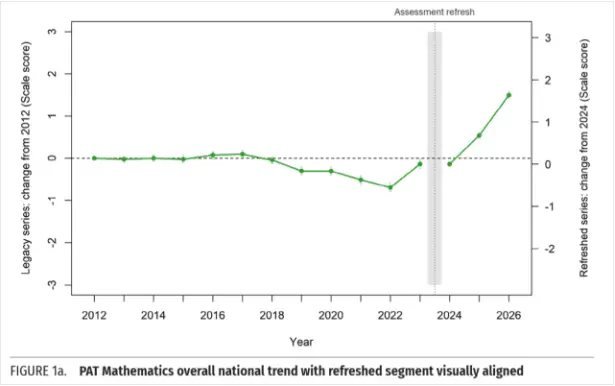
The tests changed in 2024 so could not be directly compared to earlier years but results continued to improve to the point where in term 1 this year they were a third-of-a-year's learning better than at the start of 2024.
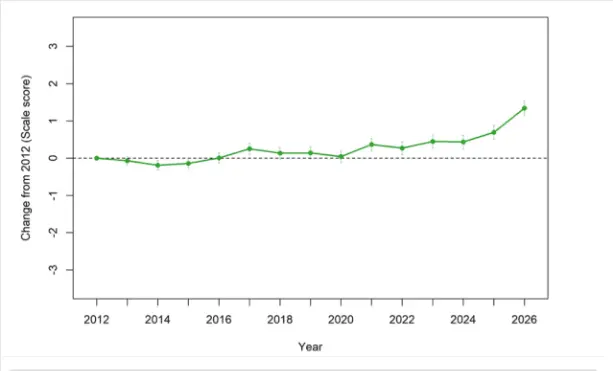
Reading vocabulary scores hovered around a baseline set in 2012 before starting to increase in 2021.
That improvement accelerated in the past year reaching a high at the start of this year equivalent to one-fifth of a year's learning better than the baseline set in 2012.
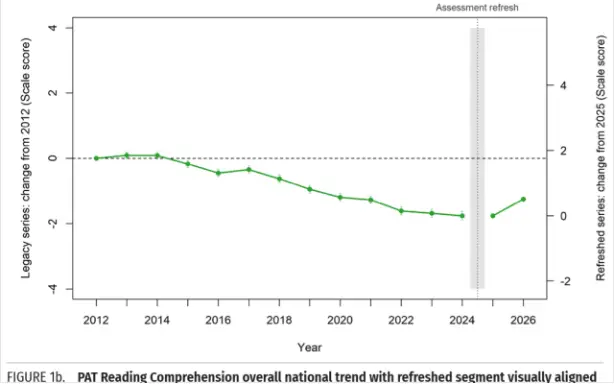
Reading comprehension scores began dropping in 2015, reaching a low point in 2024 that was about a quarter of a year's learning below the 2012 baseline.
The comprehension tests were changed in 2025 and this year's result was better than last year's.
The report said the figures covered more than half the children who had attended primary schools since 2012 and did not show achievement moving uniformly towards decline or recovery.
"Reading Comprehension declined substantially... and remains a concern despite the positive first refreshed movement. Mathematics has rebounded broadly, but that improvement has not yet proved durable. Reading Vocabulary has risen, though not equally for all learners," it said.
"The next few years will show whether the most recent gains foreshadow lasting increases in assessment scores."
The report said the results did not show why students' scores had changed, but it advanced some possible influences.
They included an increase in online testing affecting reading comprehension scores, Covid affecting maths and reading comprehension, and improved attendance helping maths scores.
"A broad change in engagement, attendance, access to learning, assessment behaviour, digital activity, or experiences in and outside school could have affected all three assessments while interacting with subject-specific teaching and learning in different ways," the report said.
David Coblentz told RNZ his personal view was that digital devices might be behind the changes in reading scores.
"There's a spike in reading vocabulary gains right around the time kids get cell phones. So, part of the story could be a technology story," he said.
"It could be that in recent years, the way kids consume media has not been great for their ability to derive information from longer texts. But nonetheless, it's been just fine or even a little better at some ages for the acquisition, the overall acquisition of vocabulary."
Coblentz said the maths improvements were driven more by better scores among Year 4 students rather than by improvements in older students' scores.
"Kids that are just coming into the testing window now are kids that have gone through their early years of school in an environment in which attendance has been more regular and in an environment that has been not disrupted Covid, which has not been the case for other cohorts of kids in recent years," he said.
"It's also possible, and I'm speculating here, that the hour a day of mathematics in particular might have disproportionately affected kids who were very young."
Coblentz said the study revealed unexpected changes in gender differences.
"In mathematics, the long story since as long as we've been testing is that male students tend to do a little bit better in mathematics in primary school. That's become more true, the recent improvements have helped everybody but they've disproportionately helped boys a bit more than girls," he said.
"In reading comprehension, the story has been one of decline, but girls have declined more than boys. Girls started ahead of boys and are still ahead of boys. Those two lines have gotten closer due to greater attrition over time among girls.
"And in reading vocabulary, the recent gains have primarily been gains among boys, whereas the girls' scores have basically been static."
Minister claims gains
Education Minister Erica Stanford told RNZ the government's reforms and teachers' implementation of those reforms were behind the improvements.
"The uptick you see just prior to our government was just children coming back to school ... You can see how it just pops back up to where we were pre-Covid," she said.
"The acceleration off the baseline has been the thing that our government has done."
She said that was down to the work of teachers.
"Teachers should feel incredibly proud and principals that this is because of them. They are the ones who picked up the curriculum, they implemented it in their classrooms, they did the PLD, they used the resources and these are the outcomes," she said.
"I can make all of the policy decisions I like and resource everything I like, but unless teachers and principals are implementing with fidelity on the ground, nothing will change."
Stanford said the improved reading comprehension scores this year were a direct result of structured literacy and the mandated approach to teaching children to read and write.
"Children can now lift words off the page. It is very hard to comprehend a word you cannot read," she said.
"Structured literacy is ensuring that children can decode words with confidence and lift the word off the page before they can start to comprehend it."
Asked if schools could sustain the improvements at the same time as introducing new curriculums, Stanford said the government would continue to support better teaching of maths and reading.
"It is a long-term implementation and we will continue to put in resource into literacy and numeracy," she said.
"This is years and years and years of supports and resources to the front line to make sure that we are locking in these gains."
The Education Ministry said the results reflected work happening across the education system to lift achievement.
"The report highlights a range of possible factors, including improved attendance, schools' ongoing efforts to support learning following Covid-19 disruption, and targeted support for students who need extra help," it said.
Teacher union the Educational Institute Te Riu Roa said it was too soon to claim improvements.
"True progress requires longitudinal data tracking the same cohort over time," it said.
"We will celebrate when we see sustained, long-term improvements in reading comprehension and writing across all ages."
The institute said the results showed persistent gaps between ethnic groups and the government should not have cut programmes such as the Pasifika Early Literacy Project and literacy resource teachers.
