

PHOTO
Is this really the best we can do?
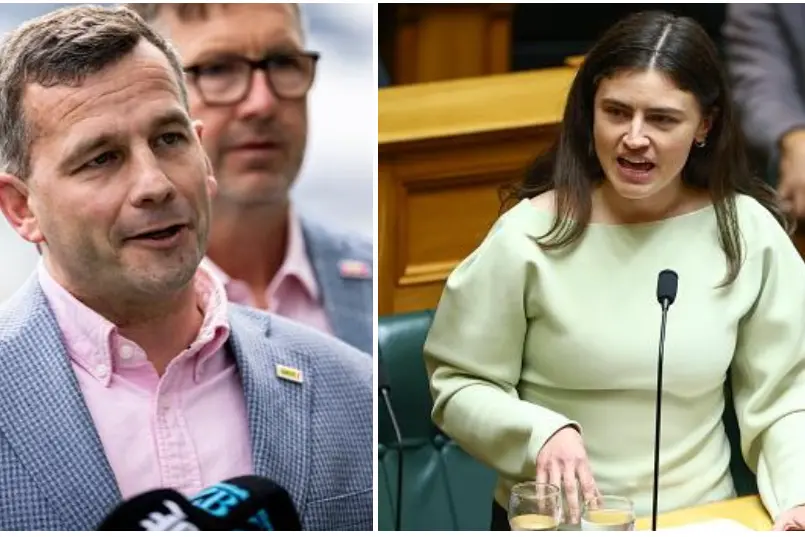
David Seymour asked New Zealanders this week to imagine Chlöe Swarbrick as Minister of Finance.
It's quite an image.
“Imagine Chlöe Swarbrick flying to New York as Finance Minister and trying to convince the bond markets that New Zealand is a sensible place to lend money,” he said.
He predicted our borrowing costs would be “whacked up” after about five minutes of her explaining Green Party policies.
Something similar had occurred to me when Swarbrick first put her hand up for the job.
How is it that people can enter politics with relatively little experience of the world outside it and, before too long, see themselves as ready to take on some of the most important jobs in the country?
Minister of Finance is one of them.
But the irony of Seymour making that criticism was not lost on me.
At the 2023 election, less than 10 percent of voters gave their party vote to ACT.
That didn't stop Seymour arguing during the coalition negotiations that he should be Deputy Prime Minister, arguably the second most powerful job in the country. Whatever doubts New Zealanders may have had about his suitability for that role, Seymour clearly wasn't troubled by them himself.
But the more I thought about this exchange, the less interested I became in which of them was right because it highlighted something much bigger.
Today’s politicians have become very good at finding people to blame for where we are.
Swarbrick's latest tax policy promises to tackle what she calls “corporate greed”. Only a few days earlier Seymour responded to a group of doctors wanting to discuss climate policy by describing them as “activists with a grab bag of causes” who were prepared to trade on their professional esteem to promote them.
Different targets, but the same instinct. Find someone to blame.
Yes, there are important arguments to be had about tax, government spending, regulation, wages and how wealth is shared. But I hear far less about how we are going to create more of it. And surely that is the bigger challenge.
There was a time when this small country at the bottom of the world was one of the wealthiest countries on earth.
How did we do that? And, more importantly, what would it take to do it again?
We have become extraordinarily good at arguing about how to divide the cake. I want to hear how we're going to make that cake bigger.
Because we've done that before.
In February 1882 a sailing ship called the Dunedin left Port Chalmers carrying nearly 5,000 frozen sheep and lamb carcasses bound for London.
The important part of that story wasn't the sheep. We already had plenty of those. It was the technology that allowed us to sell them on the other side of the world.
The Dunedin had been fitted with refrigeration machinery. It wasn't without its problems, but it worked, and it helped change New Zealand.
We took something we were already good at producing and combined it with new technology to overcome the thing that had always counted against us. Our distance from the rest of the world.
Refrigeration opened international markets for New Zealand meat and helped transform our agricultural economy. Now, I am not suggesting we need another refrigerated ship, but I am suggesting we need to start asking the same sort of questions.
What are we good at? Where can technology make us better? What can we create here that people around the world will pay us for?
The answers might be in agriculture, biotechnology, artificial intelligence, renewable energy, space, digital technology or somewhere we haven't even thought to look yet. But finding those answers seems to me a much more important economic conversation than simply arguing about how we divide what we already have.
And that doesn't mean ignoring how wealth is shared.
We need successful businesses making profits, creating jobs, investing and paying tax. But the people working in those businesses also need to be able to live on what they earn.
That is why I struggle with ACT's proposal to freeze the minimum wage for three years. Freezing the minimum wage doesn't freeze the rent, the grocery bill or the cost of getting to work.
Equally, describing successful businesses as “corporate greed” doesn't help us work out how to create more of them.
There has to be room for a much more ambitious conversation than that. One where we create more wealth, make sure the people who help create it share in it, expect those who succeed to pay their fair share of tax, and expect governments to spend that money wisely.
None of those things seems incompatible to me. What seems to be missing is the vision that joins them together.
And that isn't directed at ACT or the Greens. It is a question for every party asking us for our vote.
We hear a lot about the need to increase productivity and grow the economy. I don't think there is much disagreement about either of those things.
What I want to hear is how.
Because I have seen some of the answers in innovative companies throughout Aotearoa New Zealand. People taking ideas, science and technology and turning them into products and services the world will pay for. People finding smarter ways to do things we already do well and creating businesses, jobs and opportunities in places where they didn't exist before.
They need to be part of this conversation.
Not simply as businesses to be taxed or regulated, subsidised or criticised, but as part of a much bigger conversation about growth, success and reward. But it also has to be about how the benefits of that success are shared.
That is what the story of the Dunedin represents to me. It wasn't simply a technological breakthrough. It was an example of what can happen when we take something New Zealand is good at, add innovation and find a way to take it to the world.
Surely there are modern versions of that story being written all over this country.
So as another election approaches, I want to hear much more than what is wrong with New Zealand and who is responsible for it.
I want to hear how we grow, how the ideas already being developed here become the foundations of our future prosperity, and a vision for Aotearoa New Zealand that gives those people permission to succeed.
And perhaps that is the message our political leaders are missing.
Out here, we are tired of listening to politicians explain why someone else is responsible for the problems we face. What we are waiting to hear is what they are actually going to do about them,
and where they believe that could take us.
I keep hearing people say that this is one of the hardest elections they can remember when it comes to deciding where to place their vote.
Perhaps that shouldn't be surprising.
Because out here, people aren't looking for someone to vote against.
They are looking for something to vote for.
As am I.
- Dunedin businessman Sir Ian Taylor is the founder and managing director of Animation Research.