
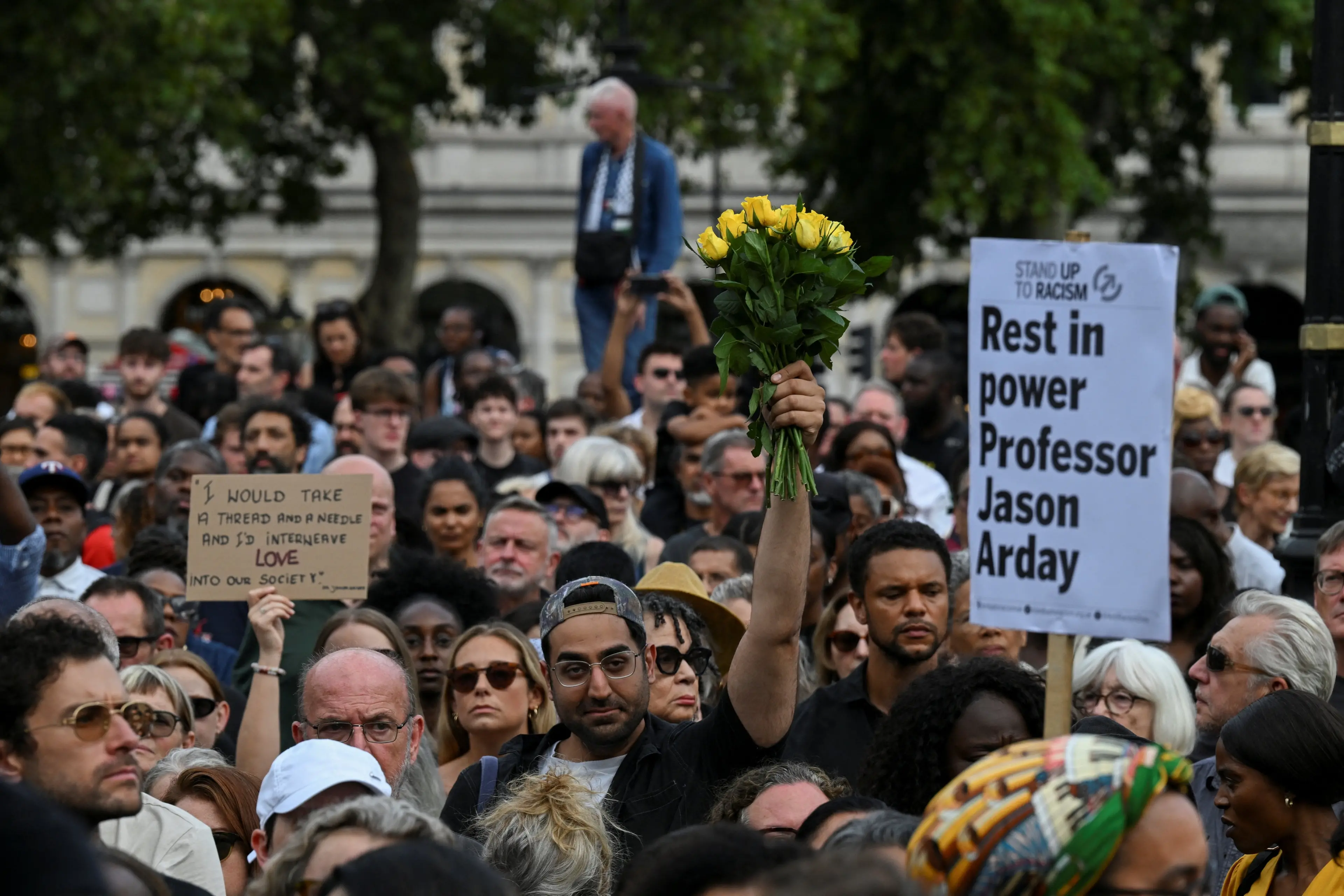
PHOTO
The tragedy of Jason Arday has been impossible to miss in Britain, but news of this very troubling affair has spread around the world.
What started out in 2023 as a triumph for a young black academic, with his appointment to a Professorship in Cambridge University, unravelled as the circumstances surrounding the appointment became increasingly tortuous, contentious and tragic.
At first it was a glowing success story. A young black person from an underprivileged background beset with serious developmental delays had been able to haul himself up.
Having gained a PhD, he had a fast rise up the academic ladder to be crowned by appointment as a professor in the sociology of education in one of the most prestigious universities in the country.
To make matters even more amazing he was a wizard in physical education running 600 miles over six days, and by doing so attracting large sums of money for charities.
The details have been recounted almost endlessly across the British media, earning praise from some quarters and derision from others. Hailed as a poster boy for DEI (diversity, equity and inclusion) but equally as a fraud and plagiarist, it finally became too much for him and he committed suicide earlier in August at the age of 41.
A number of features of this extraordinary series of events stand out and warrant our attention. These are the alleged extensive plagiarism in his PhD (undertaken at another English university), the glowing manner in which he was feted on his appointment in Cambridge, the politically motivated and contrasting reactions to his achievements, and his own promotion of his adversities and achievements.
No one is left untouched by this man and the unravelling circus of extreme claims and counter claims surrounding him – even on the other side of the world.
The cultural settings in the United Kingdom and New Zealand are very different but they are not totally
insulated from one another. There are lessons here for us all.
No university associated with Arday (Liverpool John Moores, Roehampton, Durham and Glasgow) has come out of this episode unscathed.
Undoubtedly this applies most forcefully to Cambridge and its Education Department. Most outsiders expect the highest of academic standards in Cambridge and its Colleges.
As more details about Arday and the quality of his work emerged, it seemed that Cambridge had questions to answer about the appointment. It took some time for the authorities there to begin to undertake an investigation about how the appointment had been made, especially in view of the claims of plagiarism.
Care always needs to be taken when ``academic stars’’ are appointed on the basis of their star quality. The Arday case is not an isolated example.
Others have been in the sciences, including a rising star in physics and the president of a prestigious American university
in neuroscience; in both cases there was fabrication of data and image manipulation. Even a behavioural economist, with expertise on human dishonesty was forced to retract papers for his own dishonesty.
All were highly esteemed before their fall from grace.
A fundamental appointment criterion for universities should always be academic excellence in research and/or teaching.
Whatever financial and other considerations have to be taken into account, academic values and principles should be firmly embedded in institutional decision-making.
Academic priorities should never be sidelined, no matter what other pressures exist. If core academic standards are sidelined, universities are brought into disrepute, as is currently happening in the UK in wake of the confused mess created by the Jason Arday tragedy.
Academics vary immensely in the degree to which they advertise their achievements. This is to be expected and makes for interesting communities.
The Arday affair, though, is a warning that excessive promotion and adulation can be a danger.
Being the youngest black professor in Cambridge’s history, having several honorary doctorates bestowed upon him, being appointed to a range of trustee or advisory roles, and being in the spotlight on TV, come with their own demands.
This is especially true when moving in a controversial area. The result is criticism as well as adulation.
For some this will eventually prove unbearable, as it was for Jason Arday.
The Arday affair reminds us that the line between universities and the general/ political public, is a fine one. The picture of academics living in ivory towers is a well-known myth. Admittedly there may be a few like this, but these are the exceptions.
Most have numerous interactions with the society in which they live, regardless of their academic discipline. What does vary is the discipline and how it is viewed by the public – from extremely valuable, such as many of the health sciences, to of questionable merit as with some of the humanities.
The challenge facing university authorities is to demonstrate that this simplistic contrast is false. It is also to ensure that falsehoods and misrepresentations are not rewarded.
And this is where the Jason Arday episode is troubling, and needs to be taken seriously.
- Gareth Jones is an emeritus professor in the Anatomy Department in the University of Otago.