
PHOTO
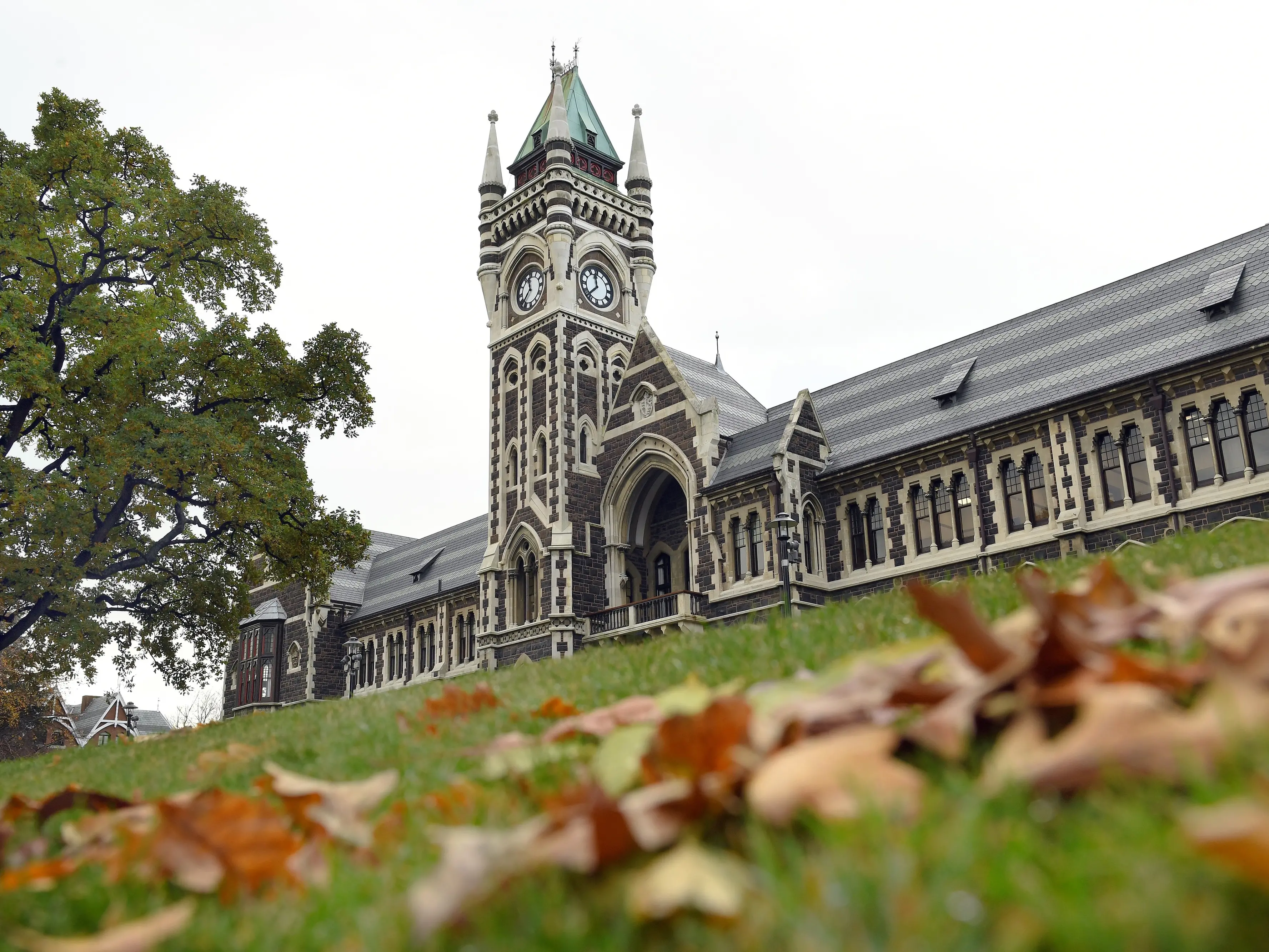
Culturally, socially and economically, Dunedin and Otago University have been inseparable since 1869. This year town and gown are enjoying the imaginative celebrations for 150 years of life together.
The university clock tower is an icon for civic tourism and pride. The campus has never looked so attractive, and has won accolades on the international scene.
And quite apart from our respect for its cutting-edge research and innovative teaching, the university contributes more than a billion dollars to Dunedin's economy each year. When students are around, the place really comes alive. Otago University - we love you!
But here's the thing: Although everything looks healthy on the outside, it feels very unhealthy on the inside.
Right now, the university is very sick. And unless radical action is taken, that sickness threatens to become chronic. This will be to the detriment of the university and the community.
The furore about marine sciences, facing "management of change'' (the fashionable euphemism for downsizing and redundancies) and the rumours that maths and statistics will be subject to the same fate are the latest symptoms of a widespread pathology.
Ask any senior academic in science, medicine, the humanities and the chances are that they will tell you that morale is at an all-time low. Many feel alienated, angry and sick at heart. The current atmosphere is often described by insiders as toxic. Leading professors, lecturers and support staff right across the disciplines feel betrayed by the institution that they work for and to which (in many cases) they have dedicated their careers. It is all desperately sad and unnecessary.
Recognising that all is not well, the university has commissioned a firm, April Strategy. It has launched a "Shaping our Cultures'' project, "He Waka Kotuia'', to improve relationships, and ensure that academic and support staff have "a better day at work''.
It is one thing, however, to talk of promoting a culture of inclusiveness and acceptance as "Shaping our Cultures'' does and quite another to actually make it happen. Many academic and support staff have declined to be part of the process because the actual actions of management have forfeited their trust.
The frequent promises of consultation are not believed or are viewed as mere window-dressing. Those who have participated in consultations often feel that their opinions and concerns have been ignored and come away feeling not empowered but disempowered.
When the vice-chancellor tells us that the "shift phase'' of restructuring has been completed and we now need to move into the "lift phase'' (to fix processes that were broken in the shift phase) there is a collective groan from the faculty.
When we learn, further, that the "Enabling Excellence Project team'' is expected to complete its work by 2021 (!), those of us at the coal face have no confidence that the decisions of the past three years were worth the pain. When the vice-chancellor asks "all staff [to] choose to "put their paddles in the water'' and participate in this project [enabling excellence] to create a "positive community for all'', desperation sets in.
Faculty and staff feel completely dispirited by these sorts of statements. The confusion, inefficiencies and chaos that we are grappling with are a result of the decisions made by those who are now urging us to jump into the Otago Waka and paddle in a direction that few of us feel comfortable with.
Pep talks and consultants paid to boost faculty morale are largely beside the point.
At the core of the disenchantment of academic and support staff has been the ways in which the restructuring of support staff and the "management of change'' has been conducted.
Departments have been reorganised into new ill-assorted schools. Decision-making power has floated from the head of department to the heads of schools, who have the same power as a former HOD. The heads of divisions and the vice-chancellor have more power than ever before but have lost the trust and confidence of the faculty underneath them. Positions have been lost, and others downgraded.
The assurance that all would be well once the reforms settled down has proved chimerical. The assumption that support staff could be shifted around at will from one area to another has led to the personal disillusionment of some of the university's best servants and to gross systemic inefficiency. We can no longer go to someone in the department to order something, get something done - multiple layers lead to delays and tasks dropping out.
Institutional memory has been one of the many casualties of an insensitive process.
The drive towards centralisation, moreover, has led to decision-making which so far has not served the interests of academics, support staff or students. Power has been transferred from a more democratic departmental base to an anonymous centre.
Teachers and researchers who love their subject and are committed to their students are no longer confident that their input is being taken with any seriousness. They are no longer prepared to go the extra mile. Some are now just hanging on till retirement.
Support staff have little sense of being valued for themselves.
For students, too, the human dimension is in danger of being lost in the push for efficiency.
It is nauseating to be told that the low morale, workplace stresses and strains, burnout and early retirements are a consequence of faculty not pulling their weight and not being sensitive to each other's needs.
April Strategy asks faculty to explain what makes for a good or a bad day, and to focus on our immediate work environments rather than the culture of the university as a whole. The culture of the whole is set by the university leadership, faculty and staff agreeing on fundamental values, and designing decision-making processes that treat faculty with respect and as adults rather than infants.
This has not occurred.
Any major institution has to be open to innovation and reorganisation. That is not in dispute. At the heart of the pathology, however, is a managerial inflexibility, and an unwillingness to take positive criticism seriously. There is considerable anecdotal evidence of dialogue being shut down, of fists being thumped on tables and of critics being marginalised. There is a worrying perception that from the top down, management is impatient of the dissenting voice. Grave decisions with long-term consequences for departments, but also for the wider community, are made on the basis of statistics about which courses 18-year-olds decide to enrol in. Marine science is a case in point.
This is no way to run a university. The case of Otago is, of course, by no means alone. Across the world market-driven ideologies and the commercialisation of the academy are hampering creativity and undermining collegiality.
Nor is the picture in Otago universally negative. Far from it. But the much-vaunted motto of the place - "Sapere aude'' - needs to be taken seriously. Universities are human institutions. They work best in an atmosphere of mutual respect, where ideology is at a discount, and attentive listening is the norm. At present this is not the case.
Our much-loved university is sick, and the prognosis is not good unless those at the helm cut out the fine words and address the real problems.
If management feels that these comments are idiosyncratic or a minority perspective,
they should put them to the test. These are testable propositions and the way to test them is via anonymised surveys of staff opinion.
Let them administer such surveys to the relevant staff (with questions phrased so as to elicit people's real opinions, not engineered so as to produce a positive result). Then let them publicise the results.
If we are wrong and we only represent a minority view, then that's still a significant problem.
But if we are right, then something really radical needs to be done.
Prof Kevin Clements is chairman and foundation director of the National Centre for Peace and Conflict Studies at the University of Otago. The Rev Dr Peter Matheson is a historian and theologian and an honorary fellow in the University of Otago's department of theology and religious studies.