
![OBIT. Wendy Harrex with her grandchildren, Daisy and Raffy Dickson. [Photo Isabella Harrex]](https://images.odt.co.nz/view/acePublic/alias/contentid/1ubfzuzt22at1gmb7k0/0/copy-of-de149c10-6e0e-4861-91e6-7b9-jpg.webp?f=3%3A2&q=0.75&w=3840)
PHOTO
Publisher, businesswoman, environmentalist, feminist, mother, and grandmother, Wendy Alison Harrex (1946-2026) was a prominent figure in the New Zealand publishing industry.
Publishing books can become an addiction, Wendy once said. Over her long career in the UK, Auckland and Dunedin, she published books of all kinds — stories for children, history, natural history, culture, art books, poetry, even a cookbook featuring the food of a multi-ethnic group in Dunedin.
She told stories through her art, the gardens she created, and never tired of reading to her beloved grandchildren, Daisy and Raffy.
Her publishing career started in 1971 when she joined Oxford University Press in Oxford where her then-husband Rod Edmond was studying.
Like most of her generation growing up and educated in the 1950s and 60s, she saw New Zealand as a small insignificant place out of the mainstream. That was overturned on a visit back to New Zealand three years later.
‘‘The country itself was exciting, energised by the changes that followed the election of a Labour Government under Norman Kirk. The soldiers had come home from Vietnam. We had sent a ship in defiance of the French nuclear tests at Mururoa. There was talk of a Māori Land March to take place next summer.
``Ohus [government-supported communes] were being established. People were more relaxed. They were making music, wearing casual clothes, growing their hair long, writing poetry. And they were writing and publishing books about everything and anything,’’ she wrote.
Back in Oxford, New Zealand found its way into a series of anthologies of creative writing she was working on for middle schools. Then a distinguished American educationalist wanted to talk to her because he had read all Sylvia Ashton-Warner’s books.
‘‘When he heard that I was from Wanganui and knew the river community where she had worked, he was delighted. I was flabbergasted. Here I was in Oxford, and Wanganui was the centre of the world! The notion I had grown up with, confirmed by the orientation of my university history course, that Britain was the centre of everything, had been turned upside down’’
In 1976 she returned permanently, charged with finding books for a branch of OUP to publish here. With a characteristic emphasis on the visual, she spent several months researching photographs around the country for Looking Back in New Zealand, one of the first photographic histories of the country, with text by Keith Sinclair.
She wanted images that had not been published before, and things that were rarely photographed.
Another notable publication, this time for children, was He Pukapuka Kupuāhua Maori/ The Oxford Maori Picture Dictionary, working with Katerina Mataira and Rangimarie Pere of Waikato University.
In 1982 Wendy started her own company, New Women’s Press, to publish books by, for and about women. At the time there was little women’s publishing by mainstream publishers and she was determined to fill that gap. Sue Lytollis’ Self Defence for Women became a best seller with an international reputation.
Over 11 years she published more than 70 titles with no bank loan, meaning she and her daughter Isabella lived on a minimum income requiring fortitude and sacrifice to make her vision for women’s books a reality.
Bella later realised Wendy had saved all her father, Hartley Pattinson’s maintenance payments, giving her a nest egg for her tertiary education.
It was a measure of Wendy’s success that the major publishers also started producing books by women and attracting her authors. This, and a desire to bring up Bella in a safer environment, prompted her move to Dunedin in 1993.
She was ready for a new challenge. The University of Otago Press was then a part-time operation and she was tasked with turning it into a significant publisher in the Asia-Pacific region, which she did by building critical mass and growing overseas sales.
She published academic and general books, history, culture, biography and memoir, literature — including the venerable Landfall magazine — poetry, natural history and ecotourism.
A particular focus was on Maori and Pacific subjects reflecting a growing sense of national identity and race relations.
Significant publications included Linda Tuhiwai Smith’s internationally influential Decolonising Methodologies; John Pule and Nicholas Thomas’s Hiapo: Past and present in Niuean bark cloth; and The Politics of Indigeneity by New Zealander Roger Maaka and Canadian Augie Fleras, which gave both Maori and Canadian Indian perspectives and is a text book in Canada.
Besides an international focus, the press also developed a regional emphasis, especially in natural history, history and heritage. The magisterial, multi-authored, The Natural History of Southern New Zealand (2004), was a highlight, but also Neville Peat and Brian Patrick’s series Wild Dunedin, Wild Fiordland, Wild Central and Wild Rivers, three of which were shortlisted in the Montana Book Awards, and local ecotourism guides to the Catlins, Wanaka, Oamaru, and Queenstown.
‘‘Until we started doing Wild Dunedin, there hadn’t been much regional natural history published in New Zealand for the general market,’’ she said.
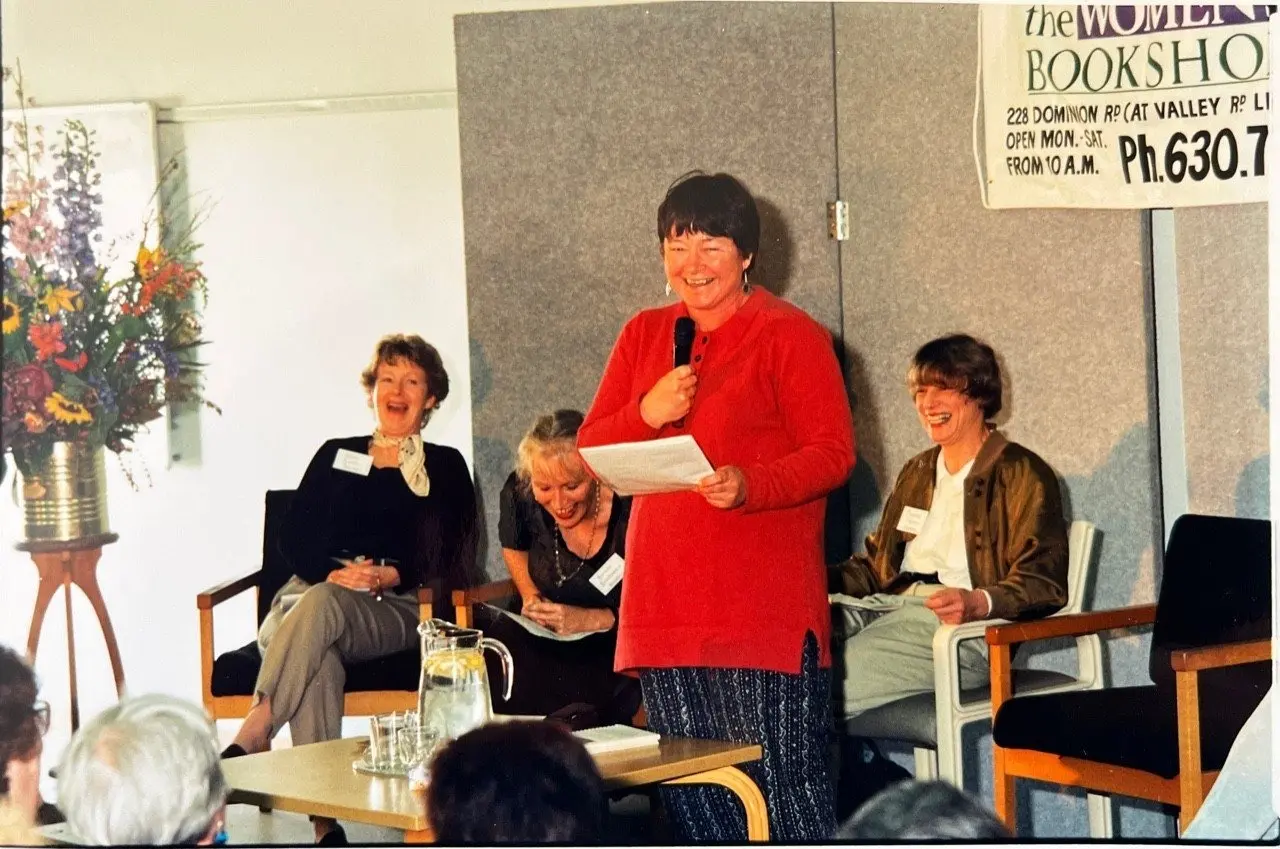
Wendy was a prominent figure in New Zealand publishing and president of the Publishers Association. The industry was making a push into export, and she attended both the Australian Book Fair and the Frankfurt Book Fair each year.
She also went to Asia Pacific Publishers Association meetings and displayed New Zealand books at two Tokyo Book Fairs.
Wendy has been described as determined, tenacious and stoic.
When she retired from the University Press in 2013, her job was split in two, a manager and an editor, Bella says.
‘‘She was a workaholic, addicted to work. She would drive home [to Waitati] for dinner then drive back to work.’’
Since her retirement in 2013 Wendy accomplished many other things, uncovering family history from original sources, including that of her great-grandmother’s extraordinary journey as a woman alone, and that of her forbear John Proctor Harrex who was sent as a convict to Australia in 1796, and managed Samuel Marsden’s farm at Parramatta.
She organised environmental projects, particularly volunteers for plantings in the Waitati Estuary, and raising money for a boardwalk.
She and John Kaiser, her partner of 34 years, made several trips to Fiordland and Stewart Island between 2005 and 2012, sailing to Dusky Sound, Preservation Inlet, Puyesgur Point, Port Pegasus and Port William on Elwing with Arthur and Barbara White and other friends.
Wendy was always assiduous in keeping in touch with her family. She grew up on a poultry farm near Wanganui with two sisters and two brothers. It was a typical country childhood, building huts, climbing macrocarpa trees, bringing in cows, gathering and cracking walnuts from their tree — and endlessly cleaning eggs.
She was a foundation pupil at Wanganui High School, then dux and head girl before studying at Victoria University, Wellington.
Their father had grown up in the Ida Valley in the Maniototo, a place to which she always felt a strong attachment, especially having spent a holiday there with her grandparents. Indeed, she chose to be buried there.
For the past eight years Wendy had been stoically and determinedly fighting blood cancer. Although she had been feeling unwell for a year, it was not diagnosed until she became seriously ill at Christmas in 2017 and was rushed to hospital.
She almost didn’t survive but her determination, medical treatment and eventually a regime of low-dose chemotherapy tablets gave her several years’ remission.
Life was for living, she said, and with her characteristic drive and determination, made the most of it, cycling the Central Otago Rail Trail and the Alps2Ocean with John and friends.
She relished time with Bella who runs her own photography business, son-in-law Aidan Dickson and enjoyed her grandchildren’s childhood. She died on September 19.
‘‘Perhaps it was that drive in her that enabled her to fight cancer all these years. A deadline was no match for mum.’’ Bella said. — Charmian Smith