
PHOTO
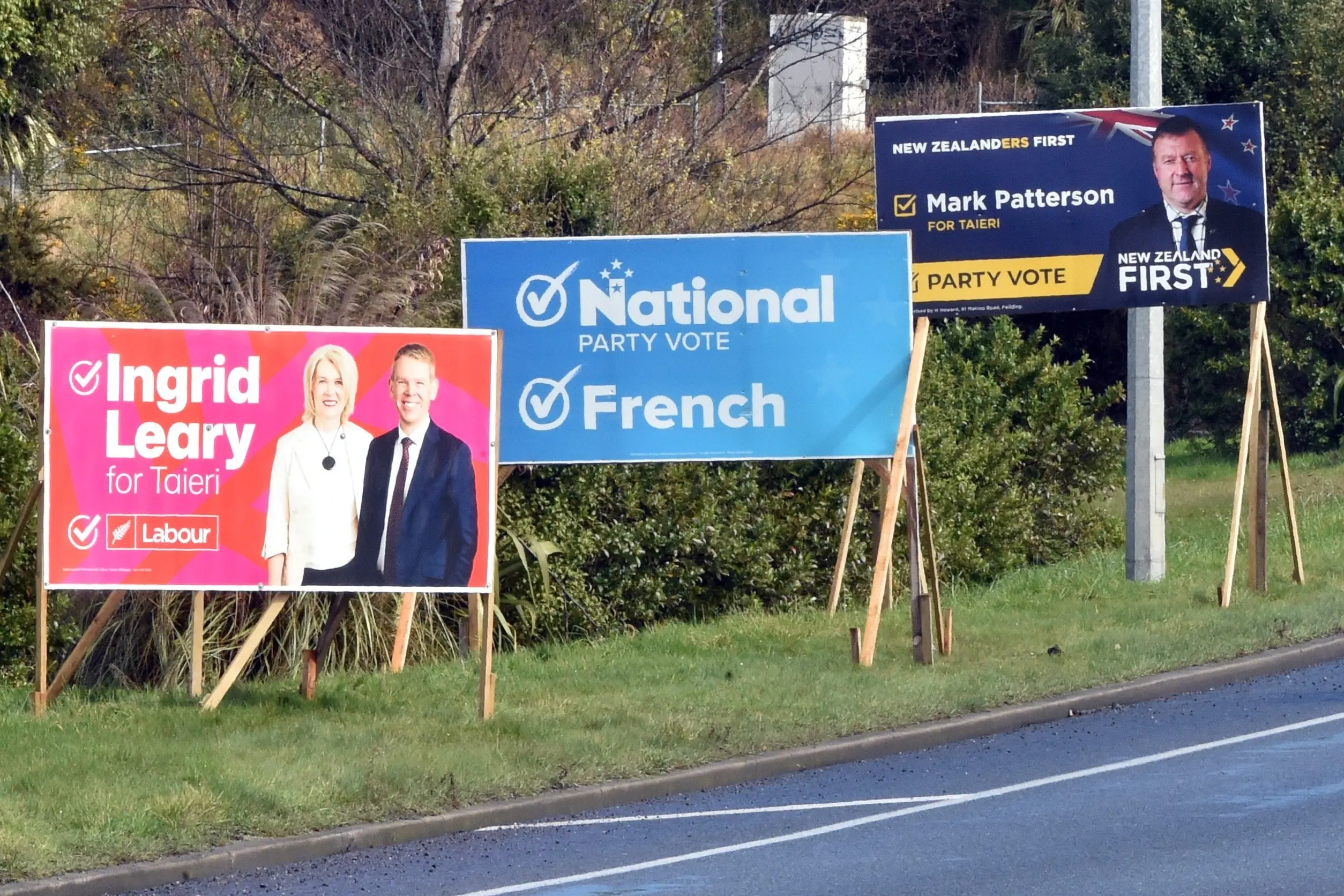
Advertising hoardings have been up for a couple of weeks now so, if it wasn’t clear enough before, the country is well into election mode leading up to the climax on November 7.
Although, that said, with our MMP system, any climax is likely to be well drawn-out before we see a final
result.
So, for the next two months we will be subject to a wide variety of political parties all making their pitches to secure our vote.
Over my too-many years of watching and participating in elections (although only to the extent of voting) I have observed three features of political party comment which are often used to bolster a party’s position. This can either be by attacking another party or promoting some policy of their own.
The first is that parties often seem to attack others for adopting “ideological” positions. These are often challenged on the basis that the ideology is not supported by evidence surrounding the issue.
Whether supported by evidence or not, somehow or other an ideological stance is painted as something inappropriate.
This, of course, ignores that every party has its own ideology and applies itself diligently to promoting that ideology.
This is made clear as attacking another’s position as “ideological” often reveals their own ideology.
Each party hopes to be among the fortunate who form the government so that they will get a chance to apply their ideology to governing New Zealand. How successful they may be will depend on their influence in the governing coalition which inevitably will be formed.
The second perhaps belongs more to the era of the Helen Clark government than the current climate (at least in my hearing) and that is the accusation of indulging in social engineering.
For some reason some parties seemed to avoid this charge, but it is surely the aim of every party to engage in their particular version of social engineering. Understanding social engineering as making changes within society to achieve a particular end, each party is hoping to have the chance to indulge in some.
They all want the chance to have a go at giving effect to their particular vision.
A third feature is always rife, but particularly so during elections. This is magical thinking.
In general, magical thinking consists of promising a benefit that can be allegedly achieved without disbenefit to some, usually a cost.
Magical thinking is also present when simple solutions are offered for complex problems or where evidence shows that problem fixes proposed do not work.
Somewhat related there is the “creative” use of statistics to bolster a particular policy position or record from a time in government.
Overall, magical thinking may well contribute to the perceptions that voters have of any particular party, either good or bad, but the aim of magical thinking is promote a positive perception in a dishonest way.
And I rather suspect that voters’ perceptions play a significant role in their voting decisions.
The point I am wanting make by looking at these features is that every political party displays them.
When it comes to ideology and social engineering, every party has the former and wants to indulge in the latter.
Rather than being a point of criticism, this is just as it should be. I want each political party to have an ideology — how they see the world, what sort of better world they want to see and how they plan to achieve it.
Similarly, I want to know what sort of social engineering will they engage in should they be successful.
Thus equipped I can make a judgment about the value of their ideology and its likely outcomes were it applied.
Equally I can judge their likely social engineering efforts. Thus equipped, I can evaluate all parties’ various positions (or, given the number of parties available, a judicious selection of them) and so make my choice about which party will get my vote.
Unfortunately, I cannot be so positive about magical thinking. Taken uncritically a voter could be influenced by magical thinking presented to them, but that very fact means it cannot be viewed uncritically.
My hope is that each voter recognises magical thinking and looks past it when making voting decisions.
So, look past the magical thinking we will be presented with.
But be glad that political parties are ideological and do want to do some social engineering, because that is actually what we are presented with for us to choose between.
Do so wisely.
- Peter Ross, formerly of Balclutha, is a retired engineer and Anglican minister.