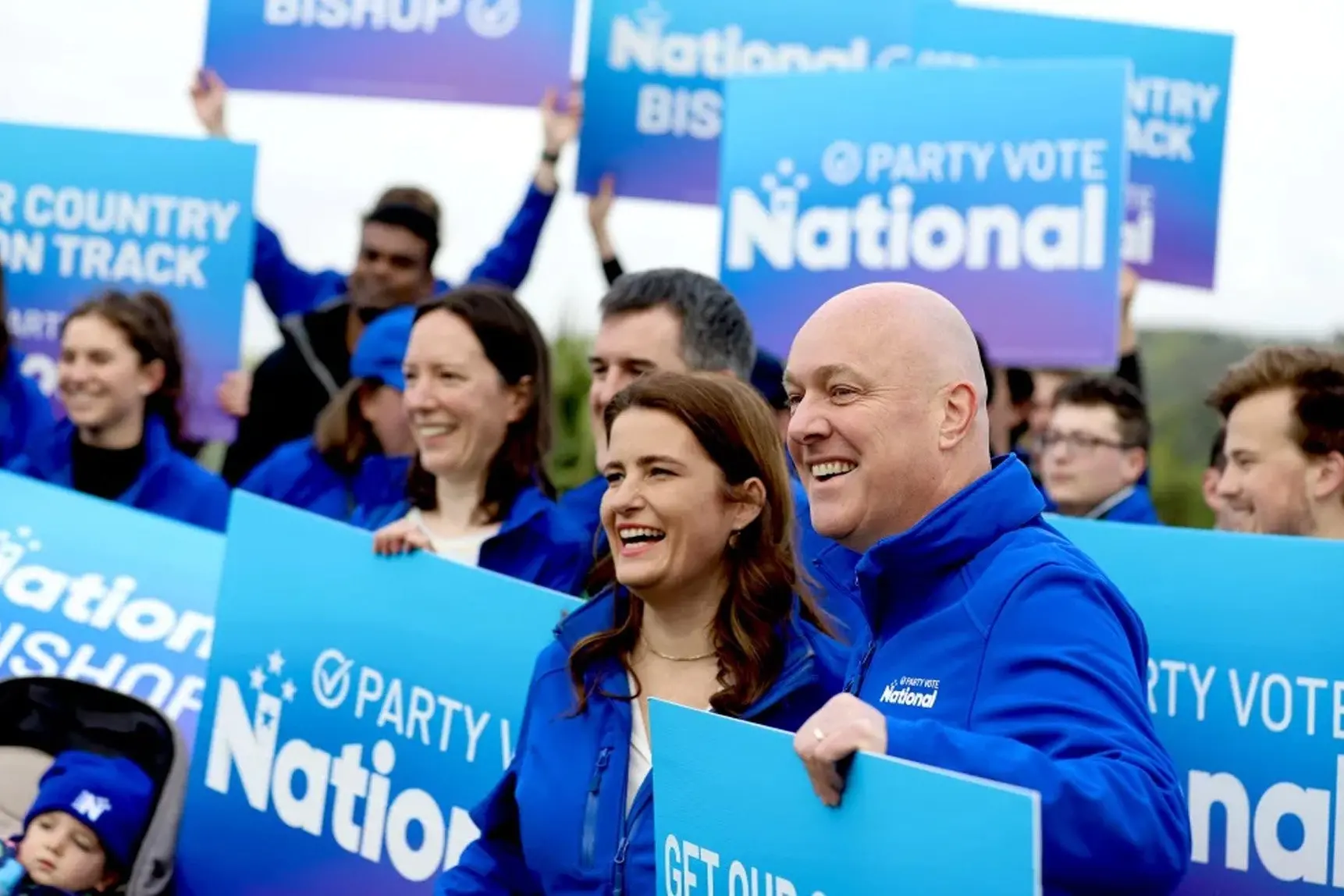
Here we go again. By the time you read these words Christopher Luxon may already be an ex-prime minister – deposed by his own colleagues less than three months out from a general election. OrMr Luxon remains in place as New Zealand’s top politician, continuing in office only by dint of there being no viable (or willing) successor. Keeping your PM in place at this point in the electoral cycle also falls under the heading of ``things you do to prevent the situation going from bad to worse’’. There is simply no recent precedent for a spill this close to election day delivering a positive outcome that does not in some way involve Winston Peters. (Although Mr Luxon’s public characterisation of his coalition partners as ``yahoos’’ and ``numpties’’ may have taken even that option off the table.) Apropos of potential coalition partners, any new National Party leader would be well-advised to declare all earlier statements regarding the Opportunity Party ``inoperative’’. Mr Luxon’s careless dismissal of Qiulae Wong’s electoral attentions may just have been one among many unforced errors, but it was a decision fraught with the most serious political consequences. A more astute political leader would have smiled indulgently at the question ``Is National willing to work with Opportunity?’’ Responding with something like: ``Well, Ms Wong would be most unwise to pin her hopes on my party agreeing to either her Land Tax or her Universal Basic Income, but there is much else in Opportunity’s manifesto that our parties could discuss. MMP has always been about never saying never.’’ All options would have remained open. No pathways would have been barricaded off. What’s more, Mr Luxon and National would have emerged from the exchange wreathed in a golden cloud of magnanimity. Powerful? Certainly. But also fair. Realistic? Yes. But not in a nasty way. Like so many on the right, Prime Minister Luxon looked at Opportunity and saw only the woke and redistributive left. What he and so many other conservatives failed to see was a potential coalition partner with much more to gain by coalescing with National and rejecting Labour. What better way for Opportunity to carve out an enduring position of influence for itself than by proving those who dismissed them as raving loony lefties wrong, wrong, wrong. The other thing Mr Luxon and his advisers failed to see was that by leaving the door open for Opportunity National would be encouraging its growth. A bigger and stronger Opportunity would obviate the need for National to deal with NZ First, producing a coalition that was considerably more rational and pleasingly less passionate than the last three years’ messy menage a trois. Magnanimity was the late Jim Bolger’s most valuable political attribute. Without it he could never have won over Winston Peters in the weeks following the first MMP election in 1996. Mr Luxon’s conspicuous lack of magnanimity, his propensity to dismiss and belittle those with whom he disagrees, almost certainly explains his eagerness to return to the days of First-Past-the-Post. He does not appear to understand that in a democracy – as opposed to a corporation – the leader who shares power multiplies his own. Hoarding power only encourages those who seek it to take it. Zero-sum must never be the rule of democratic politics. Zero-sum implies a system geared to power and nothing else. But the whole point of democracy is to create a political environment in which winning and losing matter much less than preserving a world in which winners are not forced to become hunters, and losers need not fear becoming prey. Devising a political system which ensures a peaceful transition of power surely ranks among the very greatest of human achievements. Winston Churchill quipped: ``Politics are almost as exciting as war, and quite as dangerous. In war you can only be killed once, but in politics many times.’’ That ``many times’’ is the key to democracy’s enduring virtue. Politics is not war. Politics is what human-beings created to avoid war. In war a leader must win or perish. The best sort of leader is the person who strives to keep the stakes as low and as many people in the game as possible. High stakes inevitably come at an even higher price. True leaders are defined by the possession of just one thing – followers. Auckland writer and commentator Chris Trotter writes the Reckonings column for the ODT.