

PHOTO
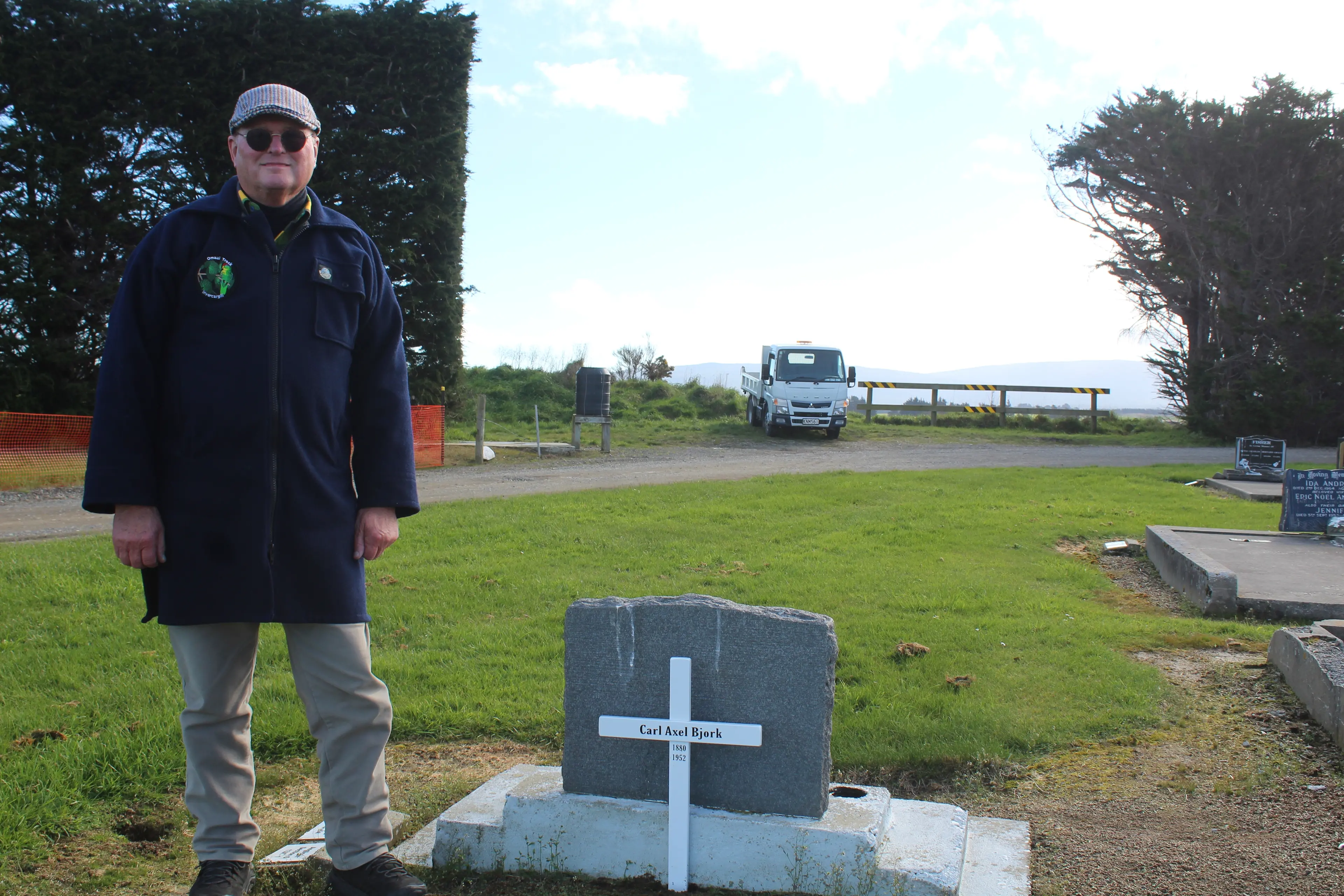
A local historian has honoured a long-forgotten Southland legend known as Jules Berg, the Swedish-born hermit of Preservation Inlet, with a cross at the Riverton Cemetery.
Greg Warden had known about Jules Berg — real name Carl Axel Bjork — for some time but his interest was piqued while reading a book on the history of Fiordland.
The book, by the late historian John Hall Jones, referenced Mr Bjork’s time as the hermit of Preservation Inlet, living alone in the bush for roughly 30 years.
Mr Warden described himself as someone who was interested in preserving local history and cemetery stories, and Mr Bjork’s story was one that really resonated with him.
After reading this, Mr Warden located an unmarked grave at the Riverton Cemetery which was assigned to Jules Berg.
“When I saw just a patch of grass, I just thought it was quite sad.
“It’s a bit of Southern folklore . . . he has no known family because he was orphaned at 4 years old.”
Born in 1880, the identity of his father was unknown and after his mother’s death, he spent just under three years in an orphanage.
Heading to sea at an early age, by the time he reached New Zealand he had travelled extensively.
Mr Bjork arrived in New Zealand in 1909 at 29 years old, working as a whaler on Rakiura/Stewart Island before settling at Preservation Inlet in 1925.
He was initially living at Diggers Creek while working as a road man on a supply track, then moved to Te Oneroa to find work as a gold miner.
After working for 10 years, it is said he made enough to pay for passage back to Sweden, but was robbed in Wellington leading to his return to Te Oneroa.
He became a local folk hero due to his personality and ability to survive for long periods in the bush, living off the land and making wine out of parsnip and beetroot.
He would have interactions with some locals who gave him the nickname of Jules Berg, also bringing him food and supplies.
It was these same locals who would find him having fallen ill and take him to the Riverton Hospital where he spent his final days.
He died September 17, 1952, aged 72.
“I’ve known about him for a while actually after tramping in Fiordland for a while, but it’s almost like he’s forgotten now,” Mr Warden said.
He put a cross at his unmarked grave last Friday, wanting to honour his memory and keep the legend alive.
“Hopefully in the future a more permanent plaque could be put there.”
He also highlighted the popularity of cemetery tours, saying those interested in Southland history would find his life story “very interesting”.
Getting a permanent plaque installed would cost about $1000, Mr Warden said he would consider fundraising for one in the future.
tayler.mutton@alliedmedia.co.nz