
PHOTO
Datagrid has unveiled a smaller resources footprint for its 49 hectare AI factory in Southland, as machines start work preparing the Makarewa site.
At a meeting in Invercargill on Tuesday, the company told business leaders it had slashed its planned water use by 70% and more than halved its backup generator requirements.
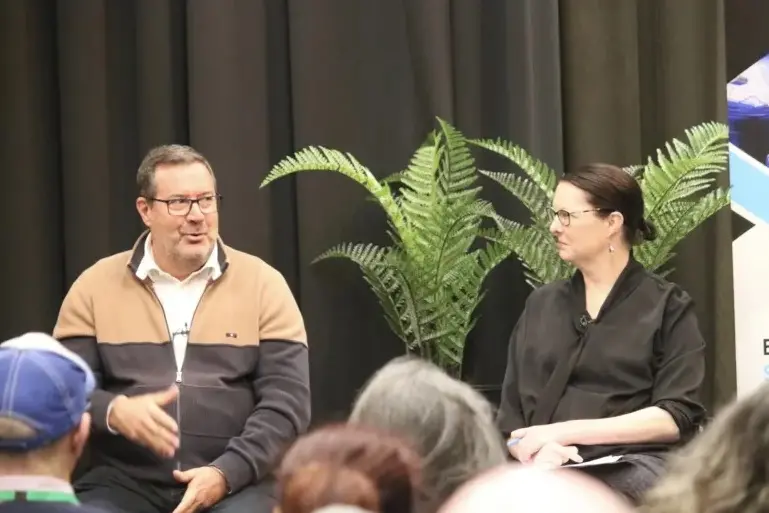
The discussion organised by the Southland Business Chamber drew more than 100 locals eager for details on the economic and environmental impacts.
Datagrid chief executive Rémi Galasso said Southland's cool temperatures offered massive potential for a sustainable digital future.
"This is going to be the most sustainable data centre in the whole Asia Pacific," he said.
"Any other location in Sydney, in Jakarta, in Singapore will use more water, more electricity for the cooling. We have a huge advantage here in Southland."
The factory, set for completion in 2028, was expected to become the country's second-biggest electricity user.
Datagrid had consent to draw up to 600,000 litres of groundwater per day, although the company had pledged to rely primarily on rainwater.
Datagrid said the factory and new subsea cables would give Invercargill some of the country's fastest internet, positioning it as a new digital gateway.
Southland Business Chamber chief executive Sheree Carey said locals had mixed feelings about the project.
"There are significant opportunities and there are also genuine concerns," she said.
"Some of the concern in the community comes from a knowledge gap. When people see quick numbers around power, around water, generators or data infrastructure, it's completely reasonable that they want the straight answers in plain English."
Opponents of the project have sought a review of Datagrid's resource consents, querying the project's environmental monitoring conditions and how much low-frequency noise the factory would produce.
Southland District Council is assessing whether to launch a review and expects to make a decision by September 5.
Some locals have also criticised the non-notified resource consent process, claiming it left them without a say on the factory.
Galasso said it had been difficult to talk to locals about a project that "wasn't fully designed" but from now on there would be monthly public meetings at Makarewa Country Club.
"Everybody's welcome and we will have full transparency," he said.
Galasso said he had chosen to work with the community, rather than through the government's Fast-track process.
"They proposed to me the Fast-track process and said we can give you the resource consent in six months," he said.
"I said, 'thank you, but no thank you. I will talk to the councils and we'll do the classic resource consent process.' We have to do it the right way."
Datagrid environmental manager Fiona Smith said the company was in constant contact with people living near the factory, partly to dispel misinformation circulating about the project.
"Over the last two years I've come to know those neighbours very well. Some of them talk to me three or four times a week," she said.
Datagrid head of technology Benjamin Black said the original plan presented in March had been scaled back and the project's consented conditions were a worst-case scenario.
"The process of consenting means that initially we have to come up with what's called the maximum set of effects, assuming the worst case for everything," he said.
"That's how you end up with some pretty terrifying numbers but as we've focused in on a specific application with a specific tenant, it's allowed us to really narrow down the set of effects."
He told business leaders Datagrid expected to use 70% less water than it was consented for, less than 66 million litres per year, down from 220 million litres per year.
The factory would need fewer than 34 generators instead of the 84 permitted, he said.
Some locals had earlier asked if the factory would cause power price hikes.
Black said a big battery storage system would help stabilise Southland's electricity supply.
"We are going to put the battery system into what's called grid-following mode to provide voltage support," he said.
"This has nothing to do with us. This is entirely around making the grid more stable."
Work to build a new access road and excavate topsoil began at the Makarewa site on Tuesday.
Southlanders who remain uneasy about the AI factory were due to hold another meeting on Wednesday night.
