
PHOTO
Move over, Cocaine Bear. Here come cocaine sharks.
In what could be the plotline for the next cheesy marine-themed disaster movie, scientists think crazed and hungry sharks could be feasting on bales of hallucinatory drugs dumped off the Florida coast.
Yet while Cocaine Sharks — a highlight of the Discovery channel’s Shark Week last week— does indeed examine if the ocean predators are chomping on floating pharmaceuticals cast overboard by passing traffickers, marine scientists who made the television programme say its purpose is beyond gratuitous entertainment.
"It’s a catchy headline to shed light on a real problem — that everything we use, everything we manufacture, everything we put into our bodies, ends up in our wastewater streams and natural water bodies, and these aquatic life we depend on to survive are then exposed to that," Florida-based environmental engineer and lead member of the research team Dr Tracy Fanara said.
"We’ve seen studies with pharmaceuticals, cocaine, methamphetamines, ketamine, all of these, where fish are being [affected] by drugs.
"If these cocaine bales are a point source of pollution, it’s very plausible [sharks] can be affected by this chemical.
"Cocaine is so soluble that any of those packages open just a little, the structural integrity is destroyed and the drug is in the water."
In their research, conducted during six days at sea in the Florida Keys, the ecologically sensitive island chain off the state’s southern tip, Fanara and British marine biologist Tom Hird observed sharks exhibiting peculiar behaviours.
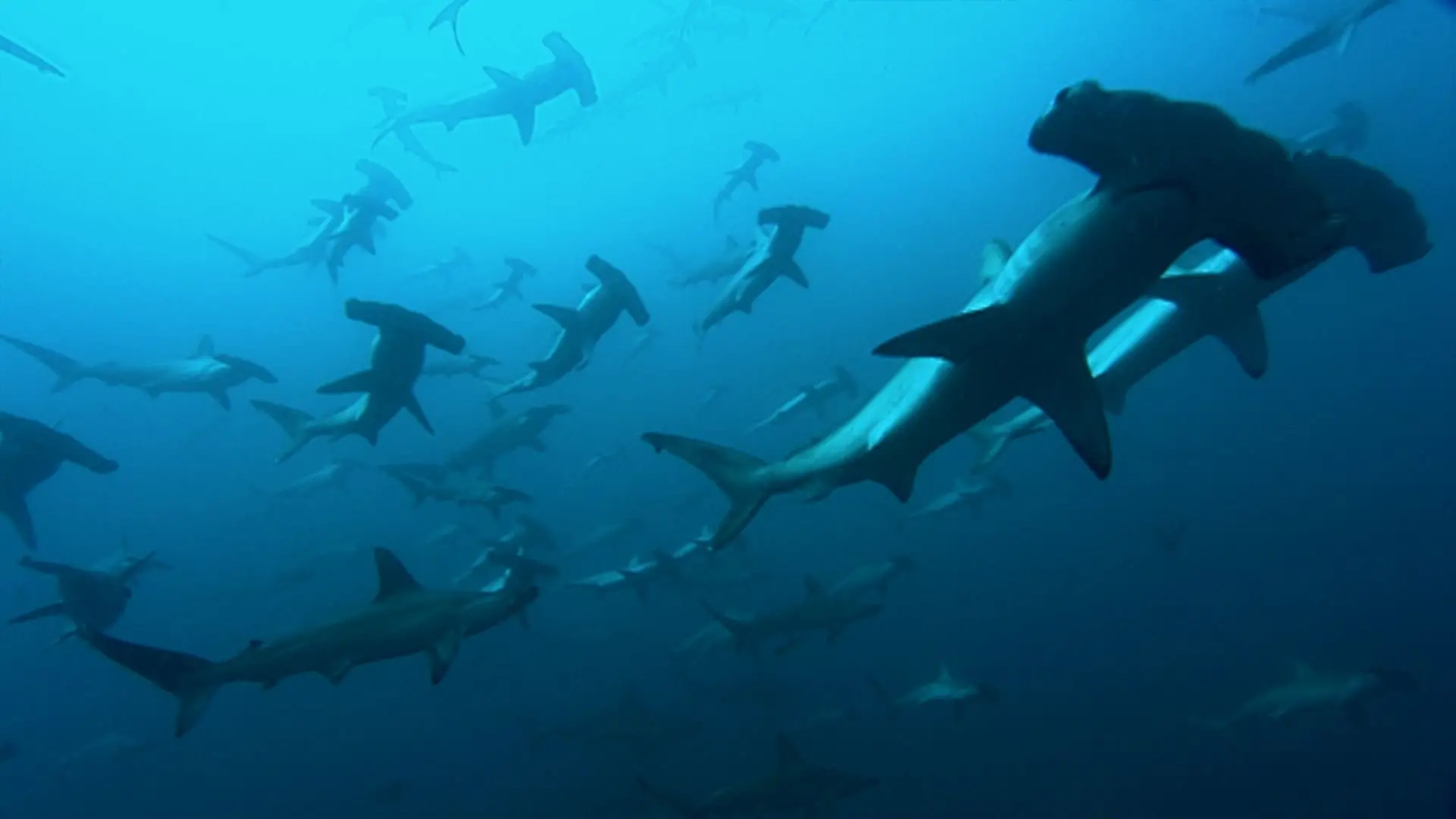
A hammerhead, a species that would usually swim away from humans, came directly towards the divers, moving erratically.
They also observed a sandbar shark swimming in circles as it apparently focused on an imaginary object.
They also conducted experiments, including dropping dummy bales in the water — which many of the sharks took bites out of — and loading balls of bait with highly concentrated fish powder to simulate cocaine.
The effect, the researchers said, was akin to catnip on felines.
"It’s the next best thing [and] set their brains aflame.
"It was crazy," Hird said.
Fanara said they chose the Florida Keys as the best location for their research because a convergence of ocean currents made the region "prevalent" for floating bales of cocaine.
Florida serves as a staging point for large quantities of drugs making their way into the United States from South America, and plastic-wrapped bundles of cocaine are often lost at sea or tossed overboard by traffickers being pursued by law enforcement.
Last month, the US Coast Guard announced it had recovered more than $US186 million ($NZ297m) of illegal narcotics from the waters of the Caribbean and southern Florida. But such seizures have little impact on an industry operating at record levels.
"While we were in the Keys filming, cocaine bales were washing ashore, like twice in one week, so it’s really a prevalent issue," Fanara said.
How much cocaine the sharks were actually ingesting was impossible to determine based on experiments that were only precursory, she said.
"At the end of every research publication you read ‘more research must be done’, and that’s definitely the conclusion from this," she said.
In the coming months, Fanara plans to partner with other Florida marine scientists to take blood samples from some of the sharks to evaluate cocaine levels.
She said she hoped those who watched Cocaine Sharks would appreciate the threat Earth’s fragile ocean ecosystem from pollutants in the water.
"It’s like a game of Jenga where we’re at the top," she said.
"We’re in the sixth mass extinction and the more chemicals we introduce, the more radical changes we introduce, the more precarious it gets.
"These animals are leaving one by one and the integrity of the tower is depleting, even if we might not feel it right now. At some point, the tower’s going to fall." — Guardian News and Media