
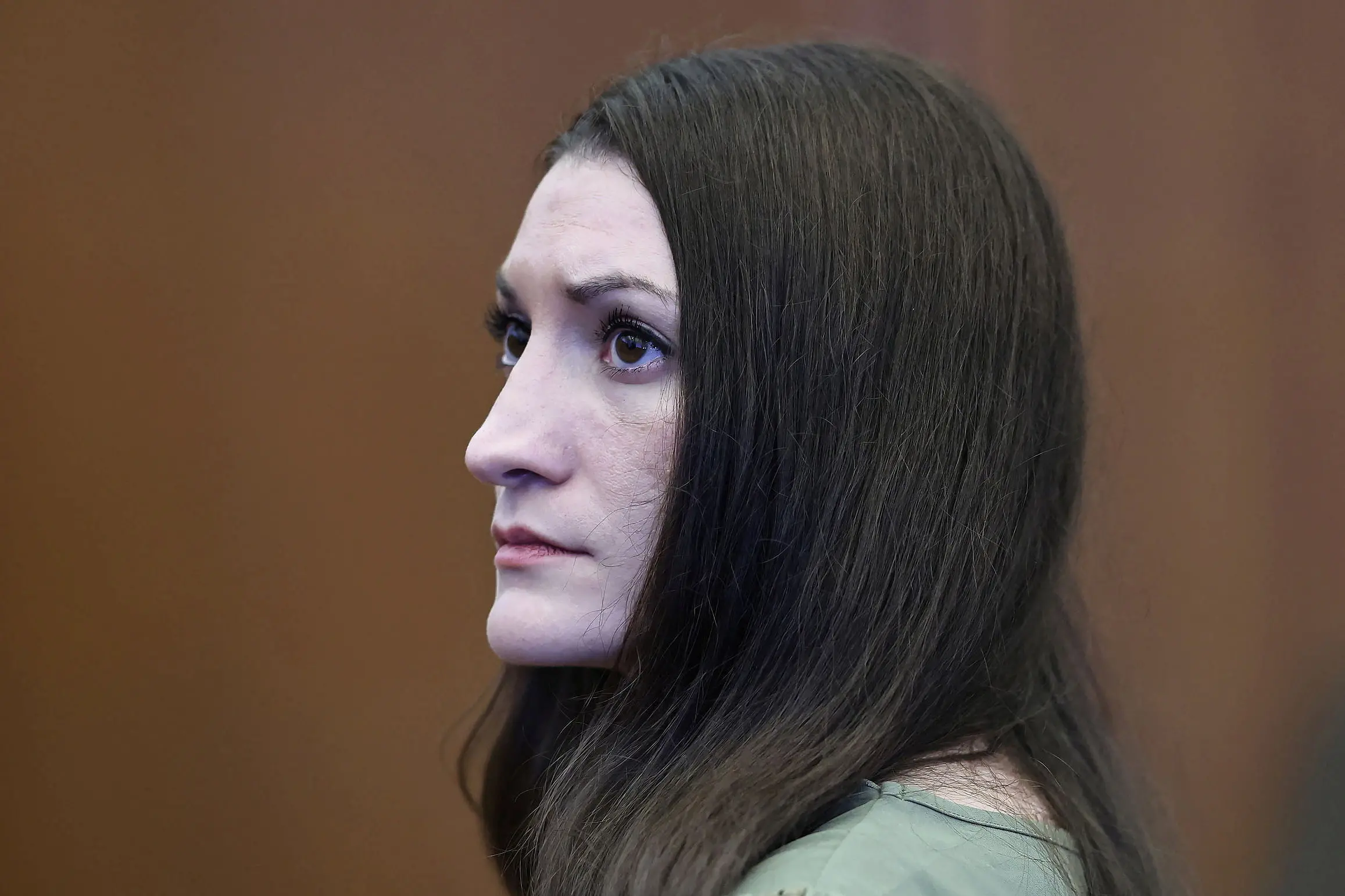
PHOTO
A judge has declared a mistrial in the US murder trial of Lindsay Clancy for killing her three young children, a tragedy her attorney said occurred while she was suffering from postpartum psychosis.
The nearly six-week-long televised trial in Plymouth, Massachusetts, revived a longstanding debate about how postpartum mental health in women is treated in the US, and how the country's legal system addresses cases when mothers kill their children.
Judge William Sullivan's mistrial declaration came after jurors sent several notes this week indicating they were deadlocked. The mistrial opened the door for a potential retrial, though Plymouth County District Attorney Tim Cruz said his office had not decided whether to pursue one.
"Children were murdered, and it's our job to seek justice," Cruz told reporters.
No-one disputed that Clancy, 36, strangled her three children with exercise bands in January 2023 in the basement of their home in the Boston suburb of Duxbury. She then cut herself with a knife and jumped from a second-storey window in an attempt to take her own life that left her paralysed.
Her attorney, Kevin Reddington, sought throughout the trial to convince jurors she should be found not guilty by reason of insanity, arguing she was a loving mother who had been in the midst of a psychotic episode when she killed Cora, 5; Dawson, 3; and 8-month-old Callan.
Clancy would face a life sentence if she is retried and convicted of murder. If found not guilty by reason of insanity, she would be committed to a state psychiatric hospital for evaluation. Her commitment would then be subject to regular review by the court.
In a sign of how closely the US public followed the trial, President Donald Trump told reporters in the Oval Office he was aware of the case and said he assumed there would be another trial.
"It's a horrible tragedy," Trump said. "She did a horrible, horrible thing. Can't be worse. But you'll find out what the price to pay is. There'll be a price."
Clancy, who remains in custody at a state hospital, is due in court for a follow-up hearing on September 29.
DEFENCE LAWYER TRIED TO HAVE JUROR REMOVED
Speaking to reporters outside the courthouse, Reddington framed the mistrial as a win for the defence and said Clancy would be ready for another trial should prosecutors pursue one.
He blamed the mistrial on a holdout juror who he said prevented the other 11 jurors from reaching a not-guilty verdict.
"They know that they were robbed, by one man, for whatever his agenda was, who stole seven weeks of the lives of these other jurors," Reddington said.
Earlier on Friday, the seventh day of deliberations, Reddington asked Sullivan to remove the juror. He cited a note the jury foreperson sent on behalf of 11 jurors indicating that one juror had acknowledged doubt but refused to apply it to the verdict.
Jurors could only find Clancy guilty of first-degree murder if the prosecution proved its case beyond a reasonable doubt.
Sullivan rejected the request. Reddington then asked Massachusetts' highest court to order Sullivan to inquire further into whether the holdout juror could heed the judge's instructions to follow the law. The top court denied his emergency appeal, paving the way for the mistrial declaration.
PROSECUTORS SAID CLANCY PLANNED KILLINGS
Prosecutors did not dispute that Clancy, a former labour and delivery nurse at Massachusetts General Hospital, had been dealing with mental health issues. But they argued she was able to appreciate the wrongfulness of killing her children and intentionally chose to do so anyway.
They presented testimony from a psychologist who, after examining Clancy, concluded that she had planned to take her own life and chose to kill her children because "she was convinced that they would suffer without her."
Prosecutors focused on evidence showing that shortly before the killings, she sent her husband to pick up a food order and go to a pharmacy after mapping on her phone the time it would take for him to return home.
The trial drew comparisons to the case of Andrea Yates, a Texas woman who drowned her five children in a bathtub in 2001. After an appeals court overturned her initial murder conviction, she was found not guilty by reason of insanity in 2006. Her lawyers had said she suffered from severe postpartum psychosis.
CLANCY STRUGGLED WITH MENTAL HEALTH, HUSBAND SAYS
Testimony from family members, including Clancy's now ex-husband, Patrick, detailed how she had struggled with her mental health in the months following the birth of her third child, repeatedly seeking treatment from healthcare providers who prescribed myriad drugs.
Patrick Clancy testified that his wife had been discharged from a psychiatric hospital weeks before the killings but showed no signs she planned to hurt herself or her kids in the days that followed. She had a "normal" demeanour when he left to pick up dinner, he said.
He spoke on the phone briefly with his wife while at the pharmacy. Upon his return, he discovered her lying on the ground in the backyard with cuts on her wrists and neck. She told him she had tried to kill herself.
He said he asked where the children were, and she said they were in the basement, where he discovered them with exercise bands tied around their necks.
Several witnesses, including Patrick Clancy, testified that later, while Lindsay Clancy was at a hospital, she spoke about having heard a man's voice tell her that if she did not act, she would lose her chance.