
PHOTO
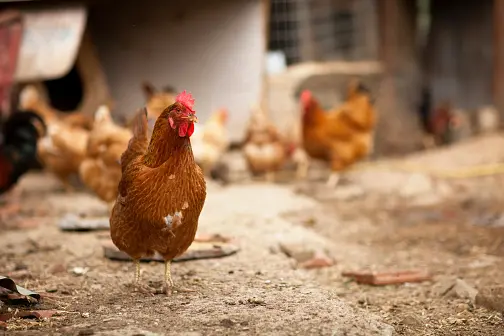
Victorian poultry farms are being plunged into lockdown as new cases of bird flu continue to climb across Australia.
The "proactive, precautionary measure" forcing producers to keep poultry temporarily housed in higher-risk areas comes as a new detection was discovered in the Melbourne suburb of Clyde.
The decision was made after a meeting with industry representatives who voiced support, Victorian Agriculture Minister Michaela Settle said on Friday.
Bird flu has not been detected in poultry or in the agricultural production systems, although 175 confirmed or presumed positive detections have been made among other birds in Australia.
There are 47 positive cases of bird flu in Victoria, with new detections at Yambuk, Apollo Bay and Clyde.
Poultry owners with 50 or more birds in metropolitan Melbourne, coastal areas and some neighbouring areas must house their birds to reduce contact with wild birds for an initial 14-day period.
Producers are concerned by the speed at which the virus has travelled, Victorian Chief Veterinary Officer Graeme Cooke said.
"Their concern is that it had reached further east than previously and that it was moving at the speed which has not happened much in South Australia," he said.
"We are a small state, so our distance has more meaning to us, therefore we are taking this precautionary measure and for a short period whilst we conduct further studies."
Cases in South Australia also continue to climb, with the state making up more than three quarters of the national total of 175.
The surge prompted organisers of the Royal Adelaide Show to cancel bird competitions and exhibits at the event, due to be held from September 5 and 13.
"While we think the risk is very low, we took the decision now out of an abundance of caution to make sure that our volunteers and exhibitors had as much time to prepare as possible," Royal Agricultural and Horticultural Society of SA chief executive Will Rayner told reporters.
Mr Rayner said the birds were a small part of the overall programme, adding there were more than 26,000 competitive entries at the show.
It's unclear whether the Melbourne Royal Show's poultry competition will go ahead, with organisers actively monitoring the situation.
"As the situation is still currently evolving, Melbourne Royal will take all necessary measures to ensure the safety and wellbeing of all animals, exhibitors and visitors to the show," general manager Hannah von Bibra told AAP.
The worsening bird flu outbreak has sparked debate over whether vaccination is the key to protecting Australian wildlife from the deadly strain.
While the Australian government is conducting pilot studies in non-poultry birds, New Zealand has begun vaccinating some of its rarest birds after completing a world-first research trial in 2025.
About 300 breeding birds were targeted from five species: kakapo, takahe, black stilt, orange-fronted parakeet and shore plover.
Questions have been raised over whether a similar approach would be viable with Australian birds and other animals.
New Zealand used a different vaccine to the one that features in Australian trials.
Safety and efficacy data is still being gathered, and there are concerns about the logistics and practical application of such a programme.
Two doses of any vaccine would need to be administered, with a period of time separating them, experts say.
The task of vaccinating wild animals would be especially challenging, University of Adelaide immunologist Mohammed Alsharifi told AAP.
"If we're talking about vaccinating wild birds, I think that's a big task," he said.
There are also fears for Australia's seals after a pup with bird flu symptoms died in Victoria.
It is potentially the first seal to be infected with the deadly H5 virus on the Australian mainland.
The federal government has released a susceptibility index, which scales the risk of H5 across native birds and mammals.