

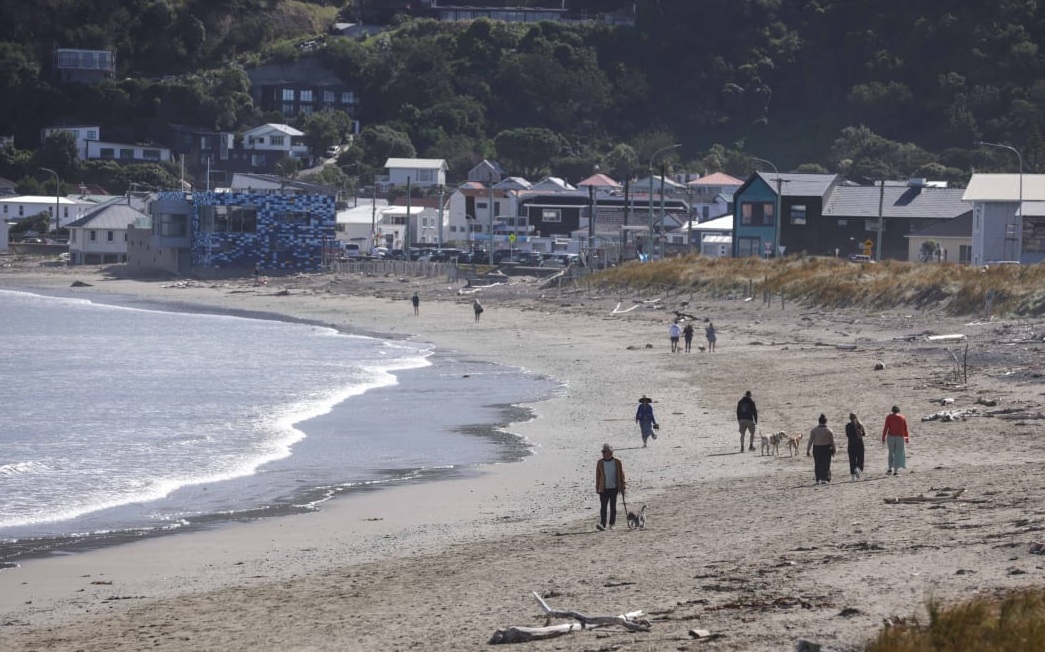
Tens of millions of litres of raw sewage have flowed into the ocean around Wellington's south coast since early Wednesday - in what the capital's mayor has called a 'catastrophic failure' - after the Moa Point Treatment Plant was flooded by raw sewage early on Wednesday morning, causing it to shut down and be evacuated.
Wellington Water said it was now racing against the clock to get the inundation of sewage out of its Moa Point Treatment Plant before it went septic and became anaerobic.
Noxious anaerobic smells happen when bacteria breaking down rotting material have restricted access to oxygen, which happens when material biodegrades in a heaped still mass.
Wellington Water says the sewage becoming septic and anaerobic means it would cause a noticeable smell, and pose a significant health and safety risk to workers onsite.
Crews were now working on the clarifier tanks that separate biological sludge from treated wastewater, Wellington Water said, but warned that work could cause a stronger smell as well as a plume in the ocean at the end of the outfall pipe.
Once the tanks were emptied, contractors could safely start investigating the plant's power system and equipment to get a better idea of how much damage the plant had suffered, it said.
People are being reminded to not collect kai moana from the area and to not walk dogs along the beach.
A rāhui remains in place until further notice from Ōwhiro Bay to Breaker Bay.
Overflow in Porirua at major highway
Wastewater overflow has also been reported at another Wellington Water site, this time in Porirua, but the overflow has since stopped.
The overflow was at the intersection of Mana Esplanade - State Highway 59 (the old SH1) and Pascoe Avenue, near Ngāti Toa Domain.
Initial investigations suggested the overflow might be related to a pump running sequence at Pump Station eight, Wellington Water said.
But to access the manhole the overflow occurred at, workers would have to excavate the state highway. So at this stage no further work was being planned on the problem, as the overflow had stopped.
However, teams were continuing to monitor the site, and "proactive environmental controls" were in place along Mana Esplanade, it said.
Focus on clearing material out of Moa Point Treatment Plant
The sewage spill after the flood at the plant had come from a five-metre short pipeline, that let out directly into the southern coastline.
On Friday Wellington Water began pumping the wastewater through its long outfall pipe, which lets out one kilometre from the closest coastal point. And the material is being screened to remove items like wet wipes and period products before being discharged.
Some of the sewage that flooded the Moa Point plant has been taken to landfill, while the rest of it is now being pumped from the plant's 1.8km-long outfall pipe, to reduce harm to beaches.
There was no wastewater discharge from the short outfall pipe overnight between Friday and Saturday, Wellington Water said.
The water company's board chair Nick Leggett said they were working hard to get the material out of the plant.
"That has been a focus from pretty much the moment that we knew there was something wrong.
"It was getting this place clean so it is a safe place to work and so it is not emitting obviously a stench."
Site cleaning was also continuing, along with coastal cleaning and sampling.
Wellington Water believed some issue with the plant's outfall pipe had caused the major failure of the plant.
Leggett said divers had been inspecting it but were yet to find any form of blockage.
On Friday it was reported Wellington Mayor Andrew Little would be raising the Moa Point treatment plant failure with Prime Minister Christopher Luxon on Monday.
The meeting was scheduled already, but Little said it would be a topic of discussion.
Little said one of the questions in the days ahead would be about setting up an appropriate investigation or inquiry into what happened.
"We can't let this happen again," he said. "We can't let such a critical plant for a modern city fail in the way that this has and cause the environmental degradation that it has.
"It's important we get the facts and it's important we understand what we need to do to prevent it from happening again."


