

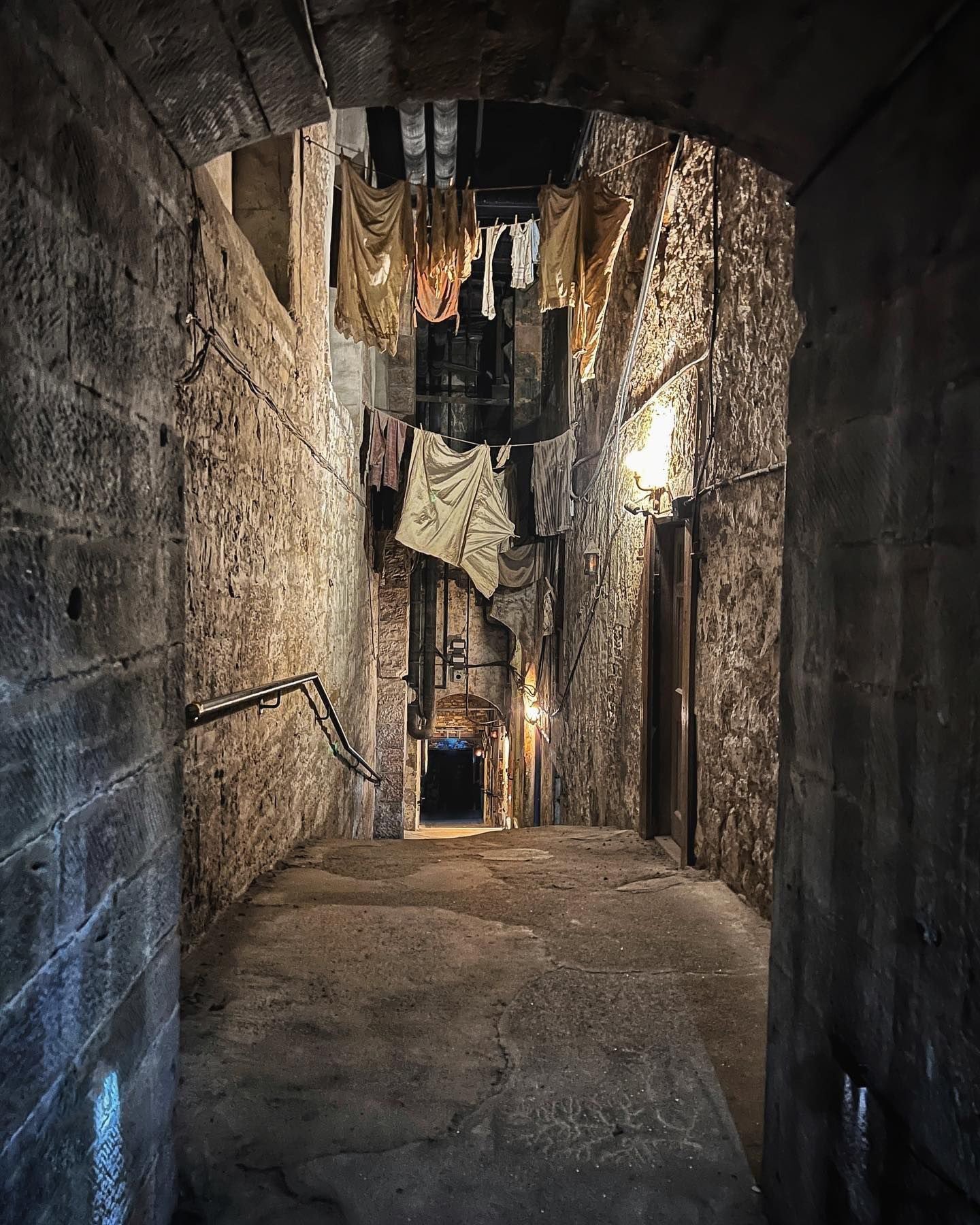
And yet today I found myself wandering reverently through a centuries-old close, the city of Edinburgh far above me, surrounded by damp stone and lamplight. The air was cold and heavy, the passageways impossibly narrow, and I felt like I was being squeezed in on all sides.
The Real Mary King’s Close is something of a notorious tourist experience in Edinburgh — advertisements for it are plastered across buses and billboards throughout the city, glossy leaflets stacked in every hotel lobby, all with sinister cloaked figures and breathless claims about “Edinburgh’s hidden underground secrets”.

A “close” is a narrow, enclosed alleyway or passage leading from a main street to a private courtyard or tenement, often plunging downhill and jam-packed with homes and workshops stacked floor upon floor. Closes are a feature of medieval cities, built as people crowded upward and inward behind defensive walls, like Edinburgh’s Flodden Wall.
In New Zealand of course, we don’t go in for closes — our cities are comparatively young, spacious, and shaped by wide colonial grids rather than centuries of compression.
Mary King’s Close is a historic close located underneath the Edinburgh City Chambers Building, just off the Royal Mile. Edinburgh’s closes were typically named after trades, taverns, or prominent residents; Advocate’s Close, for example, was named after Sir James Stewart, the Lord Advocate of Scotland from 1692 to 1709.
The close I wandered through earlier today was originally known as Alexander King’s Close, after a notable lawyer. That it later took Mary’s name is rather remarkable.
Not a huge deal is known about Mary King. Born at the close of the 16th century, she emerges from the historical record only after her marriage to Thomas Nimmo in 1616. Mary had four children — Alexander, Euphemia, Jonet, and William. Widowed in 1629, Mary inherited the status of Burgess, which granted her an impressive degree of civic influence in a society that afforded women almost none.
By the 1630s she had established herself as a successful cloth merchant on what was then Edinburgh’s second busiest street after the Royal Mile, purchasing multiple properties, running a popular stall, and supporting her children alone.
Mary died in 1644, just before the devastation of the Great Plague, and never saw the close renamed in her honour.
Over the centuries, Mary King’s Close became densely populated, with wealthier residents occupying the upper floors and poor families relegated to the dark, cramped rooms below. Contrary to popular belief, the close was not sealed up during the plague — as I was once informed by a rather histrionic tour guide on a different tour — but rather parts of it were gradually enclosed and built over as the city of Edinburgh expanded.
In 1753, the close was partially demolished and buried due to the building of the Royal Exchange, after which it was later closed to the public for many years. And so, instead of being destroyed and replaced by newer buildings as so much of Edinburgh was, Mary King’s Close survived underneath the modern city, preserved almost like a time capsule.
My experience of Mary King’s Close began before I arrived, with an email confirmation made out to look like an ancient parchment scroll and Mary King herself reaching through “the depths of time” to welcome me.
It was delightfully absurd — and that absurdity only deepened underground, where our guide, a young woman named ‘‘Lang Meg’’ greeted our group warmly and proceeded to take us on a tour of the past.
Lang Meg was a Foul Clenger; a plague cleaner entrusted with the grim responsibility of burying bodies and moving infected people to quarantine camps during bouts of the bubonic plague. I couldn’t help but notice that despite her grubby occupation, Lang Meg’s attire was suspiciously crisp and fresh.
There is, undeniably, an inherent absurdity to historical reenactment. Part of its charm lies precisely in acknowledging this, and in my case, trying to get the actors to acknowledge it too.
I take an almost perverse delight in testing the boundaries of these actors’ performances, asking them questions about the time period they supposedly originate from — their fashion, their art, their hobbies, their romances. By this, I don’t intend to embarrass or infuriate them, but rather to probe the edges of the illusion.
If I’m being honest with myself, it’s probably because I get bored easily.
For example, deep within the majestic recesses of Stirling Castle, you will find a stout older gentleman dressed as a member of the king’s bedchamber staff. Visiting him is my favourite part of the whole castle experience (I have been there at least four times).
With immense seriousness, this fine gentleman explains court rituals whilst I pepper him with increasingly niche questions about the carved Stirling Heads on the ceiling or 16th-century hygiene practices.
Despite the anachronistic cleanliness of Mary King’s Close, the humming air conditioner and the wooden IKEA flooring installed in some of the rooms, there was an authenticity to the experience that I appreciated.
Our group fell into whispers without being asked and posed oddly sincere questions of our 17th-century host. It was as if we were participating in a kind of collective theatre — something between a museum, haunted house, and classroom.
There’s something inherently British about this type of tourism, with its cheerful plague narratives and cosy suffering; the packaging of catastrophe and poverty into guided tours.
One minute you’re hearing an actor joke about the Black Death; the next, you emerge blinking into daylight to buy fudge in a gift shop that sits metres above where children once died of disease.
Today, as I climbed back up to the 21st century at street level, I found myself thinking about one underlying question: why do we enjoy proximity to historical hardship when buffered by safety and retail?
Part of the answer, I think, lies in what these experiences cannot do. Experiences like the Real Mary King’s Close can offer us reconstructed or preserved architecture, wax dummies, and scripted dialogue.
But they cannot reconstruct the smell of the 17th century — sewage, animals, smoke, unwashed bodies, illness. Nor can they reconstruct the fear, or the religious conviction that plague was divine punishment.
No modern actor can truly unknow what they know. The real Lang Meg toiled away in the 17th century; her 21st century double is an actor irretrievably shaped by this era’s sense of individualism, irony, secularism, psychology.
Nobody on that tour believed in demons the way many original inhabitants did. We visit the past only after it has been made hygienic enough to sell tickets.
But in a sense this obvious falseness is what makes immersive history work. Because we, the audience, are never fully deceived, we are free to collaborate in imagining rather than being asked to believe.
I kept oscillating between noticing absurd details — our guide’s starched white collar, the scent of Dior Sauvage wafting about the subterranean street — and feeling unexpectedly moved or intellectually engaged, by stories of a plague-ridden child left behind by her family to die, or the revelation that tens of people lived cramped in a single room.
Touring Mary King’s Close reminded me that authenticity in historical tourism doesn't require perfect reconstruction.
Rather, it requires only sincere attention: the collective effort of trying, together, to imagine lives unlike our own.
• Jean Balchin is an ODT columnist who has started a new life in Edinburgh.


