
PHOTO
The "illusionary truth effect'' is the age-old rhetorical device of repeating a statement so often that, without evidence or argument, people believe it's true.
Dunedin City Council chief executive Sue Bidrose uses the illusionary truth effect whenever she gives bewildered, outraged and disbelieving citizens and city councillors the same emphatic message: we are not able to regulate Lime scooters. It seems to be working.
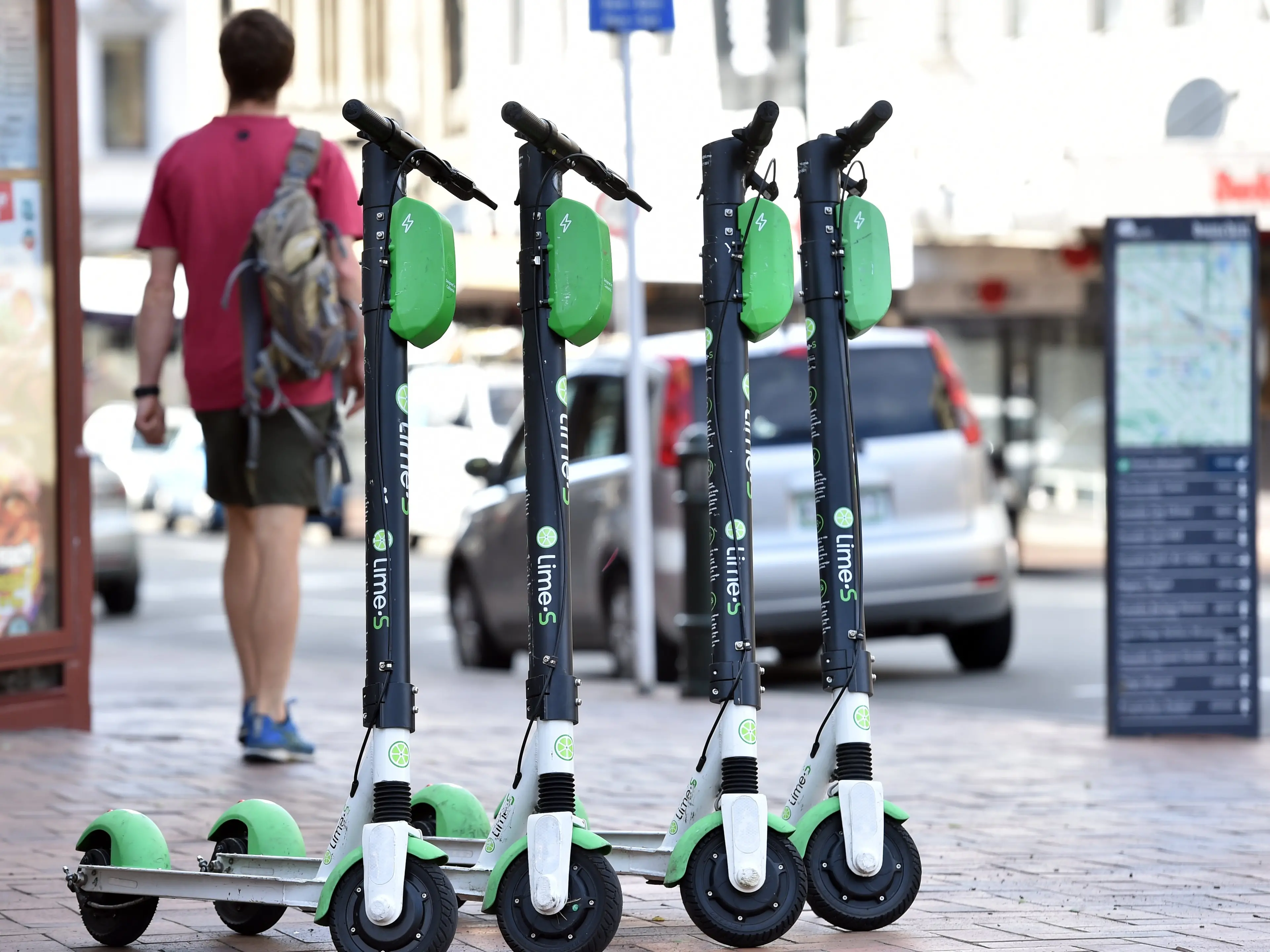
Nonetheless, questions remain. Why is Lime, having arrived uninvited, enjoying free, unlimited, commercial use of our footpaths for parking and renting out hundreds of unwarranted and unregistered motor vehicles? Why is Lime paying no ACC levies on its vehicles? Why do riders need no licences, no training, no helmets? Why are riders allowed to drive fast, drive recklessly and drive drunk? Why are riders allowed to block our footpaths with dumped e-scooters?
For city councillors, the nothing-we-can-do mantra took a while to sink in. At their March 26 meeting, when staff advised that "current mechanisms do not allow for the management or control of e-scooters,'' the council asked staff to "report back urgently on further mechanisms to restrict or control e-scooter use on footpaths in busy pedestrian areas''.
If staff had approached that task with open minds, all the published information on Lime's faulty scooters, misleading claims, and questionable business practices would have set off alarm bells.
If staff had not been mesmerised by the nothing-we-can-do mantra, they would have followed up comments from Buddle Findlay partner Tony Dellow - reported in The New Zealand Herald and the Otago Daily Times, and in interviews with Newstalk ZB - that the Minister of Commerce and Consumer Affairs has the power to order a compulsory product recall of Lime scooters under the Fair Trading Act.
If staff had their wits about them, they would have grasped the implications of district court cases in which the accused pleads not guilty to a driving offence on the grounds that ride-on lawn mowers, golf carts, electric scooters, or motorised chilly bins are not motor vehicles. In all such cases, judges have ruled that, if the motor is the vehicle's primary means of propulsion, it's a motor vehicle.
If staff had realised that the NZTA's decision to reclassify e-scooters as not motor vehicles is open to challenge, they could have asked Parliament's Regulations Review Committee to check the validity of the NZTA's Gazette notice.
And if they'd looked at the committee's website, they would have learnt that the validity of the Gazette notice is already under review. Furthermore, if the committee finds that the NZTA has misused its delegated power, it can recommend that Parliament disallow the Gazette notice, and by doing so confirm that e-scooters are motor vehicles, and therefore not allowed on footpaths.
But DCC staff did none of those things. Instead, they asked the council to approve a 12-month trial of a "voluntary footpath courtesy zone'' in the busiest part of Dunedin's CBD. The zone would have an unenforceable 15kmh speed limit for users of e-scooters, skateboards and mobile scooters on footpaths, and no legal or regulatory penalties for non-compliance.
Our mayor and councillors - uneasy, but mesmerised by the nothing-we can-do mantra - voted for the trial, but cut it to six months.
Because the trial will make our footpaths less safe for people with disabilities, the council's vote in favour of the trial, was a vote in favour of breaching the Human Rights Act.
The Human Rights Commissioner could take the DCC to court for unlawful discrimination.
Here's a better idea. The DCC should call on the Minister of Commerce and Consumer Affairs to order a compulsory product recall of Lime scooters, to be lifted only when legislation has been passed to ensure that:
- Footpaths are built and maintained for the exclusive use of pedestrians and people who cannot walk.
- Footpath safety rules are made and enforced.
- Technical standards and rules of use are developed for all new vehicles before they can be rented or sold.
- Space for the movement and parking of new vehicles is created by the reallocation of space used by existing vehicles.
- Pedestrians are recognised as key stakeholders in all transport planning decisions.
- Dr Lynley Hood is co-convener of the Dunedin Pedestrian Action Network and trustee of Visual Impairment Charitable Trust Aotearoa.