

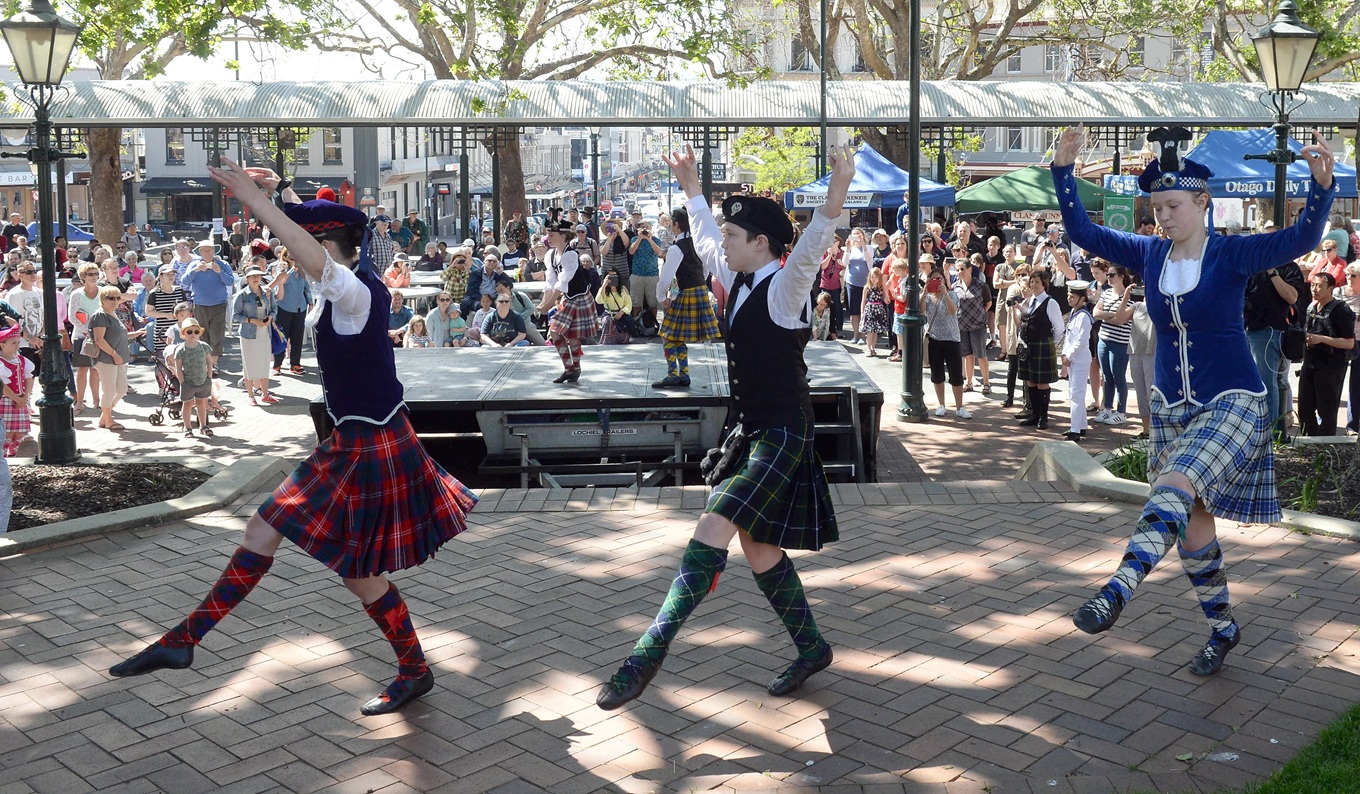
Add to this, it was St Andrew’s Day yesterday.
St Andrew’s Day is Scotland’s official national day, celebrated as November fades and winter settles in. Rooted in the ancient veneration of Andrew the Apostle, whose legends and relics helped shape Scottish identity for nearly a millennium, St Andrew’s Day is celebrated in Scotland with a sort of cheerful vagueness; some people dutifully attend a ceilidh, others make a noble attempt at cooking haggis and still others simply raise a glass and declare it a good excuse for a party.

The highlight, as I am reliably informed by my friend Ron, was the Irn-Bru ice cream.
Meanwhile, I am sure there will have been a great many Scottish-themed celebrations the world over yesterday . You can bet that Scots, or descendants of Scottish folk, will have united in the sacred St Andrew’s Day tradition of doing something vaguely Scottish, then insisting it’s exactly what their ancestors would have wanted.
St Andrew, by the by, is the disciple who introduced his brother, the Apostle Peter, to Jesus. Andrew was a fisherman, and was called upon (alongside said brother) by Jesus to be "fishers of men". (Given Scotland’s prominent fishing industry, his patronage is rather apt.)
Andrew met his end on a diagonal, or X-shaped cross — his was not a typical crucifixion. As well as being Scotland’s patron saint, he is also the patron saint of Greece and Russia, as well as fishermen, fishmongers, singers, sore throats and spinsters. He’s a busy man.
I’m not entirely sure how Andrew became the patron saint of Scotland. Medieval legend insists that Andrew’s relics were smuggled from Constantinople (now Istanbul) to the future St Andrews, courtesy of a certain Regulus — although the only historical Regulus on record had inconveniently lived a century too early.
Other historians suggest the relics probably came with Acca of Hexham in the 8th century. Then, in 832, the Pictish king Oengus supposedly prayed his way through being outnumbered by Angles, before witnessing a heavenly X blaze across the sky — handily recalling the aforementioned crux decussata (diagonal cross) upon which Andrew was martyred.
Oengus won the battle and gave Scotland its patron saint along with its saltire. Later writers embellished this connection, especially after the Synod of Whitby, when Andrew conveniently outranked Columba in apostolic seniority. By the time the 1320 Declaration of Arbroath declared Andrew "the first to be an Apostle", his status as Scotland’s patron saint was secure.
While archaeological evidence points to lengthy occupation of the area by Māori prior to the arrival of Europeans, Dunedin is nonetheless a city founded on Scottish faith, shaped by Scottish planning and proudly committed to its northern sister city.
Founded in 1848 by the Free Church of Scotland, Dunedin took its very name from Dun Eideann, the Gaelic for Edinburgh. The early settlers built their home in the style of the Scottish capital, from Princes St and the Water of Leith, to dour Presbyterian sensibilities and civic architecture. Charles Kettle’s ambitious plan for the city consciously mirrored Edinburgh’s New Town, topography be damned.
This connection between Dunedin and Edinburgh exists to the present day. The Dunedin-Edinburgh Sister City Society, for example, was established in July 1974, and revitalised by then-mayor Sukhi Turner in 2004.
It’s a fantastic society that works to preserve and celebrate Dunedin’s strong links with Edinburgh through events such as last weekend’s St Andrew’s Day celebrations, supporting Scottish arts and education, and collaborating with the city’s numerous Scottish societies and clans.
For some members, the celebrations are deeply personal. As Ron Mackintosh, a member of the sister city society, reflects: "When I came to Dunedin I was very homesick, so I didn’t get involved in any Scottish society. When I started my Scottish radio show, I began looking at Scottish history. About eight years ago I joined the Dunedin–Edinburgh Sister City Society, solely to get involved in helping to organise St Andrew’s Day ... a five-hour celebration of everything Scottish. It’s a great day."
The Dunedin-Edinburgh relationship is alive in other ways, such as in the reading room of the Centre for Irish and Scottish Studies at the University of Otago.
During my undergraduate days, I was privileged to study under the tutelage of Prof Liam McIlvanney, Stuart Chair in Scottish Studies at the aforementioned centre. He taught me to love and appreciate Scottish literature, from the gritty crime fiction of Ian Rankin to the gorgeous poetry of Kathleen Jamie.
Now the public can visit the centre to enjoy the Scottish and Irish holdings of the National Library of New Zealand, along with treasures from the Dunedin Burns Club and private collections.
Then there’s Ron’s Scottish radio show, the only live Scottish broadcast in New Zealand, airing Sunday nights at 8pm on radiodunedin.co.nz and 1305 AM.
Ron’s show is just another thread in this tapestry (tartan, perhaps) of connection, celebrating Scotland’s musical inheritance while deftly weaving history, melody and memory into the fabric of Dunedin’s cultural life.
It has been 51 years since Dunedin and Edinburgh were formally twinned. It’s only natural that the character of city partnerships is shifting.
The world today is more digital, more interconnected and more mobile. Exchanges once conducted by delegation are now mediated by screens; cultural connection increasingly flows through art, music, research and heritage initiatives rather than ancestry alone.
But at heart, this relationship remains the same. There’s a recognition that identity — Scottishness, Celtic-ness, if you will — can travel, evolve and return strengthened.
For Dunedin and Dunedinites, "Scottishness" isn’t dusty nostalgia. Rather, it’s a living, growing element of civic life, visible in its festivals, institutions, creative industries and everyday rhythms.
What will the next 51 years hold for Dunedin and Edinburgh? I can only speculate, but I am certain the connection will endure, not merely because of Dunedin’s Scottish heritage, but because of the people who care enough to nurture it.
• Jean Balchin is an ODT columnist who has started a new life in Edinburgh.


