

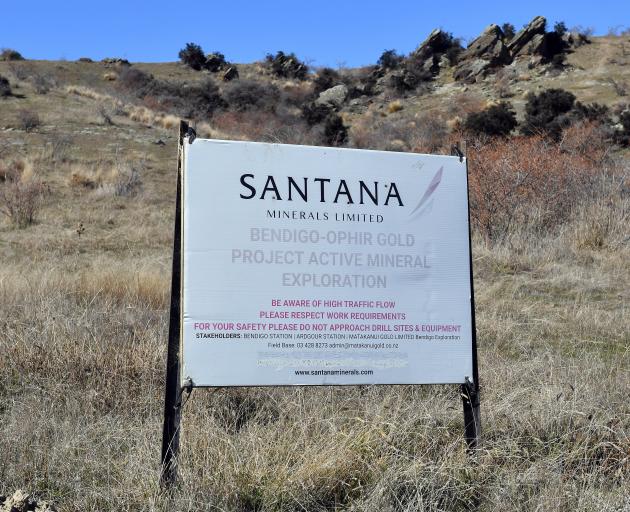
The agencies said Santana Minerals’ bid for a decision to be made in 30 days was unrealistic, the Otago Regional Council (ORC) calling for a 140-day decision-making period.
In submissions to fast-track panel convener Jane Borthwick, the Department of Conservation, Central Otago District Council (CODC) and local rūnaka raised concerns ahead of a conference call between key stakeholders earlier this week.
The Panel Convener is in the process of determining the composition of the expert decision-making panel, and the appropriate timeframe for the panel’s decision.
Representatives of the local rūnaka said the entire consultative process had been inadequate.
"Particular concerns arise regarding effects on water, ecology, landscape and whenua, and the risks arising from long-term storage of hazardous substances in proximity to land and water with ongoing risk of serious and irreversible contamination.
"Accordingly, Kā Rūnaka hold deep and immutable concern regarding the breadth, depth and timeframe of effects arising, and do not consider that the applicant has provided any evidence that these effects are able to be avoided, or reduced to an acceptable level, such that granting of consent is possible under the fast-track Act."
The runaka said the application was "complex", which was "made more difficult by absence of any meaningful dialogue with the applicant".
It also blasted the notion there had been any collaboration at this point, "due to the lack of timely and constructive communication".
"Put briefly, Kā Rūnaka considers the approach taken by the applicant does not fulfil consultation requirements, and any efforts made are insufficient gestures taken in order to ostensibly fulfil legislative requirements."
During a conference call, Santana’s legal representative said the company had a "a different perspective" and had engaged with Ngai Tahu since 2017.
There had been "good" engagement that "just needs to continue", he said.
The ORC said a longer timeframe was needed given the complexity of the application.
"The regional council considers that a timeframe of no less than 140 working days ... is required for the panel to make and issue a decision.
"The conditions, as drafted, are not accepted by ORC; and prior to lodgement of the substantive application, meaningful engagement ... was limited."
Doc complained about the "limited meaningful engagement on significant issues" with Santana and raised concerns around "gaps" in information provided.
The potential environmental effects were immense, Doc said.
"The scale of wildlife disturbance is also potentially unprecedented. For example, more than 100,000 absolutely protected lizards are likely to be impacted, with the majority expected to be killed and the remainder disturbed and/or translocated."
The CODC was also wary of the complexity of the application, and asked for an extension for consultation and decision-making of 120 days.
Heritage New Zealand focused on the archaeological values of the site, which were "significant".
Meanwhile, Santana’s submission argued it had consulted widely with the agencies and proposed a 60-day timeframe for the panel’s decision-making.
It had previously asked for 30 days.
Its submission highlighted its levels of consultation, which included 56 community drop-in sessions and presentations to more than 25 local organisations.
- Additional reporting by Mary Williams and Julie Asher


