
PHOTO
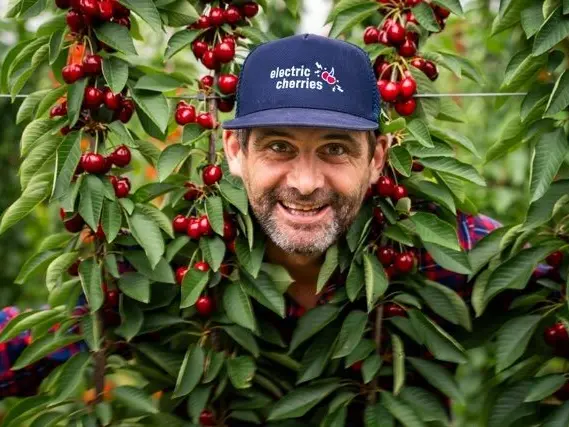
The failure to launch of Central Otago’s summer season has had a devastating impact on this year’s cherry crop, but one Cromwell orchardist has fared better than others thanks to his decision to electrify his operation.
‘‘We’ve been told by the old guard in the cherry industry that this is the worst summer in a long time,’’ Electric Cherries owner Mike Casey said.
‘‘There was a lot of wind in the spring, it’s been really cold, and every weekend there’s been 20 to 30mm of rain.
Mr Casey said that around a third of the fruit on his farm was damaged, and that a lot of farmers in the industry lost money this year.
‘‘We didn’t make money, but we didn’t lose it, so we live to fight another season.
‘‘And I think a lot of that has been down to the energy choices that we made which lowered our operating costs,’’ Mr Casey said.
The ‘‘energy choices’’ that Mr Casey refers to is the decision to run his farm using electric energy rather than fossil fuels.
On Mr Casey’s farm, everything from the frostbite fans to the utes are electric, and 90% of the energy used on the farm is generated on the premises through solar power.
Electric Cherries happened by accident.
When house-hunting in the area, Mr Casey and his family realised that they could buy a 9 hectare farm 30 minutes south of the town for the same price as a four-bedroom house on a quarter acre section in Wanaka.
With 9 hectares of pastoral land in his backyard, Mr Casey wanted a yield from the property.
Next thing you know, the software developer owned 9300 cherry trees.
‘‘When you plant 9300 cherry trees, you need the machines to operate the farm in order to grow those trees and harvest the fruit,’’ Mr Casey said.
Mr Casey — who is now the chief executive of electrification advocacy group Rewiring Aotearoa — said that he was receptive to electrification when the project started in 2019, but that the decision to electrify was as much about long-term economics as it was ideology.
‘‘We never meant to go fully electric, we just ended up like that way because every time you looked at the lifetime ownership cost of an electric machine compared to a fossil fuel machine, the electric machine won by a country mile.’’
Electrification has a long-term financial benefit, but for Mr Casey the independence offered by electrification is an important opportunity for farmers to increase their resilience to weather events and price volatility in both fuel and produce.
‘‘The great thing about running electric machines is that you can run them on energy that you can create very easily on the farm, Mr Casey said.
‘‘In farming, there’s a lot of uncertainty with weather and prices in the market, but this is one thing you can make more certain in a very dynamic operating environment.’’
Fuel prices can be volatile, but so can the weather.
So how has Mr Casey fared relying on solar power during our damp squib of a summer?
‘‘People often associate temperature with solar yield, but it hasn’t been overcast.
‘‘There’s still been a huge amount of electricity generation that has been done; I don’t think its been radically different from any other summer but I haven’t bothered to check because I don’t think there’s been a material difference in our solar yield,’’ Mr Casey said.
Through Mr Casey’s experiences in electrifying his farm, he has become a champion for electrification on a national scale.
And while electrification is generally associated with climate change and sustainability, when Mr Casey advocates for electrified agriculture these days, it’s all about the money.
‘‘Now when I talk to farmers about it, very rarely do I talk about the climate benefits, I talk about how its a slam dunk from a business perspective.’’