
PHOTO

Overseas investment in forestry is often under the spotlight but it has created a win-win for an Otago forest company and the community.
After more than seven years of hard work, Wenita Forest Products Ltd has opened 12 public tracks throughout and near its forest plantations in Berwick, Mt Allan and on the coast.
"People sometimes think forestry is just burly men in checked shirts running around with chainsaws.
"But in fact, it’s a sophisticated and responsible operation, and supporting public access allows people to see that for themselves" Wenita chief executive David Cormack said.
The process of creating the tracks began in late 2018, when the Overseas Investment Office (OIO) granted Otago Estate Limited (OEL) permission to acquire more than 22,000ha, covered in exotic forestry, owned by Wenita, near Dunedin.
OEL was controlled by New Forests Australia Forest Fund 2, of Sydney, a long-term forestry investment fund.
Wenita maintained the cutting and management rights to the trees on the land.
In late 2025, OEL was sold to APG Asset Management — Europe’s largest pension investor — along with a 38% stake of Wenita’s owner Taieri Forests Limited (TFL).
TFL is now jointly owned by APG and the Pension Protection Fund, based in the United Kingdom.
In 2018, the Outdoor Access Commission had a statutory role in assessing OIO applications with a view to protecting and enhancing public access.
While the forests were already crossed by public roads, opportunities were identified to create new walkways and access to the forest and historical sites including from early gold mining and farming days.
The OIO agreed to these access routes as conditions for the consent.
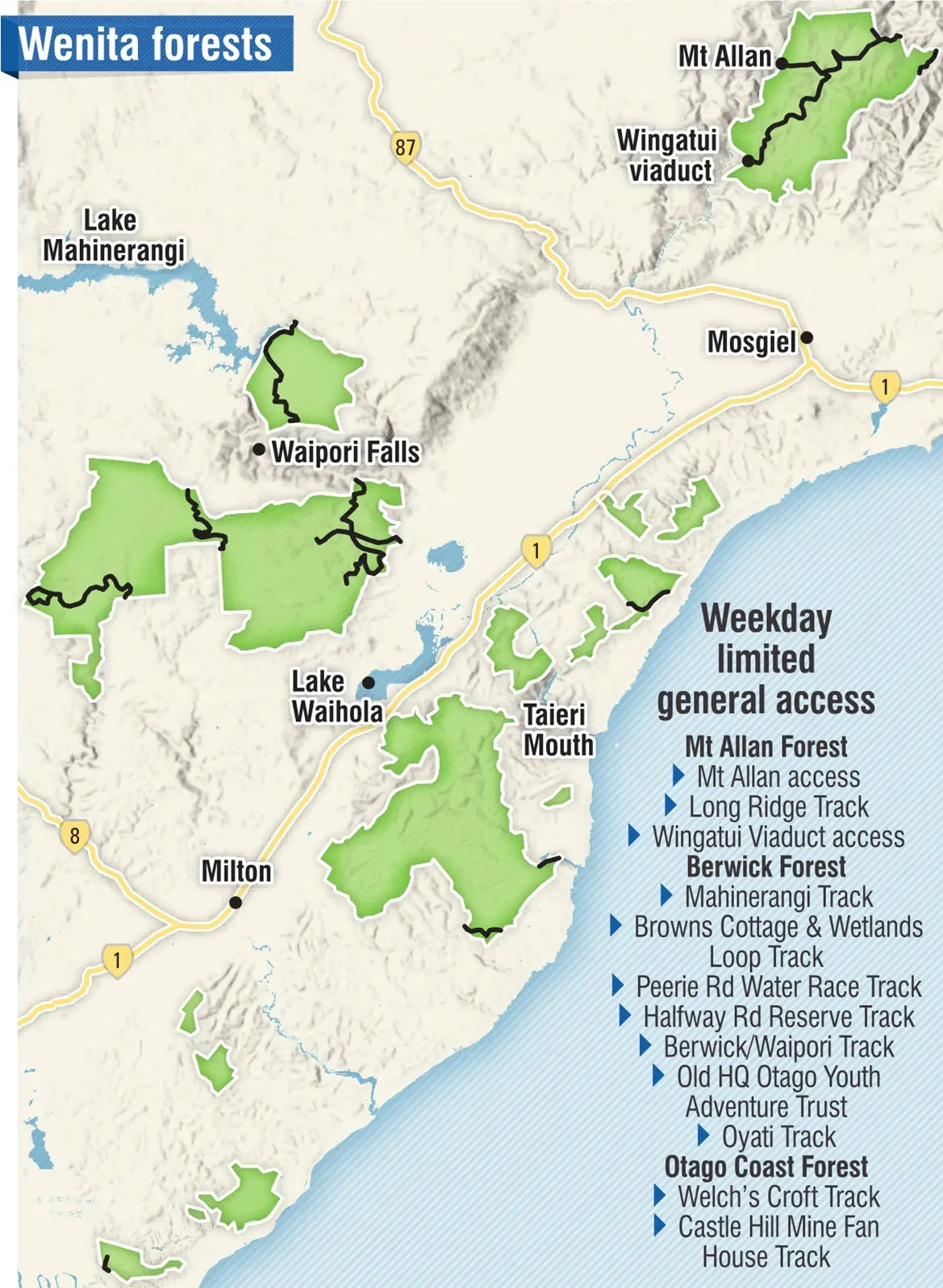
That led to seven years of work to get the routes ready.
Twelve new public access routes through Wenita’s three main forest areas of Berwick, Mt Allan and on the Otago coast, have been created.
For safety reasons, since the walkways are within working forests, access is by permit.
Last year, the company granted more than 3500 permits, mainly to hunters.
Mr Cormack said completing the project was a relief, but the best thing had been seeing people enjoying the benefits.
The company did not reveal the total cost of building the tracks.
"Wenita forests are a very popular place to spend time, and so far, we have had only positive feedback — so that’s the proof of the pudding, for me."
The new walkways range from a few hundred metres to 15km in length and from gravelled, driveable forestry roads to steep walking tracks.
Most are through exotic forest, but there are pockets of mature native trees and birdlife.
About 3200ha of the forest area is cloaked in indigenous vegetation, managed for conservation purposes and some easements run through or around these areas.
The forests were also home to a growing population of the nationally threatened kārearea, New Zealand falcon, as well as at-risk native galaxiid fish, Mr Cormack said.
"Our creeks do sustain life and hence it’s important to work around them and not damage them."

Most public access routes are for walking or cycling only.
Information passed on by visitors could help Wenita manage the forest, Mr Cormack said.
He said the company’s co-operation with public access was partly about social licence, in terms of being seen to be a responsible and sharing member of the community.
Mr Cormack said the main advice he would share with other landowners, especially forestry owners, considering allowing public access was "don’t fear it".
"There are certainly benefits to having people in your forests.
"But go in with your eyes open.
"It can be a complicated process — it can be expensive.
"But, in our experience, the benefits have outweighed the disadvantages."
More broadly, people now expected to know what was going on in forests and on farms, he said.
"We need to give people the opportunity to see with their own eyes how we’re treating and leaving the land, how we’re operating on it.
"If you’re not prepared to do that, someone else will fill them in for you.
"And it won’t always be favourable."