

AMI, State and NZI chief executive officer Phil Gibson said between March 1, 2025, and February 28, 2026, the insurance companies processed 33,174 customer claims from storms during the year.
Among them was the October 22, 2025 storm which battered Otago and Southland with wind gusts up to 180kmh, causing widespread damage, particularly in Southland.
It reportedly resulted in more than 10,000 insurance claims and caused more than $28million in damage.
AMI, State and NZI supported customers through 5289 of those insurance claims, and Mr Gibson said it was the most damaging storm of the year.
The next two most damaging storms were the February 16, 2026 storm, which affected the lower and central North Island and some parts of the South Island (3354 claims), and Ex-Tropical Cyclone Tam on April 16, 2025, which caused major damage and widespread power outages in the upper North Island (3281 claims).
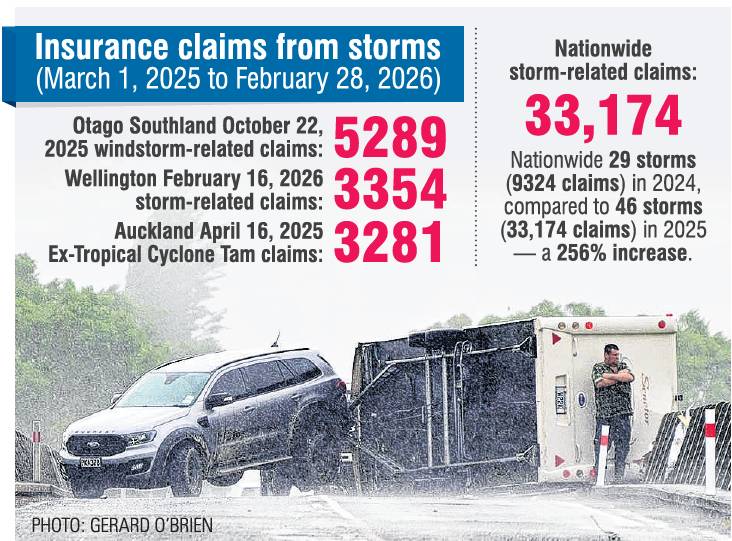
Mr Gibson said overall the 33,174 claims during the 12-month period were ‘‘an astounding’’ 256% increase on the previous year, when 9324 weather-related claims from 29 storms were recorded.
He said over the past 15 years, storms typically affected parts of the country once every 19 days.
However, in the past 12 months, that frequency had more than doubled to once every eight days, making storms a near-weekly occurrence, he said.
‘‘Simply put, our data indicates that storms are arriving more often and with greater intensity.’’
Mr Gibson said the recent passing of Cyclone Vaianu over New Zealand had been another ‘‘stark reminder’’ of how vulnerable the country was to wild weather.
‘‘While thankfully not as severe as originally projected, Cyclone Vaianu has to date resulted in more than 890 claims across home, contents, commercial, motor and boat policies.’’
The majority of claims were due to roof leaks, fallen trees and damage to windows and glass, particularly in the east of the North Island.
He said as severe weather events became more frequent, the insurers were also seeing a shift in seasonal storm patterns.
‘‘In this tracked period, 61% of storms occurred in spring and summer, rather than in the cooler months where we’ve previously seen more storm claims.
‘‘This shift highlights the volatile nature of New Zealand’s weather and the need for year-round preparedness.’’
In a recent climate change survey, 90% of New Zealanders said they expected more frequent and extreme storms, and more than 75% wanted investment in risk reduction, mitigation and resilience.
‘‘Conversations around climate risk are maturing and there is widespread public support for risk reduction,’’ he said.
‘‘New Zealanders know this is a worsening problem and want action.’’
If we wanted to keep people protected, councils, government and insurers must work together to address the underlying risks, he said.
‘‘We can do it. It simply requires making risk reduction a priority and collective, timely and co-ordinated action from all of us.
‘‘Ultimately, reducing natural hazard risk is the fairest and most durable way to keep insurance affordable and available to as many New Zealanders as possible,’’ he said.


