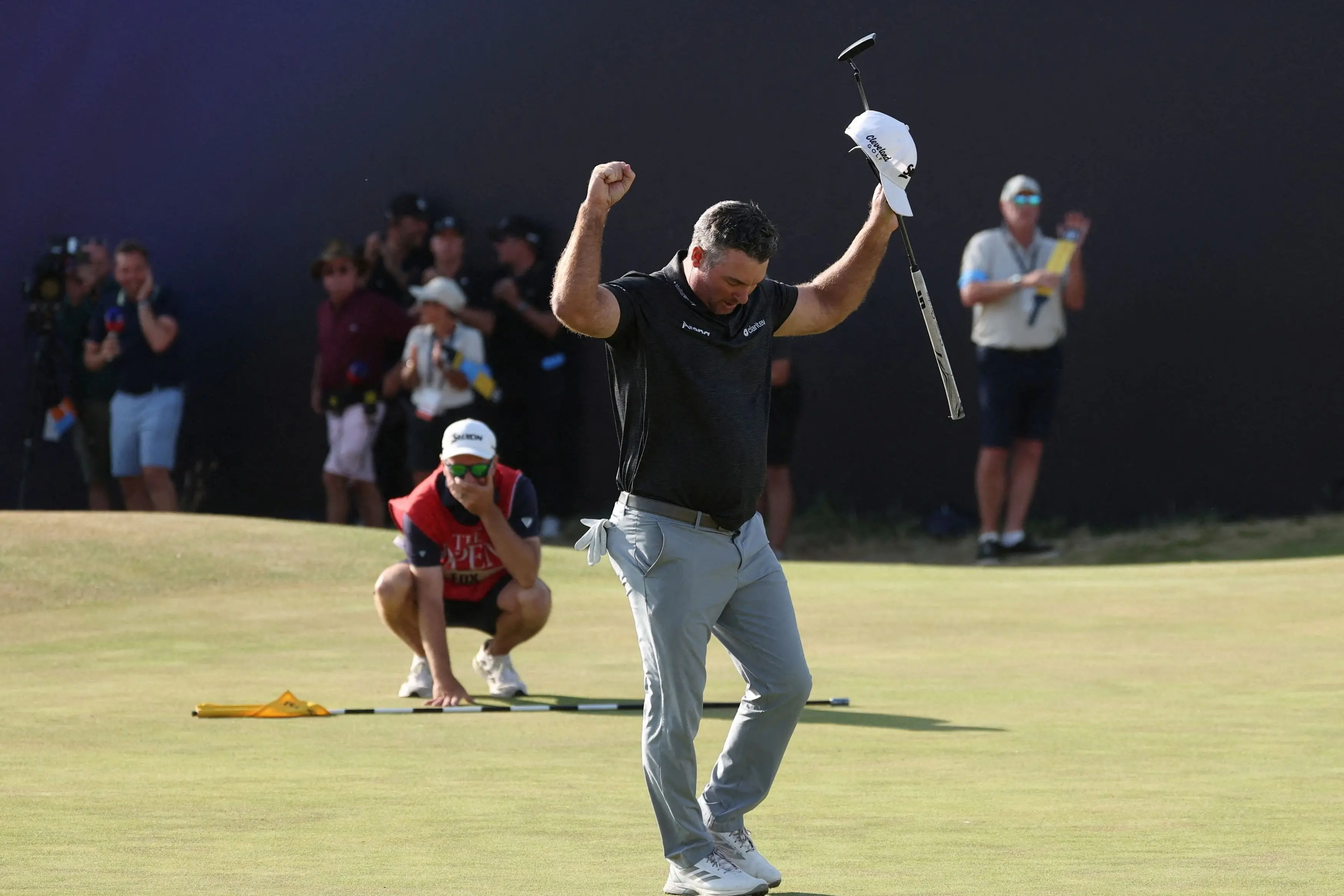
It takes something special to make veteran golf correspondent Neville Idour speechless. He reflects on the magnificence of Ryan Fox’s win at the British Open. What can one say that hasn’t been said? The accolades have been pouring in since proud Kiwi Ryan Fox sank that lengthy final putt on the 18th at Royal Birkdale to join Sir Bob Charles as an Open champion. What a rollercoaster ride it was as Fox emerged from oblivion after round one in 52nd place. He just made the weekend and would then produce the largest 36-hole comeback by position to win a men’s major. In fact, he is just the second golfer outside the world’s top 50 ranked players to win a major in the past 15 years. His best finish at The Open in nine previous attempts had been T16. And before round three began, his chances of success were razor-thin according to bookmakers. Some had him at 750/1. A stray dollar or two would have brought rich rewards. Fox’s brilliant 62 in the third round rocketed him up the leaderboard into the final grouping for the fourth round with Sam Burns. For 12 holes, the battle raged with Fox tantalisingly close to the lead along with several others, including Scottie Scheffler, lurking ever threateningly. However, come hole 13 the Fox would show his fighting qualities and produce one of the finest closing six holes in major history. He would reel off birdie, birdie, bogey, birdie, par, birdie. His bogey on 15 was remarkable as he had a wretched lie in a bunker, forcing him to play out away from the green, bringing double bogey into play. An excellent recovery and putt saved a bogey. So, it would all come down to his final 10-foot putt, which he would face after Sam Burns had putted out. In typical Fox fashion, he took just 22 seconds from the time Burns’ putt dropped to sink his. Extraordinary. Fox may well become known as the “22 second man”. New Zealand’s newest major champion showed a steel-like temperament when it mattered most, and coupled with his no-nonsense fast play, it was mesmerising to watch him go about his business. However, his at-times cavalier attitude has not happened naturally since childhood or as an adult. His performance coach since 2019, Karl Morris, has had a significant role to play with their weekly work. Morris has an impressive portfolio, having worked with Louis Oosthuizen, Graeme McDowell, Darren Clarke, Lee Westwood, Ian Woosnam, Paul McGinley and others. Before the Open began, Morris talked with Fox and caddie Dean Smith and gave some guidance. He suggested that Smith should take a back seat in helping Fox with his shots and stick to providing cold, hard facts. He did not want Smith suggesting that Fox should do this or do that when Fox saw it differently, otherwise Fox would end up with mixed messages blurring his vision of what to do. So, Smith would just get to the shot and give Fox the necessary facts and data such as distance, wind direction and velocity, pin position, green slopes, and ask Fox what shot he was going to play. “That way he’s got a really clear intention of what he’s trying to do,” Morris said. “But he also owns the whole process and won’t end up saying ‘why did you say this’ or ‘why tell me to hit 8 iron’.” The common sense of this approach was confirmed on the final hole when Fox said he would play the hole to win the Open, not end up in a playoff . . . and so it proved. Coming back to those final six holes, the progression round by round was interesting. He parred all six in round one, and had a solitary bogey in round two. In round three, he hit his hopples with three birdies and added the coup de grace in the final round with four birdies and the bogey. Not surprisingly, most golf pundits rated this the best of the four majors in 2026 with Fox receiving so much praise not just for his win but for the way he plays the game. His caddie rates the Kiwi as “probably the fastest player in the world.” In a world where golf can sometimes seem to be agonisingly slow at times and getting worse, Fox’s Open victory was like a huge breath of fresh air.