
PHOTO
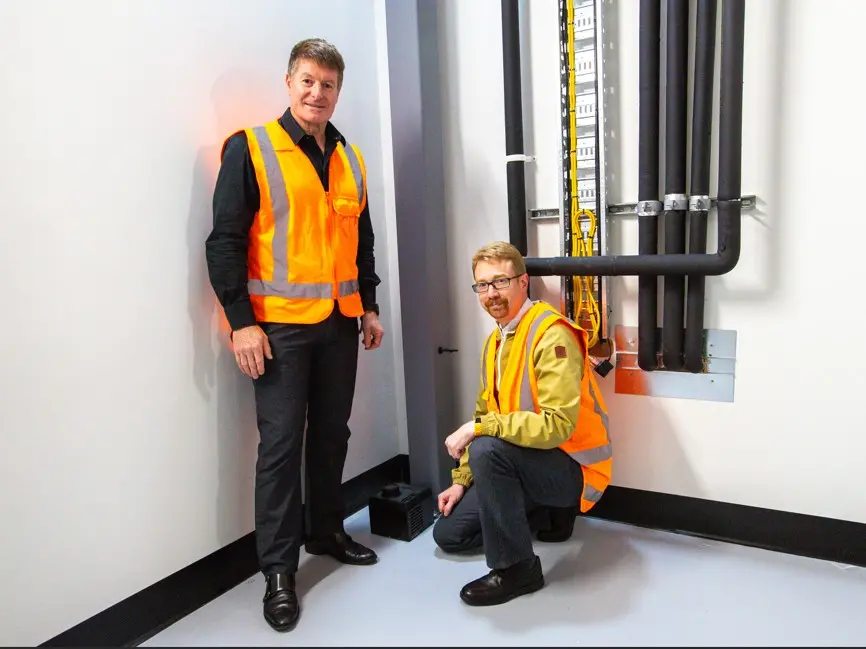
Earthquake sensing tech, designed by Canterbury researchers to allow fast, accurate safety assessments, has been installed inside Christchurch’s new stadium.
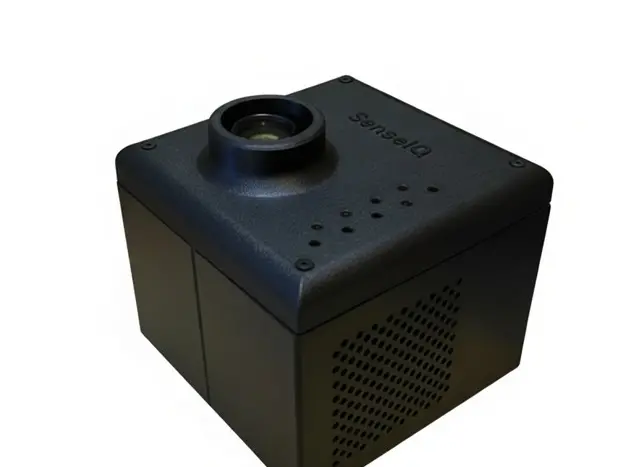
The sensor, called SenseiQ, measures inter-storey drift – the relative movement between floor and ceiling - during an earthquake. It then provides information that speeds up the process of clearing a building for safe reoccupation.
One of the sensors has been installed at One New Zealand Stadium, which will host New Zealand’s first Super Round of Super Rugby Pacific matches this weekend.
SenseiQ was developed by Te Whare Wānanga o Waitaha | University of Canterbury (UC) Civil and Environmental Engineering Professor Daniel Nilsson, Emeritus Professor Roger Nokes and Dr Gabriele Granello, a structural engineer and former UC postdoctoral researcher now based in Italy.
UC alumni, lawyer and independent director Andrew Logie has also joined the Sense i Solutions Ltd team.
Professor Nilsson, Director of SenseiQ, says it’s exciting to have a landmark facility adopting the technology.
“The sensor measures the damage, not just the shake, telling us straight away how much a building has moved - the ‘inter-storey drift’ - allowing the building’s condition to be assessed more quickly and accurately.
“Traditional safety inspections are slow and costly leading to prolonged downtime, unnecessary disruptions and financial costs. We’re delighted that the new stadium – a symbol of Christchurch’s post-quake recovery – is now equipped with our device.”
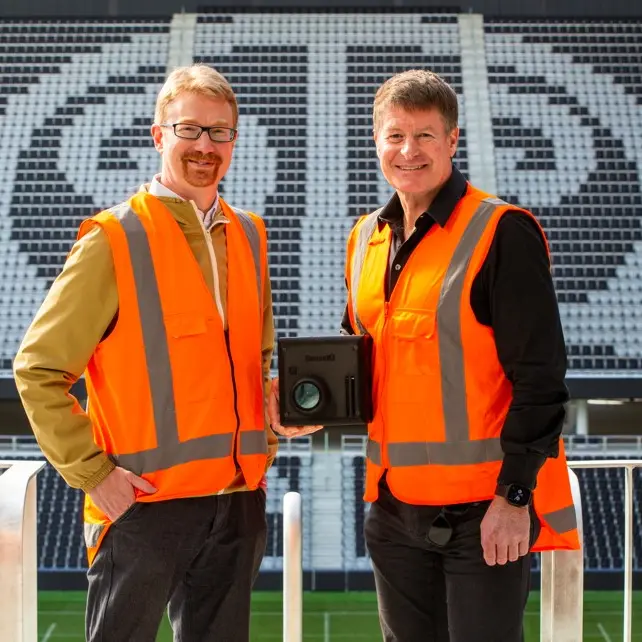
Professor Nilsson says unlike conventional sensors that measure only acceleration, SenseiQ captures both inter-storey drift and acceleration - two factors that directly correlate to the damage a building sustains during an earthquake.
The data is available within minutes of an event. The sensor has already measured one very small earthquake on 6 April, of 2.4 magnitude, at the stadium.
SenseiQ is made up of two components, a sensor and a target. The sensor is mounted on the floor and the target is attached to the ceiling.
Professor Nilsson says by providing precise, real-time data on a building’s response to seismic activity, SenseiQ enables structural engineers to make fast and informed estimates of building damage. This helps building managers make quick decisions about reoccupation.
He predicts there will be strong demand for the device from businesses around New Zealand, particularly in Wellington.
“The majority of our shareholders are researchers and we’re all focused on getting the best outcome in terms of buildings and human safety, for New Zealand and internationally,” Professor Nilsson says.
“The idea behind this technology came from what was seen in the aftermath of the Canterbury earthquakes when it took a long time for buildings to be assessed and cleared for people to come back to work.”
The research started with KiwiNet Emerging Innovator funding in 2018. Since then, the technology has evolved and a spin-out company was created in 2022, with UC as a shareholder.
Sense i Solutions Ltd is now working on promoting the technology nationally and internationally.
In another UC connection to the stadium, the university has just signed an agreement with Venues Ōtautahi, which manages the stadium, to gain naming rights for the East Stand.
From now until the end of 2027, it will be called the University of Canterbury Stand.
-Allied Media