
PHOTO
Consumer NZ says New Zealanders are getting a worse deal than they used to, as it releases its latest Yeah, Nah Awards results.
Chief executive Jon Duffy says the awards are designed to expose products, services and industries that let consumers down.
One award went to a coffee machine it said was "not worth getting out of bed for".
The Dr. Coffee H1 finished at the bottom of a Consumer coffee taste test, tied with three other machines, but it was $1000 more expensive.
"At $1399, this is far too much to pay for a machine that produces a bad-tasting brew," said Duffy.
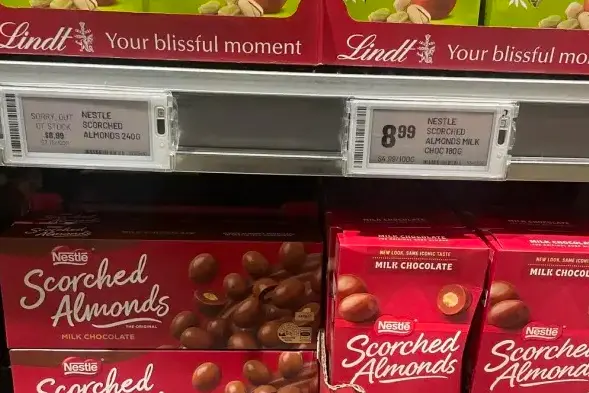
Consumer also called out Nestle Scorched Almonds for having dropped in price by 11% while the size of the packet fell 25%, from 240g to 180g.
"Shrinkflation is a regular source of complaints, and this product stands out as one of the most significant examples we've seen," Duffy said.
"We think the downsizing of the self-proclaimed 'perfect little gift' means it's now too little."
Nestle told Consumer it was part of efforts to manage cost pressures but Duffy said it was like gaslighting consumers.
"Effectively the price has gone up and you're getting less. It's really irksome for consumers."

Consumer gave the electricity sector as a whole a "power trip" award because it was still reporting record earnings while people were struggling to pay their bills.
"Power bills have risen 20% in two years and in 2026 business is booming for the major players in the electricity sector," Duffy said.
"When you've got the OECD finding that wholesale power prices in New Zealand are uncomfortably high, far higher than countries with similar renewable energy systems - at the same time that every consumer energy hardship indicator is moving in the wrong direction this year - there's no question that the sector is broken."
Health insurer nib was given an award for its poor customer service.
It recorded the lowest customer satisfaction rating of any service provider across every sector Consumer monitored. Its net satisfaction score was just 1 percent, and more than a third of customers said they had experienced a problem with the health insurer in the past three years.
Duffy said some businesses that had been highlighted in previous years had taken action to address the problems.
Westpac received a poor customer satisfaction score for its life insurance product in 2024 but had since made improvements that lifted that significantly, he said.
After receiving a Yeah, Nah in 2025 for its pricing practices, Harvey Norman undertook to improve some promotional labelling.
"Our team's been price tracking for a Black Friday investigation and it’s noticed marked improvement in Harvey Norman's promotional language."
But he said, overall, things were not looking up for consumers.
"I think things are actually getting worse because in many of the markets we monitor, customer service is declining, competition is lessening, there are fewer players.
"A lot of sectors are largely owned offshore and businesses are really focused on taking cost out of their operations rather than improving customer service to make things better for their customers.
"That's a generalisation, I'm not saying all sectors are like that but that is the trend that we see.
"Automation is increasing at an exponential rate so humans are increasingly out of the loop when it comes to customer service, so decisions are being made by machines and and advice is being offered by machines which means for many people they feel a sense of disconnection to the businesses that they're paying for the things they need in their lives and for some people that works fine but for others it's quite dehumanising and the overall quality of service that's provided is lower in my view."
