
PHOTO
The government has backed down on paying for its LNG import terminal through a levy, and is imposing steeper fines on power companies to shore up energy supply.
The government has also agreed to proceed with a terminal, and the Ministry of Business, Innovation and Employment is beginning consultation on new regulations for power companies' dry year supply backups.
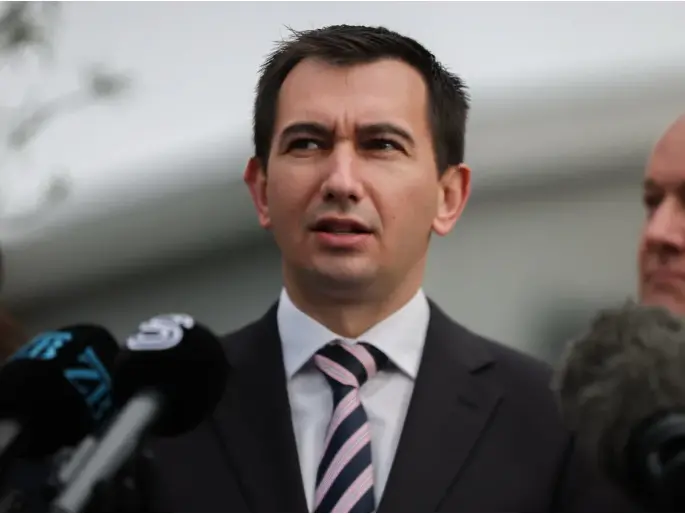
Energy Minister Simeon Brown announced the moves in a speech to the Auckland Business Chamber on Tuesday morning.
LNG power bill levy scrapped
"I have asked MBIE (the Ministry of Business, Innovation and Employment) and NIFFCO (the National Infrastructure Funding and Financing company) to work through the detail of how the facility will be paid for, including engaging with the gentailers on a fair funding model, and will have more to say in due course," Brown said.
"Kiwis can be certain of one thing - it will not be funded by a levy on power bills. Responsibility for keeping the lights on sits squarely with the electricity sector, and that is the principle guiding our decisions on funding."
His predecessor in the role, Simon Watts, announced in October the government would begin procurement for a liquefied natural gas (LNG) facility with the aim of completing construction by winter 2027.
In February, Watts and Prime Minister Christopher Luxon said the $1 billion facility would be paid for through a levy of between $2 and $4 /MWh, saying power companies would pay it and the terminal would cut future prices by at least $10 /MWh.
They also confirmed a likely delay to construction, with the facility set to finish in 2027 or early 2028.
The opposition attacked the levy as a 'gas tax', saying there was nothing to stop the costs being passed on to consumers, and warning that relying on LNG imports to protect against dry year risk would tie New Zealand's energy market to international fossil fuels vulnerable to price shocks.
The Iran conflict and Strait of Hormuz closure later that same month led to soaring prices, and documents later revealed the government had not considered the effects that would have when modelling the value of the terminal.
Alternative renewable energy solutions were also "considered but not advanced" due to "factors such as expected time to construct, feasibility of generating power reliably on the required scale, and effects on electricity market incentives".
Brown on Tuesday said renewable energy was now "booming" - crediting the government's fast-track consenting regime, national policy statements, and regulatory changes - but said without LNG to fall back on a dry year would mean skyrocketing power prices or business closures.
"Recent events in the Middle East are a timely reminder that New Zealand needs secure, diversified fuel supplies. Despite the conflict, LNG remains the fastest, cheapest, and most flexible dry-year solution that can be put in place this decade," he said.
He also confirmed the government had narrowed down its options for who would build the import facility to two providers, and intended to sign a deal this year.
Luxon had previously said the facility would only be built if the business case stacked up, but maintained that the government was "very interested" - dismissing an OECD report that said it risked locking in fossil fuel dependence.
Higher penalties for power companies, new regulations, bigger role for Electricity Authority
Brown also announced plans to increase the fines power companies would have to pay for failing to secure enough generation in a dry year.
Currently at $2 million, the penalty would increase to the whichever was the highest of three options: Three times the commercial gain, 10 percent of the company's turnover, or $10m.
This would be paid by companies that failed to meet regulations - called the Winter Energy Reliability Obligation.
The obligation requires electricity buyers to secure dependable winter cover where a shortfall is forecast in years ahead; and in the short term to show they have enough firm fuel cover if hydro storage runs low before winter.
Brown said MBIE would begin consultation "today", saying it would make the system "more resilient, reducing the risk of outages and sharp price spikes".
"Kiwis should not be paying more because the big power companies run the system on the edge - those days are over," he said.
Law changes would also give the Electricity Authority a "clear role in ensuring dry-year risk is effectively managed," he said, with the authority required to report annually to the minister on supply risks.
Changes to the Government Policy Statement on electricity would also set expectations that it prioritise dry-year and supply risk alongside reliability and affordability.
