
PHOTO
A Canterbury mayor is looking forward to partnering with Ngāi Tahu on local government reform, but is not so keen on the iwi’s proposed structure.
Te Rūnanga o Ngāi Tahu last week unveiled its own Head Start proposal for local government reform, which would divide its takiwā (territory), which makes up most of the South Island, into five councils aligned with river catchments.
The proposal would place the three North Canterbury councils into a council covering from Ngāi Tahu’s northern takiwā boundary at the Awatere River to the Rakaia River.
But Waimakariri Mayor Dan Gordon said he favoured keeping the southern boundary at the Waimakariri River.
The Waimakariri and Hurunui district councils have put in a joint proposal for a new North Canterbury unitary council, while Kaikōura has opted to join with Marlborough.
‘‘The North Canterbury Council proposal has been community-led, and our view is that this strikes the right balance between managing catchment areas and river corridors, supporting common communities of interest, as well as financial sustainability,’’ Mr Gordon said.
‘‘Regardless of what shape this may take, we look forward to continuing to collaborate and partner with Ngai Tūāhuriri and Ngai Tahu going forward.’’
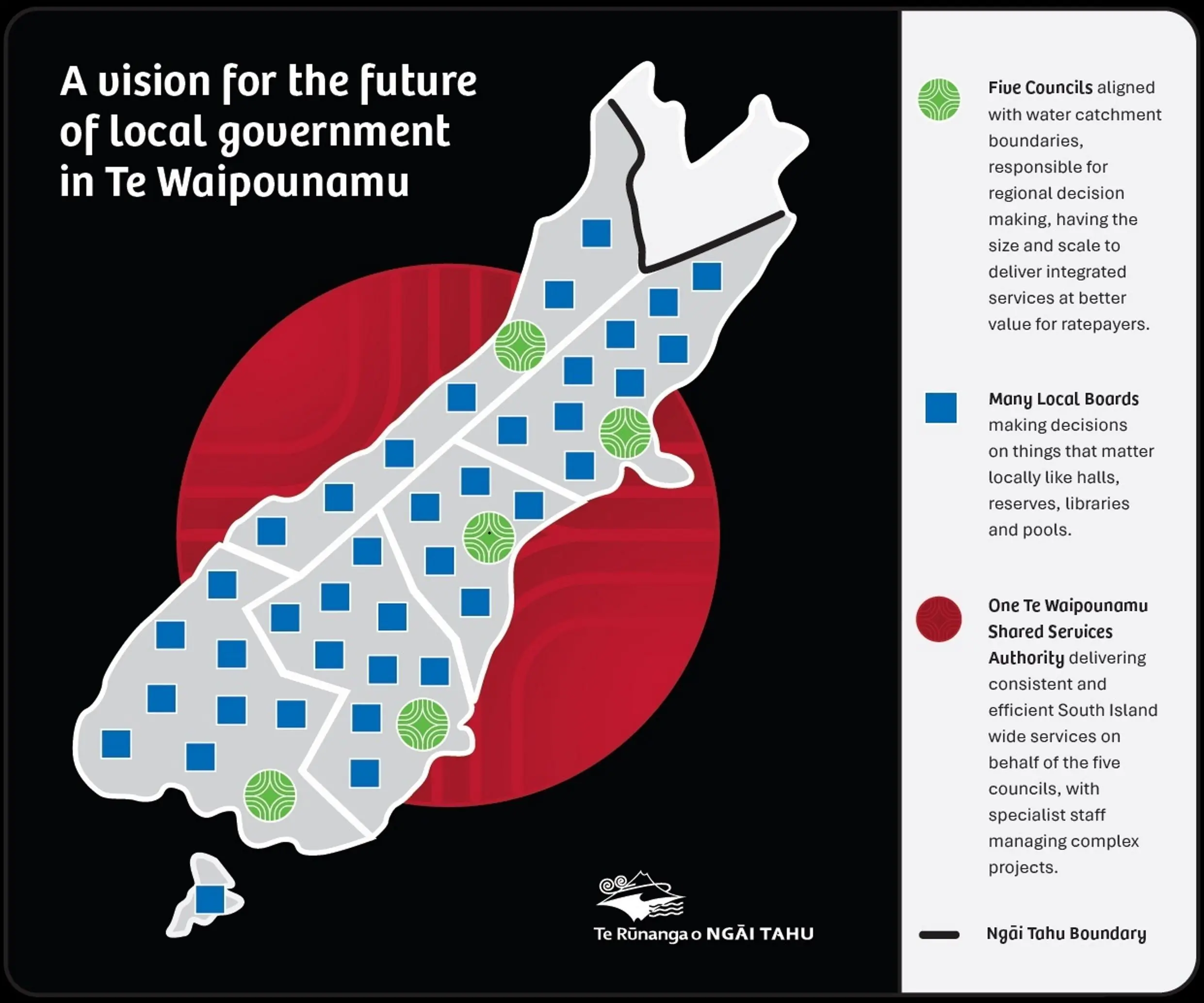
Te Rūnanga o Ngāi Tahu Kaiwhakahaere Justin Tipa said the five councils would be supported by locally elected boards and a South Island-wide shared services entity.
‘‘As an iwi whose takiwā spans most of Te Waipounamu, we have a unique perspective on the opportunities and challenges facing our communities.’’
The North Canterbury council, proposed by the iwi, would bring together more than 600,000 people across Christchurch, Selwyn, Waimakariri, Hurunui and Kaikōura.
The other four councils would have a combined population of around 500,000.
‘‘A lot of the discussion to date has focused on where the lines should be drawn between urban and rural communities, but council boundaries need to be at the right scale to deal with the challenges in front of us,’’ Mr Tipa said.
‘‘Rivers flow from the mountains to the sea, through both rural and urban areas and decisions made up stream directly affect communities much further down the catchment.
‘‘Natural disasters don’t discriminate between one district and the next either.’’
Electing local boards will ensure communities have a voice, he said.
‘‘The experience of our iwi since settlement shows that scale can sit alongside local voice and authority.
‘‘Different parts of the system can hold their own responsibilities and powers while working together on the issues they have in common.’’
Under the proposal, Papatipu Rūnanga representatives would be elected alongside mayors, councillors and board members.
The Government has said it will announce which Head Start proposals will proceed to the detailed design stage next month.
■ LDR is local body journalism co-funded by RNZ and NZ On Air.