

A spiral bound notebook is never far from Nick Austin’s hands.
The lined pages filled with notes and drawings is effectively the Dunedin artist’s studio.
It is where he jots down ideas as he goes about his daily life and where he plays with those ideas when he has some time.
“Then sometimes it’s just a matter of execution.’’
Daily life is busy with a day job, as Hocken Collections art and photography collections assistant, and family but it is also where Austin gets much of his inspiration from.
“There are various materials we see here in my exhibition that I kind of come across in my day-to-day life, whether that’s at work or at the shop or something like that.
“And those are the kind of the sources for material gathering.”
Within a research-based environment such as the Hocken, he finds he often comes across items by accident which he believes is a strength of his practice.
“I think it’s an unusual way for a research-based practice to manifest. It’s a perk of the day job I guess.’’
This more recent work is a circling back to his earlier practice at art school where he studied and made assemblage sculpture.
It was while going through photographs as part of his job that he came across a set of photographs of workers at the Brinsley Works in Jutland St.
“They were manufacturers of coal ranges and then later ovens.
“So these are my iPhone photos of the photos that were taken between the 1940s and 1960s, many by Cyril Leeden.”
Digital Oils (2025) features the white-gloved hand of a curator holding the photograph — just as Hocken staff do when dealing with delicate materials — as part of a slideshow of photos accompanied by the soundtrack of Dunedin band Negative Nancies, who used to perform with various other bands at a warehouse residence next door to the factory in the 2010s.
“These elements have different links to the site across time.’’

It is an example of how Austin, who as a teenager was intrigued by the unusualness of the life of an artist, seeks to make two or three connections between materials within any one work.
Another work To Be a Rest Home (2025) features a series of mirrors found in a second-hand shop. On each mirror he has inscribed the names of some of New Zealand’s most celebrated women artists including Rita Angus, Frances Hodgkins and Grace Joel.
The artists were selected as their names are all used by corporate aged care for retirement homes or villages.
Austin is intrigued by why artists’ names have been used in this way and he uses it to raise discussions about legacy.
“Interestingly as far as I know only one of these artists had children.’’
He is also curious about the concept of retirement as it is often said that artists never retire.
“I’m interested in ‘retirement’ as a post-work stage but also as a kind of withdrawal.’’
The name of the show “What Did People Do All Day?’’ is a meditation on work and self-reflective about how time is occupied.
“There are various time scales in the show.’’
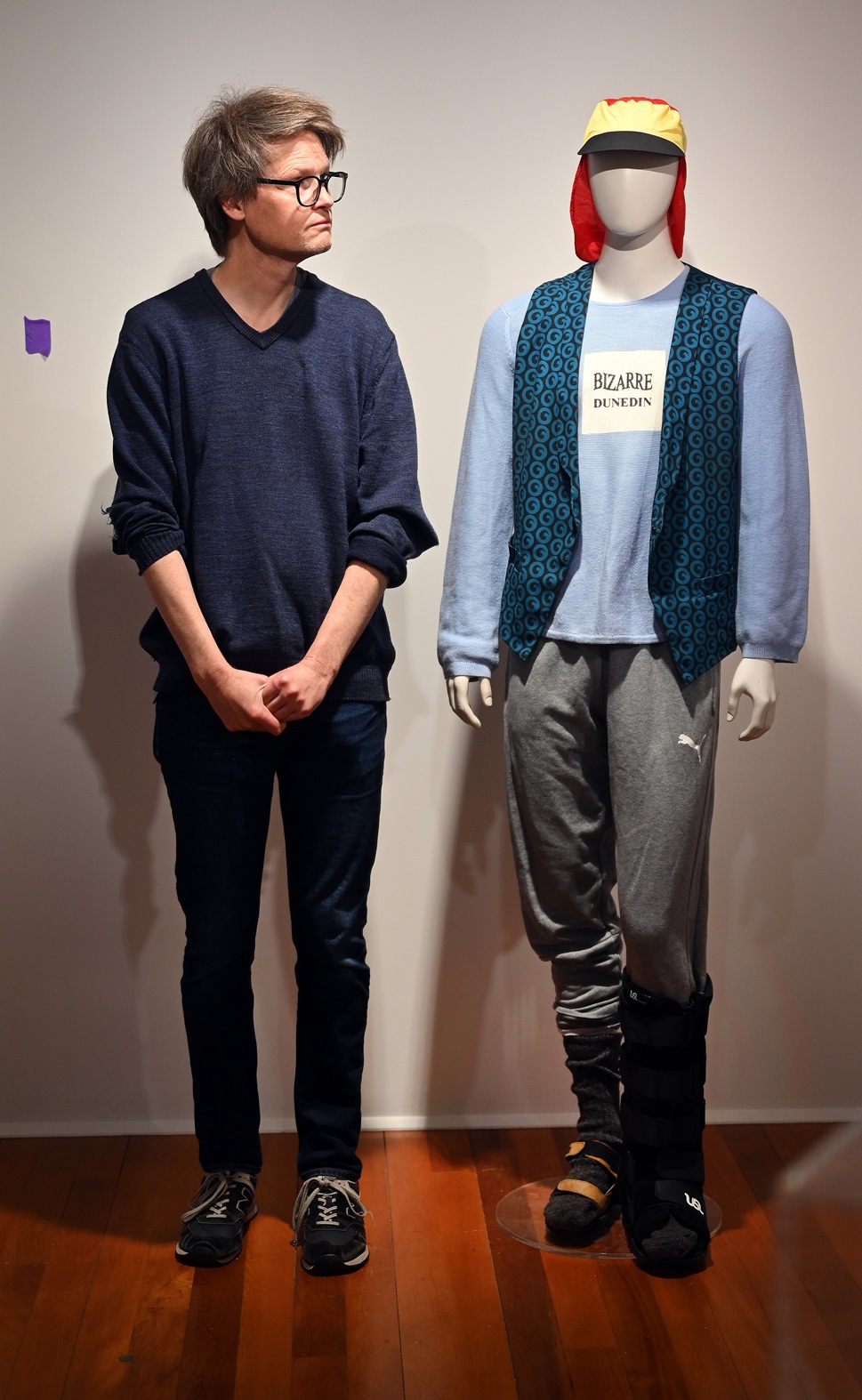
“It became an accidental concrete poem.’’
Another work idea came to him when he was driving through Gore one day and saw a display of transistor radios in the front window of a home electronics shop — something he had not seen in a very long time and does not imagine he will again.
But it was during a bad weather event when internet communications had gone down highlighting the relevance of terrestrial radio today.
So Austin assembled a collection of transistor radios, tuned them to different radio stations and mounted them on the wall alongside packets of different flavoured Airwaves chewing gum.
“It has all sorts of associations for me.’’
Radios and gum are both background items, something you listen to or chew while doing something else, he says.
“They’re often overlooked but it brings those background things to the forefront — one of art’s crucial functions.’’
Austin’s practice is based on what works for his life at the time. After art school — he got his bachelor of visual arts from Auckland University of Technology in 2001 and a masters of fine arts from Elam School of Fine Arts, University of Auckland, in 2004 — without the resources available to make sculpture he moved into painting, a more sustainable practice for him at the time that did not require a large studio space.

“There is a series of paintings I’d like to do.’’
He moved from Auckland to Dunedin in 2012 to take up the Frances Hodgkins Fellowship and decided to stay after his Hocken fellowship exhibition in 2013.
Over the years he has not exhibited much in the city. In 2015 his work featured on the Dunedin Public Art Gallery’s big wall, a painting of downpipes, bricks and mortar and he has shown at Blue Oyster Art Project Space.
Austin’s work has been exhibited more often in the North Island, including in Auckland last year at Coast Signs “Breath Spectrum’’.
Some of those works will be in the Dunedin show as Austin believes in re-showing works, something he learnt from a “very wise’’ fellow art student at art school.
“Showing selected works in different contexts alongside different works recontexualises those works. It provides new opportunities for people to see works they have not seen before and it’s a very economical way to work.’’
— “What Did People Do All Day?” is the second exhibition in Dunedin Public Art Gallery’s Suite 2026. It is an ongoing exhibition series that presents recent work by artists living and working in Dunedin.
TO SEE
Nick Austin “What Did People Do All Day?”, Dunedin Public Art Gallery, June 6-August 23. Artist Talk: Nick Austin, June 6, 11am.


