
PHOTO
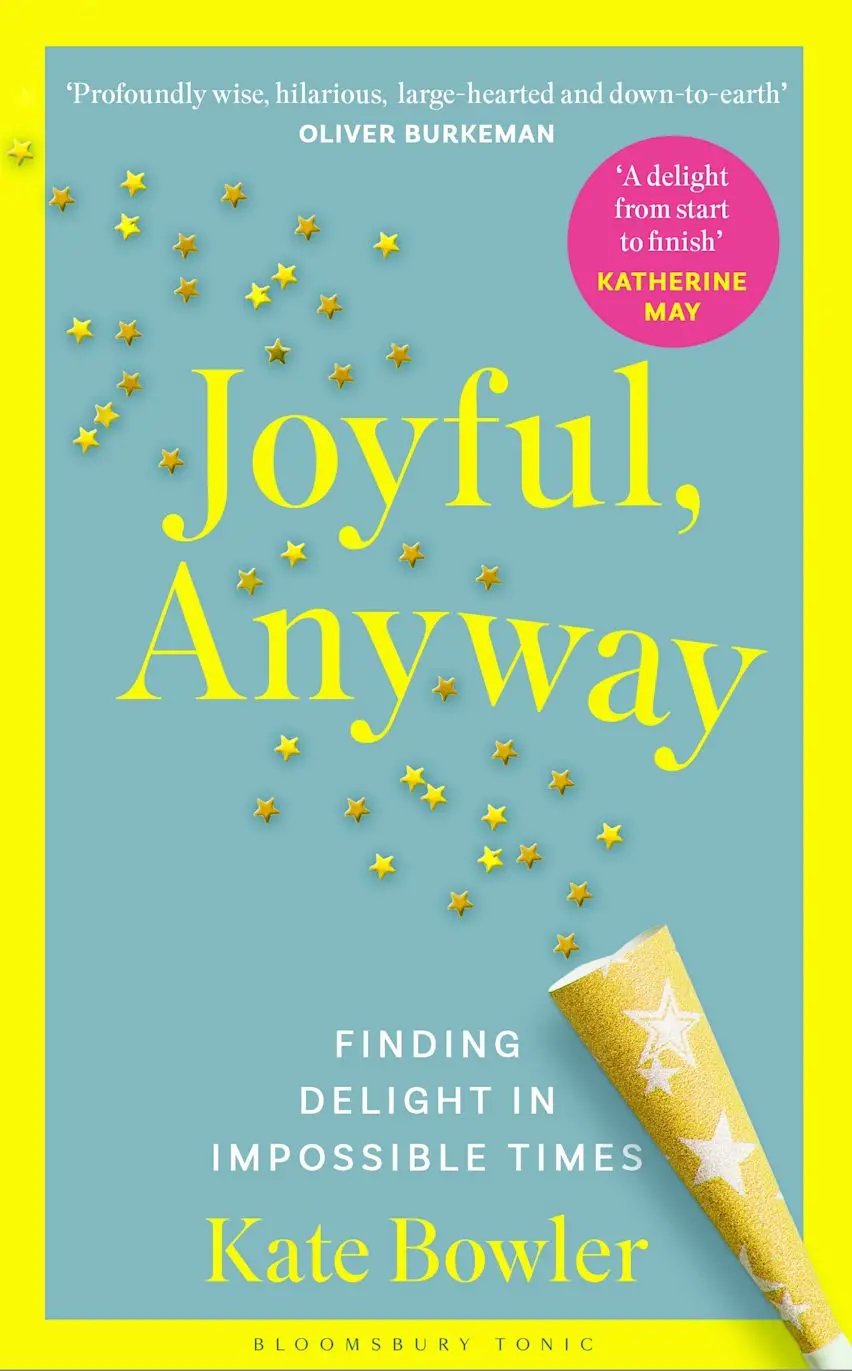
Joyful, Anyway
Kate Bowler
Bloomsbury
Reviewed by Feby Idrus
Traditionally, a book review is built on these three questions: 1) what is the author’s intention? 2) was the author successful? and 3) how did the author achieve or fail to achieve that success?
Joyful, Anyway thwarts all three questions.
Regarding the first question, it is hard to say what Kate Bowler’s intention is.
I initially thought it was a wellness book focused through Bowler’s own experiences, and in some ways it is.
Certainly, her experience as a cancer survivor is a major source of Bowler’s initial dilemma: that surviving a near-death experience did not in fact give her everlasting gratitude, but instead merely returned her to the humdrum, unfulfilling, domestic life she had before.
I know this because the book is also something of a memoir, chronicling her quest to rediscover joy in her life.
So what actually is this book?
Is it a wellness book or a memoir, or both?
Bowler pulls her punches so much that it is unconvincing as either.
Bowler clearly intends her journey to be instructive to the reader, but Bowler rarely writes as if she even has the reader in mind, sometimes making her points so subtly that she doesn’t make them at all.
Moreover, if this is supposed to be a memoir, then why is Bowler’s life worth reading about, over that of any other cancer survivor?
Bowler is an associate professor at Duke University, has a reasonable social media platform (including a TEDx Talk) and an apparently successful Substack newsletter, but surely you need to be more than internet famous to warrant writing a memoir?
Regarding the second question of success: if I cannot determine the author’s intention, I cannot determine whether the author was successful in achieving her intention.
The book is probably most successful if seen as a memoir, but may be seen as increasingly didactic as the book nears its ending.
Regarding the third question: like I said, much of the failure of this book comes down to Bowler pulling her punches.
For example, Bowler only starts mentioning her Christian faith a good way through the book.
Christian readers may well ask, why wait so long to talk about it? Was she worried about annoying atheists?
On the other hand, atheist readers may indeed be irritated by her seemingly sneaking Christianity in after the reader has already invested a good chunk of time in her book, even though her discussion of Christianity is not proselytising, but philosophical in nature.
There are elements of Joyful, Anyway that are genuinely enjoyable.
Bowler writes well, even if sometimes too purple, and as the book progresses, more humour comes through which lightens the book’s tonal colour.
As she moves from a place of dulled resentment and guilt towards searching out joy — in other words, from passivity to activity — we more willingly move with her, and the ending is fully engaging.
In other words, it is entirely possible to read this book and enjoy it.
It is, however, impossible to read it and not also, at some point, be annoyed at its inability to decide what it is or who it is talking to.
Feby Idrus is a writer, musician, and arts administrator