
PHOTO
Labour Weekend. Others went tramping, painted the deck or drove to Wānaka. I sat in a shed in Middlemarch, listening to the sheep, peering at a star.
Not just any star. YY Eridani, in the constellation of Eridanus the River, is really two suns so close together that they touch, sharing a peanut-shaped envelope of glowing gas. It is known as a contact binary. The two stars’ centres are only about 1.6 million km apart, four times the distance from Earth to the Moon. They whirl around each other every seven hours and 43 minutes.
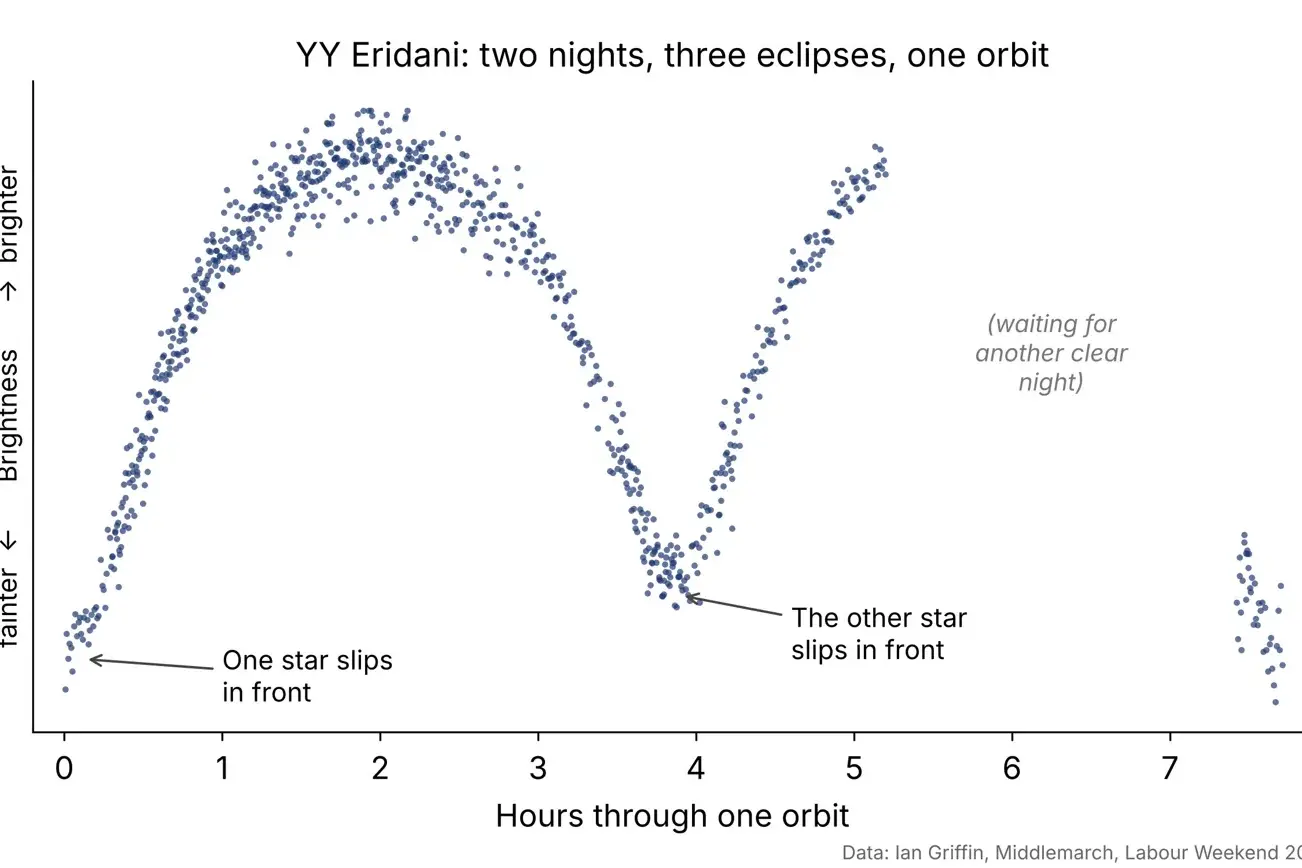
YY Eri is about 184 light-years away, so the light I collected left it around 1842, six years before the John Wickliffe sailed into Otago Harbour. As the pair spins, each star passes in front of the other in turn, and their combined light dips.
Over two nights, my telescope took nearly 900 measurements and caught three of these dips. Its lens is just 3cm across. We live in a golden age of astronomy, when equipment you can carry in one hand lets you investigate the changing orbit of a pair of stars.
Then came the fun. Astronomers have been timing YY Eri’s eclipses for decades. Against a fixed timetable starting in 1972, my eclipses arrive about 24 minutes late.
My clock is fine. The stars are rather less reliable timekeepers.
One possible explanation is gas flowing from one star to its companion, slowly stretching their orbit. The estimated change is tiny: about a third of a second added to the orbital period over my lifetime. But a clock that runs increasingly slowly falls further behind. After more than 61,000 orbits since 1972, small changes can add up to minutes.
A third, unseen star could also be making the pair sway towards us and away again, changing how far their light must travel. Timings like mine could help untangle what is happening.
Plotting both nights against the same orbital cycle produced the graph on this page, offered with apologies to my correspondent in Gore, who wrote after my last graph to say one per year was plenty.
So there you have it. On a holiday weekend, while sheep bleated, a star system 184 light-years away ran late, and I timed it happily. My family has long suspected I am the dullest man in Otago. I can now supply the data.