
PHOTO
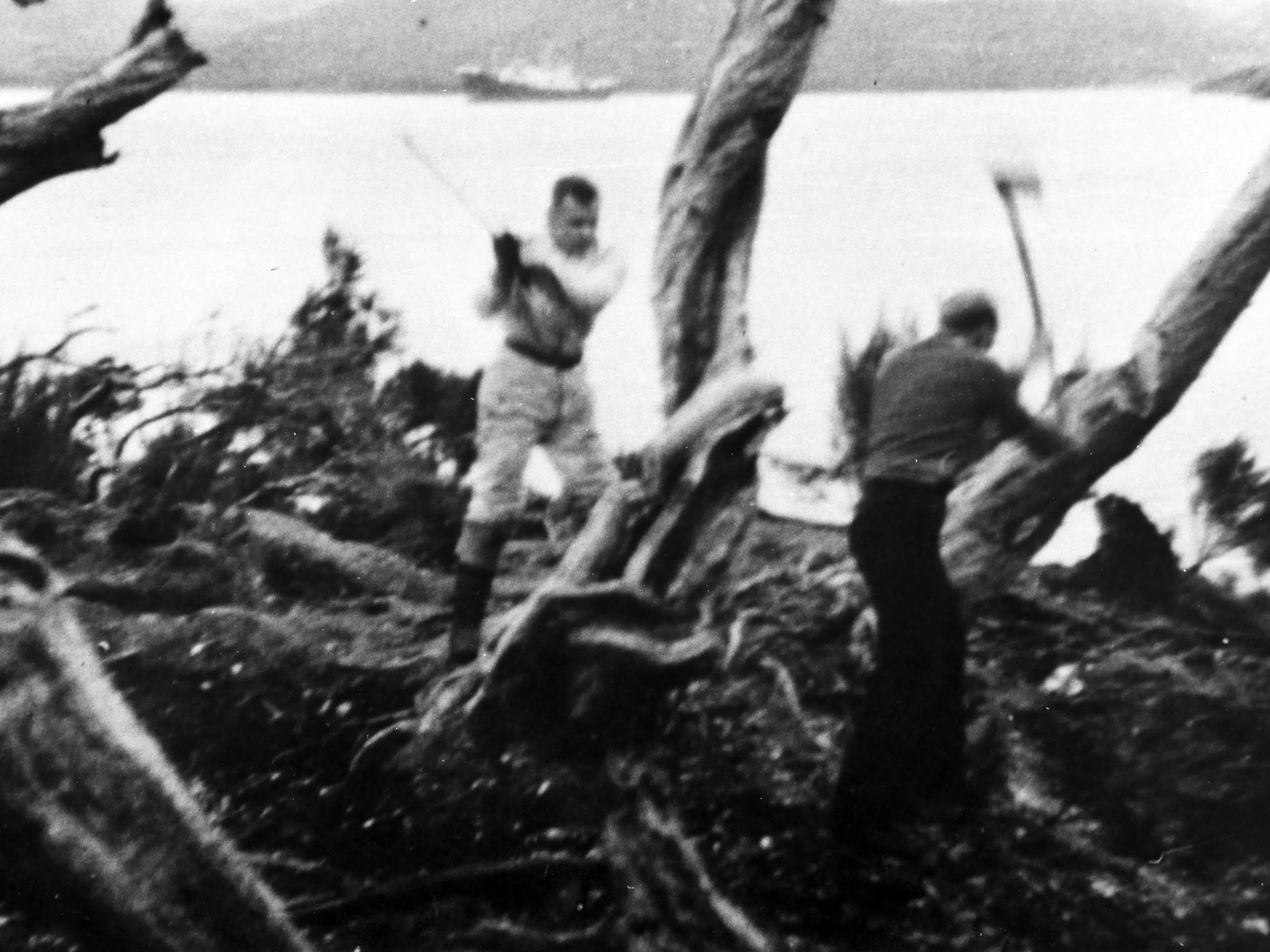
In the foreground, two men hack away at the wood of twisted trees, their blades a blur. Behind them in the murky monochrome distance a ship lies at anchor.
It’s a curious scene, to say the least. But the grainy black and white photo is not the half of this story.
What we know now is that the two men are sailors from the German ship the SS Erlangen, and the scene in which we find them played out in the Auckland Islands — in wartime. We also know a huge quantity of wood fell to their axes, because they had a long way to go and desperate times called for desperate measures.
The photo, alongside a couple of others, previously almost unknown to the general public, is evidence of one of the strangest maritime episodes of World War 2 — what happens when war interrupts human relationships.
It has emerged courtesy of the University of Otago’s Hocken Collections, along with a translation of a German sea captain’s account of the ordeal.
The story, from the opening weeks of World War 2, is a reminder that in peace — as in war — timing is everything.
‘‘The Erlangen was a German ship that made many visits to New Zealand after it was launched in 1929, and one of its regular ports of call was Dunedin,’’ says Heritage New Zealand Pouhere Taonga area manager Otago Southland, Eva Forster-Garbutt, who heard about the ship’s story from a colleague — who was researching unusual New Zealand war stories for Anzac Day.
‘‘The ship entered Dunedin’s Otago Harbour on August 24 1939 — mere hours before receiving a telegram sent to 2400 German merchant ships around the world warning them that war was imminent.’’
The Captain, Alfred Gram, wrote an account of the voyage in 1967, which was translated by Beverley Booth, of the Hocken Library. Gram recorded his thoughts as the ship steamed into pre-War Dunedin:
‘‘It was not like the Dunedin which we knew. Everything was certainly ‘different’ in those days and you didn’t need to know much about politics to sum it all up in one phrase: ‘the threat of war’. I had always felt a special empathy for the small New Zealand port: yet this time it was different. We all felt oppressed by the storm clouds gathering over Europe. What should we do in the Pacific — far from home, when the powder keg exploded?’’
‘‘On the surface everything was the same, as always the friendly smile and ‘happy trip’ from the pilot, when he was dropped. Yet, everyone on board felt the tension in the air, everyone knew that the ship was under threat of eventual confiscation by the enemy.’’
The telegram initially advised ships to stay away from normal shipping lanes and — in subsequent telegrams — to seek friendly or neutral ports within four days; an order which drew a frustrated response from Gram, who recorded his ire:
‘‘A bureaucratic telegram! 4800 nautical miles separate the Erlangen to the nearest port, a distance which, taking into account our dwindling coal reserves, was completely absurd.’’
‘‘The directive left the Erlangen in deep shtuck. When the ship left Dunedin on August 26 it had 220 tonnes of coal on board, but consumed it at a rate of about 45 tonnes a day. It was clear that she wasn’t going to get very far,’’ Forster-Garbutt says.
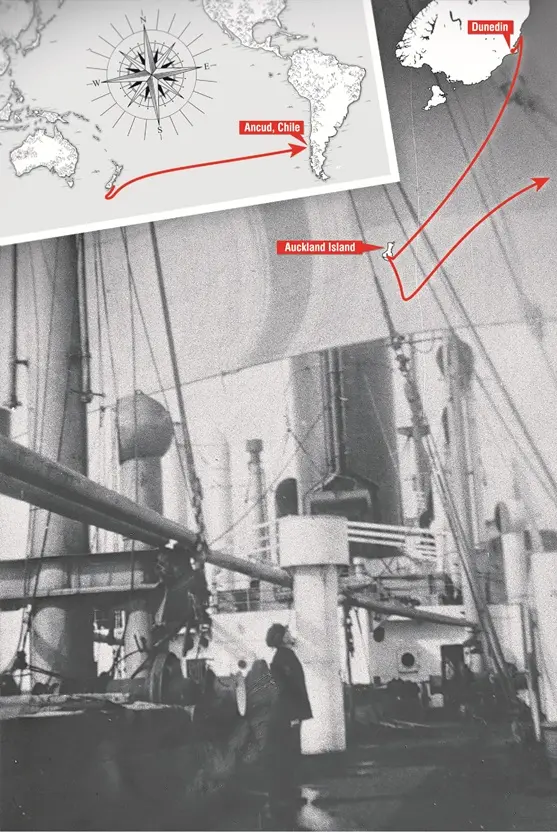
The official story was that the Erlangen would steam its way over to Port Kembla in New South Wales, bunker up with coal, then continue on its way to New York as scheduled. However, after heading north along the coast during the day, the cargo ship turned south once night fell and, with lights off, headed for the Auckland Islands.
‘‘Grams, faced an uncomfortable choice. If he proceeded to Port Kembla and war was declared his ship would be impounded, and he and his crew — including about 50 Chinese seamen on board — would be incarcerated as prisoners of war,’’ Forster-Garbutt says.
‘‘The only alternative was to cross the Pacific and get to Chile, which was still neutral.’’
Initially, Grams decided to wait within the secluded anchorage of Auckland Island’s Carnley Harbour to see how events unfolded in Europe while his plan took shape. As it happened, the telegram was accurate, and war began on September 1 with the German invasion of Poland.
‘‘From their secluded anchorage, the crew spent about five weeks cutting timber from the island’s southern rātā forest to try to harvest 400 tonnes of wood that would fuel the vessel,’’ she says.
‘‘Crew members also set to work making sails from available canvas and tarps on board, which were then rigged to the masts and derricks as an additional means of propulsion.’’
It was heavy going as Gram recorded:
‘‘The work . . . turned out to be more difficult than we had anticipated. The wood was so incredibly hard that our axes bounced off it with almost no effect. Moreover it was so twisted that splitting it was impossible.’’
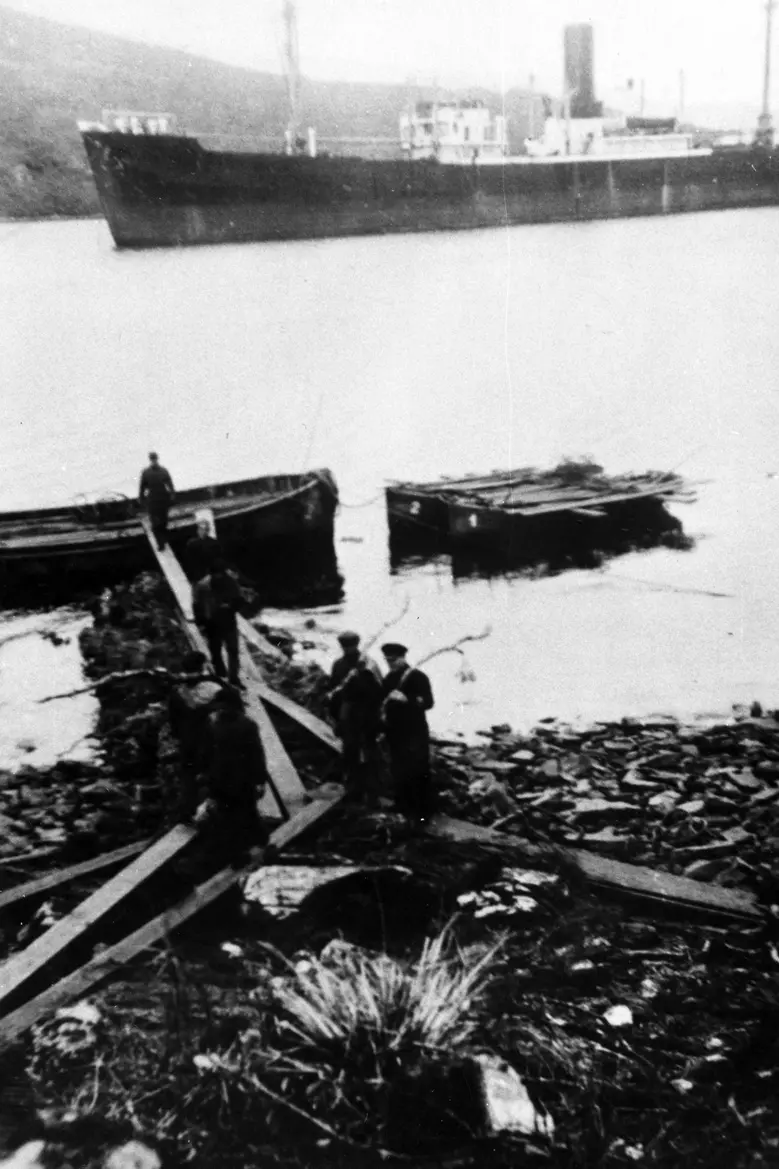
The Erlangen was anchored about 100m offshore and a cable was strung to land along which boatloads were hauled. Some of the wood was tied together in the form of rafts and floated to the ship’s side to be hoisted aboard by the ship’s derricks.
During their time on the island, the crew also reprovisioned by shooting wild geese and raiding numerous mussel beds, while deliberately not touching emergency rations that were stationed on the island for shipwrecked sailors, to avoid discovery.
With the extreme dietary limitations, the Chinese cook came into his own:
‘‘The Chinese cook made really delicious dishes from the mussels. The advantage of the mussels was that they could be prepared in different ways. Many a one from us Germans learnt to relish mussels here and certainly today baked mussels are still counted as one of the tastiest dishes.’’
To the rest of the world, it appeared that the Erlangen had mysteriously disappeared. The New Zealand authorities smelt a rat, however, and suspected that the ship may have made for the Auckland Islands. The government despatched HMNZS Leander to seek her out.
‘‘In late September the Leander arrived at the Auckland Islands looking for the missing ship, though due to poor weather conditions — and after checking the emergency provisions depot and finding them untouched — did not enter the channel ,’’ Forster-Garbutt says.
‘‘The ship also declined to launch its aeroplane on board — possibly due to the bad weather. If they had, they would almost certainly have spotted the Erlangen sheltered in the harbour.’’
Gram recorded an incident that may have been evidence of the Leander’s presence:
‘‘One night the cry ‘searchlight!’ rang out. In a flash I was on the bridge and stared into the darkness. Was ‘Tommy’ going to seek out the entrance to the bay with searchlights? After further discussions we decided that the light was staying in the same place in a southerly direction . . . ’’
Gram later wrote:
‘‘It is incredible as far as I am concerned that the English cruiser didn’t find us on her two visits to the Auckland Islands, as other reports show that she had an aeroplane with her.’’
Having dodged that bullet, the Erlangen set out out to sea again on October 7 1939 — somewhat optimistically. Instead of the 400-plus tonnes of firewood that she needed, the crew had only managed to fell 250 tonnes. Faced with a fuel shortfall of just under 50%, the ship began the voyage using its jury-rig sails, a critical moment recorded by Grams:
‘‘As soon as we had reached the open sea I gave the order to set the sails, for only if our sails worked could I — or would I — risk the adventure.’’
‘‘After heading south, only to be frustrated by the lack of wind in the southern latitudes, the ship used some of its precious fuel stocks to steam north to the Roaring Forties where it could catch some better wind,’’ Forster-Garbutt says.
Meanwhile the lack of provisions became increasingly noticeable:
‘‘Flour and potatoes in particular were nearly gone. Fortunately, because of our Chinese crew, we had a good supply of rice on board and we wondered whether we could make a kind of flour out of rice; that is to say if you put rice through the coffee mill a couple of times you get a kind of flour, from which a type of bread can be baked. Our Chinese cook made it possible.
A shortage of fuel called for desperate measures:
‘‘There was finally no other way out that to tear up the floor coverings and to burn them. The fire still needed more and more fodder. We burnt everything burnable on board: wood stocks, duck boards, as well as hatches between decks and bilges. We had to make it!
‘‘After 35 days at sea — a voyage doubled in duration by unfavourable weather conditions — the Erlangen finally dropped anchor off the port of Ancud in southern Chile. According to her logbook she had covered 8937km during the trans-Pacific crossing, of which 2790km had been entirely under sail — a remarkable example of modern seamanship and sheer determination.’’
By the end of its Pacific crossing the crew had burned every stick of wood on board, and water stocks were all but exhausted. They had made it however, though once the ship had reached Puerto Montt, Gram and his crew faced one final ordeal:
‘‘At 9 o’clock there was a reception on board. The German Consul, the head agent and others as well. I couldn’t offer them anything to eat because of our meagre store. Sandwiches made from rice flour bread with oily wild goose meat would certainly not be called for. I had, however, a bottle of whisky, without ice, ready. This sufficed to keep up appearances.’’
Gram recorded the seemingly impossible arithmetic behind the Erlangen’s epic voyage, with commendable understatement:
‘‘Fuel consumption: Coal — 154 tonnes; Everything burnable on board — 121 tonnes; Wood chopped on the island — 235 tonnes.’’
The Erlangen remained in Chile for a year and a half, time for the Chinese crew members to be discharged and for the remaining crew to enjoy being fussed over by the expat German community. By May 1941, however, the Erlangen was ordered to try to break the Allied blockade by shipping a load of raw materials vital to Germany’s war effort. After loading, the ship left Mar del Plata in July 1941.
‘‘This time, the Erlangen’s luck had run out. The ship was sighted by a spotter plane from HMS Newcastle. Captain Grams ordered the crew to the lifeboats, and scuttled the ship by detonating pre-prepared explosives on board sending the ship and its cargo to the bottom,’’ said Forster-Garbutt, who has German heritage and was intrigued to find a World War 2 story with a close link to her New Zealand hometown.
‘‘The ultimate fate of the Erlangen, however, doesn’t take anything away from the achievement of Captain Gram and his crew whose remarkable voyage makes for a fascinating footnote in World War II maritime history,’’ she says.
