

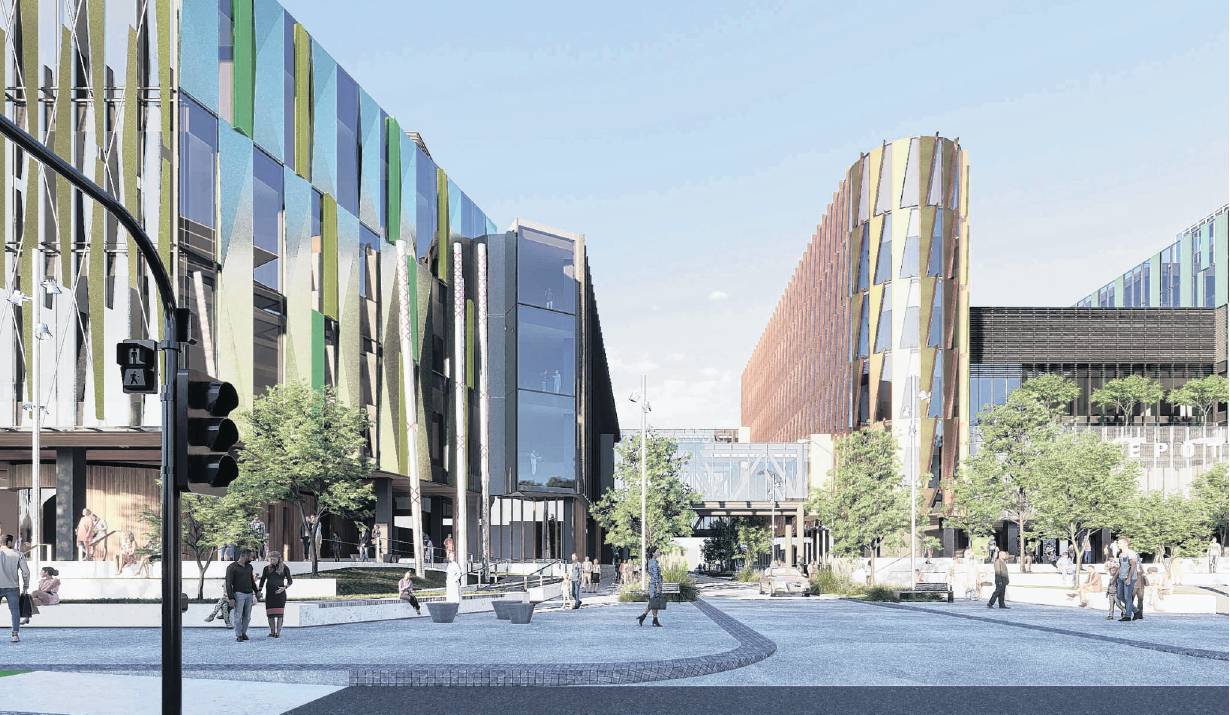
The transport agency was one of several interested parties consulted in the first stage of the fast-tracked consent process for the $1.47billion project, which concerns foundations and groundworks.
Two bridges are planned to span St Andrew St and one will run over Castle St.
Agency principal planner Richard Shaw told the independent panel assessing the Ministry of Health’s application that planned bollards to protect the bridge piers might not do their intended job.
‘‘[They] are not located in an ideal position within the footpath for optimum deflection of vehicles that may hit these structures.’’
Mr Shaw said that the agency accepted the piers for the St Andrew St overbridges would have to be in the footpath.
‘‘However, Waka Kotahi [NZTA] would like to assess the final design of the pier/columns and location of the bollards around the pier/columns to identify if there is any possibility of even an incremental reduction of the pinch point for the east link bridge.
‘‘Any improvement to these restrictions on the pedestrian facilities that can be achieved through the detailed design process should be considered.’’
Fire and Emergency New Zealand South Island property manager Stephen Hill stressed that its Castle St building was both the Dunedin Central Fire Station and an operational and management hub.
‘‘It is simply not an option for Fire and Emergency to temporarily vacate the premises or provide suitable emergency service response from elsewhere within the city.’’
Mr Hill asked that Fenz be given ample notice of any work which could potentially disrupt its service to the community, and also to mitigate noise and vibrations which could affect the historic building.
Allied Press, publisher of the Otago Daily Times, raised one current and one future concern with the consenting panel.
Its immediate concern was that vibrations from earthwork and piling could disturb the company’s printing press.
‘‘Vibrations can result in the press going out-of-level,’’ Allied Press operations manager Raja Chakrabarti said.
‘‘As a result, the paper will not flow correctly and will tear, thus becoming n-operational.’’
Re-levelling the press was a significant undertaking which could not be done locally and engineers had to be brought in from overseas.
‘‘Even under normal circumstances there is at least an eight-week delay in getting someone across and even more challenging (or impossible) under the current Covid climate and restrictions to international travel.’’
Allied Press asked that planned monitoring of vibrations be significantly increased, and all piling work cease if a problem was found.
Mr Chakrabarti also foreshadowed a possible future issue concerning the inpatient building, being built next door to Allied Press on the former Cadbury factory site.
Communication devices for the firm’s regional television stations were on the roof of its building and needed a direct line of sight to transmission towers — a line which could be blocked by the new building, he said.
Related Stories


Comments
Cons & pros for the site
No geotech survey
Disruption to oneway system
Disruption to cross city traffic flow
Dunedin Central Fire Station, operational and management hub
Dunedin Central Police Station
Regional television stations need a direct line of sight to transmission towers
Allied Press operations
Pros
Close to the university
?
?
?